Searching Case Laws & Precedent on Legal Query.....!
Analysing the retrieved Case Laws
Scanned Judgements…!



Searching Case Laws & Precedent on Legal Query.....!
Analysing the retrieved Case Laws
Scanned Judgements…!
Bailable Offense - An offense that is designated as bailable in the First Schedule of the BNSS, 2023, or made bailable by law, allowing the accused to be released on bail without stringent conditions. Such offenses are generally punishable with less than three years of imprisonment or are deemed bailable by law 2025 0 Supreme(Pat) 575, 2025 0 Supreme(Pat) 168,
State Of Goa VS Venkatesh Mahature - Bombay
, 2024 Supreme(Online)(MP) 18798, 2024 Supreme(Online)(MP) 27533, 2025 0 Supreme(SC) 2075, 1994 0 Supreme(SC) 1.Nonbailable Offense - An offense that is classified as nonbailable either by specific statutory provisions or due to the severity of the crime, typically punishable with more than three years of imprisonment. Courts exercise caution before issuing non-bailable warrants, especially considering the deprivation of personal liberty involved
Purushottam Chaudhary VS Central Bureau of Investigation thru. the Superintendent of Police CBI/ACB LKO - Crimes
, 2025 0 Supreme(Pat) 168,State Of Goa VS Venkatesh Mahature - Bombay
, 2024 Supreme(Online)(MP) 18798, 2021 0 Supreme(Raj) 1650, 2021 0 Supreme(Raj) 701, 2025 0 Supreme(Pat) 13.Issuance of Warrants - Bailable and non-bailable warrants should never be issued casually. Proper scrutiny of facts and complete application of judicial mind are essential before issuance, especially for non-bailable warrants, which involve deprivation of liberty and should be reserved for cases where the accused is avoiding proceedings intentionally
Purushottam Chaudhary VS Central Bureau of Investigation thru. the Superintendent of Police CBI/ACB LKO - Crimes
, 2025 0 Supreme(Pat) 13, 2007 0 Supreme(SC) 1294.Legal Precautions - Courts are advised to exercise extreme caution when issuing non-bailable warrants, ensuring that all procedural safeguards are followed, including verifying service attempts and the accused’s behavior, to prevent misuse and protect personal liberty
Purushottam Chaudhary VS Central Bureau of Investigation thru. the Superintendent of Police CBI/ACB LKO - Crimes
, 2025 0 Supreme(Pat) 13.Special Provisions under Acts - Certain statutes like the NDPS Act and the Essential Commodities Act specify offenses as bailable or nonbailable based on the nature and punishment prescribed. For example, offenses punishable with less than three years are generally treated as bailable unless explicitly stated otherwise 2025 0 Supreme(Pat) 575, 2024 Supreme(Online)(MP) 18798, 2024 Supreme(Online)(MP) 27533.
Bail and Court Discretion - Even in nonbailable offenses, courts may grant bail based on judicial discretion, especially if the circumstances suggest that the accused is not likely to abscond or misuse liberty. Anticipatory bail can also be granted in nonbailable cases if the court finds sufficient grounds 2010 8 Supreme 353, 2007 0 Supreme(SC) 1294, 1994 0 Supreme(SC) 1.
Conversion of Warrants - Courts can convert non-bailable warrants into bailable warrants upon proper application and deposit of surety or amount, facilitating the accused’s ability to secure bail and pursue legal remedies 2021 0 Supreme(Raj) 1650, 2021 0 Supreme(Raj) 701.
Bailable offenses are those where the law presumes the accused can be released on bail, promoting individual liberty and judicial discretion. Nonbailable offenses involve more serious crimes warranting stricter measures, including non-bailable warrants, which require careful judicial scrutiny to prevent misuse and safeguard personal rights. Proper procedural adherence, verification, and judicial caution are crucial in issuing warrants, especially non-bailable ones, to balance law enforcement needs with individual freedoms.
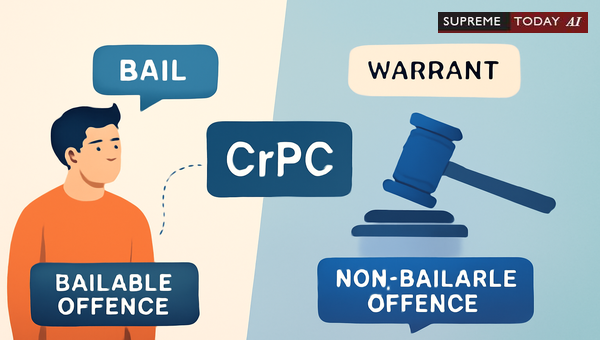
In the Indian criminal justice system, understanding the distinction between bailable and non-bailable offences is crucial for anyone facing legal proceedings. These classifications determine whether an accused person can secure bail as a matter of right or must seek court discretion. But what exactly do bailable and non-bailable mean? This blog post breaks down the definitions, legal principles, examples, and practical implications to help you navigate this complex area.
Note: This is general information based on legal precedents and statutes. It is not specific legal advice. Consult a qualified lawyer for your situation.
The terms bailable and non-bailable refer to the classification of criminal offences based on the severity of punishment prescribed and the procedural rights of the accused regarding release on bail. An offence is bailable when the law explicitly provides that the accused has a right to be released on bail as a matter of right, whereas an offence is non-bailable when the law restricts or denies this right, requiring the court's discretion to grant bail. 2007 0 Supreme(SC) 1294
Bailable offences are those in which the law presumes the accused has a right to bail, and the court is generally obliged to grant it unless exceptional circumstances exist. 2007 0 Supreme(SC) 1294 These typically include less serious crimes punishable with imprisonment of less than three years or only fines.
In practice, even in bailable cases, courts may impose conditions, but refusal is rare without strong justification like risk of absconding. 2007 0 Supreme(SC) 1294
Non-bailable offences are those where the law restricts the grant of bail, and the court's discretion to grant or refuse bail is guided by considerations such as the gravity of the offence, the likelihood of absconding, or tampering with witnesses. 2020 0 Supreme(Kar) 1237 2007 0 Supreme(SC) 1294
govern bail in these cases, categorizing them further based on the trial court (Magistrate or Sessions Judge). 2018 0 Supreme(Guj) 906
The classification depends on the punishment prescribed and the statutory provisions, which specify whether an offence is bailable or non-bailable. This is outlined in the First Schedule of the , and similarly in the . 2007 0 Supreme(SC) 1294 2022 0 Supreme(UK) 154
Special statutes, such as the or , may override general rules based on punishment. 2006 2 Supreme 277 2025 0 Supreme(Pat) 575
Warrants play a key role. allow appearance with surety, while () lead to arrest without prior notice.
Purushottam Chaudhary VS thru. the Superintendent of Police / LKO - Crimes
2025 0 Supreme(Pat) 13In the legislative history for the purposes of bail, the term ‘bailable’ and ‘nonbailable’ are mostly used to formally distinguish one of the two classes of cases. 2013 0 Supreme(MP) 449
Even in non-bailable cases, bail isn't impossible. Generally .2022 0 Supreme(UK) 154 Courts consider factors like offence gravity, accused's antecedents, and flight risk. 2020 0 Supreme(Kar) 1237
Purushottam Chaudhary VS thru. the Superintendent of Police / LKO - Crimes
These illustrate how punishment thresholds (e.g., >3 years = typically non-bailable) guide classification.
Bailable offences prioritize the accused's right to liberty with minimal restrictions, while non-bailable ones demand judicial scrutiny due to severity. Understanding this framework—rooted in CrPC/BNSS and judicial precedents—empowers informed decisions. Always prioritize procedural fairness: Authorities should ensure that warrants and bail orders are issued with proper application of mind, respecting the constitutional rights of personal liberty. 2020 0 Supreme(Kar) 1237
Purushottam Chaudhary VS thru. the Superintendent of Police / LKO - Crimes
Stay informed, but seek professional advice for cases. (Word count: 1028)



warrant can be issued but at the stage of nonbailable warrant the court should take proper care and precaution convincing itself that despite the service of bailable warrant on couple of dates the process of law is being avoided only in that extreme circumstance the Non- Bailable Warrant should be issued ... The issuance of non-bailable warrants involves interference with personal liberty. Arrest and imprisonment means dep....

As such, the offences which are punishable with imprisonment for less than three years under the NDPS Act must be treated as bailable in view of the Part II of the First Schedule of the BNSS except the offences which have been specifically made nonbailable irrespective of the quantum of punishment. ... Consequently, when the contravention under the NDPS Act involves 'Small Quantity', the offences are Bailable'. When the drug quantity falls ....

remaining offences are deemed to be ‘nonbailable’. ... Act clearly provides that every offence punishable under the Act shall be cognizable, however, it does not provide for making every offence under the Act as nonbailable. ... Act are bailable. ... Bailable offence is defined under Section 2(c) of the BNSS, 2023 which is as under: – “2(c) “bailable offence” means an offence which shown as bai....

of non-bailable warrants. ... Saying so in the report submitted regarding non-execution of the nonbailable warrant issued by this Court is not enough. The concerned police station, Police Station Mormugao in this case, ought to have gone further in ensuring that the warrant issued by this Court was duly executed. ... Thereafter, this appeal was adjourned on the number of occasions to enable the appellant/State to execute the nonbailable war....

In view of the above legal provisions, the offence is not nonbailable. Cognizance of such an offence can be taken but in the absence of any other provision showing the offence to be nonbailable, The offence would continue to be bailable in view of schedule II of the Code of Criminal Procedure,1973. ... Firstly, I would like to reproduce the relevant provision of Act of 1955 to clear the position as to whether offence under section 3/7 of Es....
Essential Commodities Act, 1955 is bailable or non-bailable. 7. ... Therefore, as the offence is bailable, an application under section 438 of Cr.P.C . would not be maintainable. ... Section 10(A) of the Act of 1955 reads as under:- “Offence to be cognizable and bailable notwithstanding anything contained in the Code of Criminal Procedure,1973 every offence punishable under the Act shall be 'cognizable' (xxx)2. ... Fr....

In view of above submission, as the petitioner is ready and willing to deposit 20% of the cheque amount, the same may be deposited within a period of two weeks from today and the nonbailable warrant issued against the petitioner is converted into bailable warrant of a sum of Rs.10,000/- (Rupees Ten Thousand ... Kotai upon instructions states that if the petitioner is granted two weeks time, the petitioner is ready and willing to deposit 20% of the cheque amo....

into bailable warrants. ... The legal position is no more res integra that when a Court is summoning an individual as accused, in normal circumstances, either the summons are to be issued at the first instance or bailable warrant and if the accused is not responding to bailable warrant then Court may resort to issuing non bailable ... Moreover, sub-section (2) of Section 70 CrPC prescribes for cancellation of non-#HL_START....
into bailable warrants. ... The legal position is no more res integra that when a Court is summoning an individual as accused, in normal circumstances, either the summons are to be issued at the first instance or bailable warrant and if the accused is not responding to bailable warrant then Court may resort to issuing non bailable ... Moreover, sub-section (2) of Section 70 CrPC prescribes for cancellation of non-#HL_START....
issuing non-bailable warrants. ... In the third instance, when the court is fully satisfied that the accused is avoiding the courts proceeding intentionally, the process of issuance of the nonbailable warrant should be resorted to. ... Non-bailable warrant should be issued to bring a person to court when summons of bailable warrants would be unlikely to have the desired result. ... Further, in absence of service report of ....

In the matter of bailable offences, bail is claimed as a matter of right under the Code, but provision of bail as incorporated under Section 12 of the Act are quite distinct. 9. At this stage only, it may be noted that generally bail is a rule and jail is an exception. The Code of Criminal Procedure, 1973 (“the Code”) categorizes the cases under two categories, namely, bailable and nonbailable offences. It makes the provision that in all cases, be it bailabe or non-bailable, ....

The word 'bail' has not been defined under the Cr. P.C. although under the definition Section 2, an offence is either bailable or nonbailable. Section 436 Cr. P.C. contains the provisions for bail in bailable offences. Sections 437 and 439 Cr. P.C. arc in respect of non-bailable offences, which may be again categorised into three categories: (i) non-bailable offences triable by a Magistrate; (ii) non bailable offences triable by a Sessions Judge; and (iii) non bailable offenc....

Thus, 'nonbailable offence does not mean not bailable'. Distinctive feature of a non-bailable offence is bail is 'not as a matter of right, but before granting bail opportunity should be given to the prosecution'. It is also bailable provided opportunity should be given to the prosecution and it should be considered on merits. This is with regard to a bailable offence and a non-bailable offence.

To appreciate the present case, it is pertinent to discuss the meaning of ‘bailable offences’ and ‘non-bailable offences’ and the circumstances in which a non-bailable warrant can be issued. In the legislative history for the purposes of bail, the term ‘bailable’ and ‘nonbailable’ are mostly used to formally distinguish one of the two classes of cases, viz. ‘bailable’ offences in which bail may be claimed as a right in every case whereas the question of grant of bail in non-b....
After taking such cognizance for a non-bailable case, the provisions of Rule 558 will come in picture and a complainant can seek benefit of these provisions under the Rule. Unless a Magistrate after examining the complainant and his witnesses as aforesaid, to arrive at the conclusion that some offence, if any, has been committed, on which cognizance is required to be taken by him and registers the complaint for that offence, issuing process under section 204 CrPC, it cannot be said that a comp....


An indispensable Tool for Legal Professionals, Endorsed by Various High Court and Judicial Officers
Please visit our Training & Support
Center or Contact Us for assistance

Scan Me!
India’s Legal research and Law Firm App, Download now!


For Daily Legal Updates, Join us on :



 Back to top


