


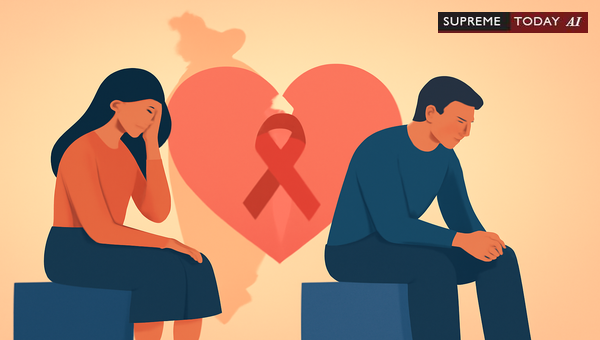
Can a Wife Divorce Her HIV-Positive Husband in India?
In today's world, health issues like HIV can profoundly impact marital relationships. Many couples face heartbreaking dilemmas when one spouse is diagnosed with HIV, raising questions about the future of their marriage. A common query is: Husband is Affected by HIV can Wife Get Divorce? This post delves into the legal landscape under Indian law, particularly the , to provide clarity. While this information is based on precedents and statutes, it is not legal advice—consult a qualified lawyer for your specific situation.
Legal Framework for Divorce on HIV Grounds
Under , a spouse can seek divorce if the other is suffering from a . Courts have consistently interpreted HIV/AIDS as fitting this category since it is a sexually transmitted, communicable disease. This provision aims to protect the healthy spouse from potential infection and associated hardships.
For instance, in key judgments, courts have affirmed that HIV qualifies as grounds for divorce. As noted in one case, Admittedly, HIV positive is a communicable disease and there were chances of wife and children getting infected with the said disease. Therefore, the Court below rightly granted divorce between the appellant/ husband .... 2022 Supreme(Online)(Tel) 6145
This framework applies primarily to Hindus, but similar provisions exist under other personal laws like the .
Landmark Cases and Key Findings
Indian courts have addressed HIV-related divorce petitions multiple times, establishing clear precedents:
Affliction with HIV as Grounds: In and , courts granted divorce to the uninfected spouse, recognizing HIV under Section 13(1)(v). 2020 0 Supreme(P&H) 848 2019 0 Supreme(P&H) 235
on the Petitioner: The spouse alleging HIV must provide robust evidence, such as medical certificates. In one instance, a husband proved his wife's HIV status despite denials and collusion claims.
2013 0 Supreme(Mad) 1628
Communicability and Cruelty: Concealing HIV can amount to . Courts view the disease's transmissibility—especially through unprotected intercourse—as justifying dissolution. He has also stated that if the husband had intercourse with his wife when he is suffering from HIV, the wife also can get contacted with HIV. It depends on several factors...
Refusal to Test: If the accused spouse refuses a court-ordered blood test, it creates an . Failure to cooperate weakens their defense.
2013 0 Supreme(Mad) 1628
Additional cases reinforce this: The Trial Court held that since HIV is a venereal disease of communicable form, the respondent is entitled to decree of divorce.
Counterarguments and Challenges
The HIV-positive spouse may raise defenses:- : They cannot be forced to give a blood sample, invoking (right to life and personal liberty) of the Indian Constitution.- Evidence Admissibility: Medical certificates alone may not suffice without the doctor's testimony. 2013 0 Supreme(Mad) 1628
False accusations also occur, as in cases where a husband allegedly propagated that his wife had HIV to get rid of her. 2023 Supreme(Online)(AP) 23256 2023 Supreme(Online)(AP) 9936
Moreover, courts scrutinize if the disease was contracted post-marriage or through no fault of the infected spouse, though communicability often trumps this. The above answer of the wife shows that she was having doubt that the husband is suffering from HIV or other disease.2014 0 Supreme(Bom) 1242
Integrating Broader Legal Insights
HIV's impact extends beyond Section 13(1)(v); it can constitute under , especially if it disrupts marital harmony or poses health risks. Precedents emphasize medical proof: HIV as a Ground for Divorce - Several court cases confirm that suffering from HIV, a communicable venereal disease, can be grounds for divorce under Indian law. 2022 Supreme(Online)(Kar) 146 2023 0 Supreme(Kar) 428
INDHC_KAHC030034212016
_KAHC030034212016Courts balance compassion with protection, noting duties like condom use or disclosure. In pregnancy-related cases, HIV fears have intersected with termination petitions. 2018 0 Supreme(P&H) 369
Under the Hindu Marriage Act, both husbands and wives can petition on these grounds, though societal stigma often affects women more. 2025 0 Supreme(Mad) 2963
Practical Recommendations
If pursuing divorce:- Gather Evidence: Secure certified medical reports from government hospitals.- Court-Ordered Tests: Request directions for HIV testing; non-compliance aids your case.- Anticipate Defenses: Prepare for privacy claims and ensure doctor cross-examination.- Holistic Approach: Consider counseling or mutual consent divorce under for amicable resolution.
Pending cross-petitions, like divorce by husband and restitution by wife, highlight the need for strategic legal planning. 2021 Supreme(Online)(MAD) 19017
Conclusion and Key Takeaways
Generally, yes—a wife may obtain divorce if her husband is HIV-positive, as courts recognize it as a communicable venereal disease under the Hindu Marriage Act. Precedents like those cited prioritize health safety, provided the petitioner meets the with solid medical evidence. 2023 0 Supreme(Kar) 428 2008 0 Supreme(Bom) 1533
Key Takeaways:- HIV falls under Section 13(1)(v) as grounds for divorce.- Medical proof is crucial; refusals hurt the accused.- Cruelty from concealment strengthens claims.- Always seek professional legal counsel.
This evolving area reflects India's balance of personal rights and public health. Stay informed, prioritize well-being, and approach with empathy.
References:-
2019 0 Supreme(P&H) 235 2013 0 Supreme(Mad) 1628 2023 0 Supreme(Kar) 428 2008 0 Supreme(Bom) 1533 2020 0 Supreme(P&H) 848 2022 Supreme(Online)(Tel) 6145 2023 Supreme(Online)(AP) 23256 2023 Supreme(Online)(AP) 9936 2025 0 Supreme(Mad) 2963 2021 Supreme(Online)(MAD) 19017
2018 0 Supreme(P&H) 369 2014 0 Supreme(Bom) 1242
(Word count: 1028. This post is for informational purposes only.)
#HIVDivorceIndia, #FamilyLaw, #DivorceRights














