


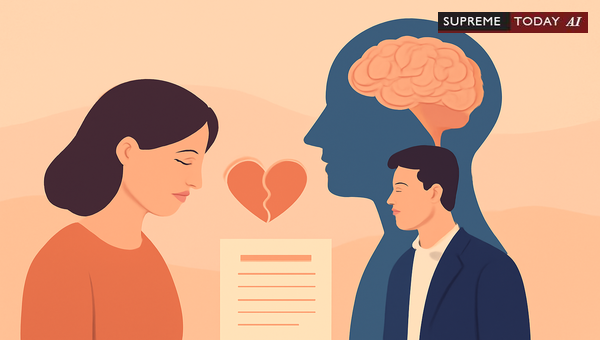
Divorce for Mental Illness Under Special Marriage Act: A Comprehensive Guide
In the complex landscape of Indian matrimonial law, mental health issues can profoundly impact marriages. Many couples solemnized under the wonder: Can divorce be granted on grounds of mental illness, such as schizophrenia? This question arises frequently, especially when one spouse's condition makes challenging. While mental disorders are recognized as valid grounds, strict conditions apply. This blog post delves into the legal framework, judicial interpretations, evidence requirements, and key precedents to provide clarity.
Important Disclaimer: This article offers general information based on statutes and case law. It is not legal advice. Consult a qualified lawyer for personalized guidance.
Understanding Mental Illness as Grounds for Divorce
Under the , (equivalent to in structure) allows divorce if the respondent has been , or has been suffering continuously or intermittently from of such a kind and to such an extent that the petitioner cannot reasonably be expected to live with the respondent. This mirrors provisions in the , but applies to inter-faith or civil marriages. 2023 6 Supreme 264 2003 0 Supreme(Raj) 259
The law does not permit divorce for every mental health issue. The disorder must be grave, incurable, and render marital life untenable. Mere diagnosis of schizophrenia or other conditions is insufficient. Courts emphasize: the must be of such a grave, incurable nature that becomes unreasonable. 2023 6 Supreme 264 2003 0 Supreme(Raj) 259
From other judicial insights, Mental illness is a ground for divorce under the Hindu Marriage Act, and similar principles extend to the Special Marriage Act, but only for severe cases. 2020 0 Supreme(Ker) 1080
Key Legal Conditions
- Severity and Incurability: The illness must impair the spouse's ability to lead a normal life or fulfill marital obligations. Mild or treatable conditions do not qualify. 2022 0 Supreme(Cal) 766 2006 2 Supreme 662
- Reasonable Expectation of : The petitioner must prove they cannot reasonably be expected to live with the respondent. rulings stress this threshold. 2003 0 Supreme(Raj) 259 2022 0 Supreme(Cal) 766
- No Automatic Entitlement: The mere presence of a , including schizophrenia, does not automatically justify divorce. 2003 0 Supreme(Raj) 259
and Medical Evidence
The spouse seeking divorce bears the . Substantial medical evidence is crucial, including reports from qualified psychiatrists detailing the disorder's severity, duration, incurability, and marital impact. 2023 6 Supreme 264 2024 5 Supreme 459
Courts reject claims based solely on diagnosis. For instance, expert testimony must show the condition makes normal married life impossible. In English precedent referenced in Indian cases, like Whysall v. Whysall (1959) 3 All ER 389, a spouse is if mental incapacity prevents normal marital life with no improvement prospects. 2014 0 Supreme(Bom) 2530 2013 7 Supreme 78
If the illness is managed through treatment, divorce is typically denied. Conversely, persistent, grave cases supported by evidence succeed. 2023 6 Supreme 264 2003 0 Supreme(Raj) 259
Judicial Interpretations and Landmark Cases
Indian courts, including the , have refined these grounds:
- In Kollam Chandra Sekhar vs. Kollam Padma Latha (2014) 1 SCC 225, the Court held the disorder must be of such gravity, backed by medical evidence, that living together is unreasonable. 2003 0 Supreme(Raj) 259
- underscored: the degree of must be such that the petitioner cannot reasonably be expected to live with the respondent. 1998 0 Supreme(Ker) 288
- echo this: In Pramatha Kumar Maity v. Ashima Maity (1991) AIR Calcutta 123, of the Wife, even if proved, cannot, by itself, warrant a and it must be further proved that it is of such a nature as the Husband could not be expected to live with the Wife. 2018 0 Supreme(Mad) 4257
Under the Special Marriage Act specifically, courts assess: the disorder must be of such a nature that it makes the marriage untenable. Severity is key, not mere abnormality. 2024 0 Supreme(All) 1287 2025 Supreme(Online)(Pat) 644 2025 0 Supreme(Jhk) 1401
Cases also note fraud or concealment of mental illness at marriage time, strengthening claims alongside grounds. 2016 0 Supreme(Jhk) 717
Exceptions, Limitations, and Related Grounds
Not all cases qualify:- Mild or Temporary Illness: Manageable schizophrenia or intermittent episodes without severe impact fail. 2022 0 Supreme(Cal) 766- Insufficient Evidence: Forged documents or weak proof lead to dismissal, as in cases alleging tied to mental illness. 2023 0 Supreme(Jhk) 953- Matrimonial Context: Courts consider , , or denials. Mental illness alone may not suffice if other factors like false claims misuse laws. 2024 0 Supreme(Mad) 1258 2020 0 Supreme(Ker) 1080
Other grounds under the Act, like , often interplay: the entire materials related to the case point towards an act of committed by the respondent and the petitioner is entitled to get a on the ground of mental illness. 2023 0 Supreme(Jhk) 953
Proving Your Case: Practical Recommendations
To strengthen a petition:1. Gather Comprehensive Medical Reports: From psychiatrists confirming incurability and impact.2. Expert Testimony: Detail how the disorder affects daily and marital life.3. Document Impact: Evidence of disrupted , failed treatments.4. Avoid Misuse: Courts scrutinize for fabrication. 2024 0 Supreme(Chh) 227
Future reforms might define clearer thresholds to reduce ambiguity.
Conclusion and Key Takeaways
Divorce on grounds of mental illness under the Special Marriage Act is possible but hinges on proving a severe, incurable disorder making unreasonable. Backed by robust evidence, petitioners can succeed, balancing compassion for mental health with marital realities. Courts protect against misuse while upholding justice.
Key Takeaways:- Mental illness qualifies only if grave and incurable. 2024 0 Supreme(All) 1287 2025 Supreme(Online)(Pat) 644- Burden on petitioner with medical proof essential. 2022 0 Supreme(Cal) 766- Judicial focus: Impact on marital life, not diagnosis alone. 2003 0 Supreme(Raj) 259- Consult professionals; outcomes vary by facts.
For more on Indian family law, stay tuned. Share your thoughts below!















