


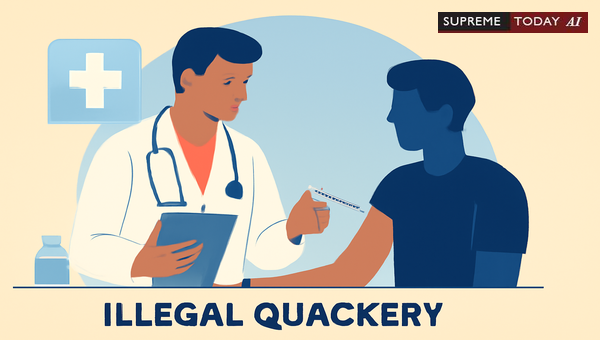
Unqualified Allopathy Practice: Legal Risks in India
In India, the line between legitimate healthcare and illegal practice can be thin, especially when unqualified individuals administer treatments like injections. Imagine a scenario where someone with a Diploma in Medical Laboratory Technology (DMLT) starts giving allopathic treatments. Is this legal? What laws apply? This post dives deep into the regulations governing medical practice, focusing on a common query: A, a DMLT Graduate Giving Allopathy Treatment and Using Injection to the Patients, Not Possessing any Valid Graduation, what Section of which Act will Attract against A?
We'll explore the (), key provisions, penalties, and insights from related cases. Note: This is general information, not legal advice. Consult a qualified lawyer for specific cases.
The Legal Framework for Medical Practice in India
The practice of modern scientific medicine, commonly known as allopathy, is strictly regulated to protect public health. The serves as the cornerstone legislation. It ensures that only qualified professionals can diagnose, treat, and prescribe allopathic medicines.
is pivotal: no person other than a medical practitioner enrolled on a State Medical Register shall practice modern scientific medicine in any State.1998 7 Supreme 575 This creates a clear prohibition against unqualified practice.
Only individuals with recognized medical qualifications—such as MBBS or equivalent, listed in the Schedules of the —can legally practice allopathy. Enrollment in a State Medical Register is mandatory. 1996 4 Supreme 328
Key Violation: Practicing Without Qualifications
For someone like A, holding only a DMLT (a lab technician diploma, not a medical degree), administering allopathic treatments or injections crosses into illegal territory. DMLT qualifies for lab roles, not clinical practice. As noted in recruitment contexts, DMLT is an essential qualification for lab assistants, not doctors: Science graduate with BZC Group or Inter science with BP group with DMLT for lab posts. 2025 Supreme(Online)(CAT) 12354
Practicing allopathy without such qualifications amounts to . Case law emphasizes: only recognized qualifications permit practice in specific systems, and practicing without such qualifications amounts to illegal practice or negligence.1996 4 Supreme 328
Nature of the Offense
- Prohibition: Unqualified persons cannot practice modern medicine. 1998 7 Supreme 575
- Consequences: Liable for prosecution, termed quackery.
- : Automatic civil/criminal liability due to statutory violation. 1996 4 Supreme 328
Penalties Under the
Violations aren't just theoretical. prescribes strict punishments:- Imprisonment up to one year.- Fine, or both. 1998 7 Supreme 575
Authorities, including State Medical Councils, can initiate proceedings. Patients harmed by such practice may file complaints, leading to further negligence suits.
Application to DMLT Graduates and Similar Cases
A DMLT graduate like A, injecting patients with allopathic drugs, directly attracts . Without MBBS or equivalent and State Register enrollment, this is unauthorized.
Related cases highlight boundaries:- AYUSH doctors (Ayurveda, Unani) cannot practice allopathy without dual qualifications. AYUSH doctors are using indigenous systems... and CHS doctors are using Allopathy... petitioners are not entitled to similar treatment as Allopathic Doctors.2025 Supreme(Online)(RAJ) 4683- Even postgraduates in super-specialty courses treated COVID patients under bonds, but only with proper oversight—not a free pass for unqualified practice. 2024 Supreme(Online)(MAD) 8952 2023 Supreme(Online)(MAD) 10167
In one instance, a practitioner's license suspension was quashed for procedural lapses, but the court scrutinized qualifications: insufficient qualifications and unauthorized practices.2025 Supreme(Online)(Mad) 80151 This underscores that claims of charitable treatment don't exempt violations.
Exceptions and Limitations
Are there loopholes?- Indian Systems Practitioners: Ayurveda/Unani doctors can't crossover to allopathy without allopathic registration—rarely granted. 1996 4 Supreme 328 2025 Supreme(Online)(RAJ) 4683- Emergencies: Limited allowances, but not for routine injections.- Higher Qualifications: Preferences for postgraduates exist in promotions, but not for basic practice rights. 2021 Supreme(Online)(CAT) 985
Discrimination claims, like differing retirement ages for allopathic vs. Ayurvedic doctors, have been struck down under Article 14, but this doesn't permit cross-practice. Different retirement ages for Allopathic and Ayurvedic Doctors are discriminatory under Article 14.2025 Supreme(Online)(RAJ) 4683
Broader Implications and Case Insights
Unqualified practice endangers lives. Courts have quashed overreaching suspensions but upheld qualification mandates. In a Tamil Nadu case, procedural fairness was key, yet the focus remained on operating practices in cardiology without adequate qualifications.2025 Supreme(Online)(Mad) 59901
Judicial review is limited: Such matters do not ordinarily attract the power of judicial review... the court itself is not above the law.2023 Supreme(Online)(Del) 17462
Patients must verify via State Medical Council portals. Platforms like hospital websites often list registrations.
Recommendations for Compliance
To avoid pitfalls:- For Practitioners: Obtain MBBS/PG, register promptly. DMLT holders: Stick to labs.- Authorities: Prosecute under Section 15(2)(b); educate public.- Patients: Check qualifications; report quackery to police/Medical Council.
A should cease allopathic practice immediately and pursue proper training.
Key Takeaways
- Core Law: Section 15(2)(b), , 1956—bans unqualified allopathy. 1998 7 Supreme 575
- Penalties: Up to 1-year jail/fine. 1998 7 Supreme 575
- DMLT Limit: Lab tech only, not treatment. 2025 Supreme(Online)(CAT) 12354
- No Crossovers: AYUSH ≠ Allopathy. 1996 4 Supreme 328
Stay informed, practice safely. For personalized advice, contact a legal expert.
References:1. 1996 4 Supreme 328: Recognized qualifications essential.2. 1998 7 Supreme 575: Statutory prohibition and penalties.3. Other cases as cited.
#MedicalLawIndia, #QuackeryBan, #AllopathyRegulations












