Searching Case Laws & Precedent on Legal Query.....!
Analysing the retrieved Case Laws
Scanned Judgements…!



Searching Case Laws & Precedent on Legal Query.....!
Analysing the retrieved Case Laws
Scanned Judgements…!
Proved Document Forgery Not Required for Conviction under Sections 467, 468, 471 IPC Convictions under Sections 467, 468, and 471 IPC can be upheld even if the document is not proven to be forged or proved to be false. The key element is whether the document is created or used with the intent to deceive or commit forgery, not necessarily whether the document is proved to be false in all cases. For example, in 2022 Supreme(Online)(MAD) 36946, the Court held that if the document is not proven to be false (not a false document under Section 464 IPC), then Sections 467 and 471 would not apply; however, convictions under Sections 465 and 468 were upheld based on the creation or use of a document with criminal intent.T.RAJAREDDY @ GULLAREDDY vs THE STATE REP BY ITS - 2022 Supreme(Online)(MAD) 36946*>2022 Supreme(Online)(MAD) 36946
Section 467 IPC – Forgery of Valuable Security, Will, etc. Section 467 specifically pertains to the forgery of valuable security, will, or similar documents. Conviction under this section requires proof of forgery, which involves creating or altering a document with fraudulent intent. Mere execution or registration of a document without proof of forgery does not automatically attract Section 467.Kalvinder Singh Alias Goldi vs The State Of Madhya Pradesh - 2024 Supreme(Online)(MP) 41142*>2024 Supreme(Online)(MP) 41142, VIJAY PAL SHARMA Vs STATE OF NCT OF DELHI & ANR - 2023 0 Supreme(Del) 10903*>2023 0 Supreme(Del) 10903
Section 468 IPC – Forgery for Purpose of Cheating Section 468 deals with forgery committed for the purpose of cheating. Like Section 467, it requires proof of forgery, but it also emphasizes the intent to cheat. Convictions under this section are possible even if the document is not explicitly proved to be false, provided there is evidence of forgery and fraudulent intent.LAXMI CHAND Vs UT OF CHANDIGARH*> LAXMI CHAND Vs UT OF CHANDIGARH
Section 471 IPC – Using as Genuine a Forged or Altered Document Section 471 applies when a person uses a forged or altered document as if it were genuine. The key point is whether the accused knowingly used a false or forged document as genuine. The document need not be proved to be false beyond doubt; the act of using it as genuine with knowledge suffices for conviction.T.RAJAREDDY @ GULLAREDDY vs THE STATE REP BY ITS - 2022 Supreme(Online)(MAD) 36946*>2022 Supreme(Online)(MAD) 36946, LAXMI CHAND Vs UT OF CHANDIGARH*> LAXMI CHAND Vs UT OF CHANDIGARH
Legal Precedents and Analysis Courts have held that the absence of proof of a document being false does not necessarily preclude conviction under Sections 467, 468, or 471 IPC if other evidence indicates forgery or fraudulent intent. For instance, in Sheila Sebastian and Md. Ibrahim cases, the Supreme Court clarified that merely executing a document claiming ownership or rights does not amount to forgery unless it is proved to be false or forged.JAYALAKSHMI vs THE NEW INDIA ASSURANCE COMP - 2021 Supreme(Online)(MAD) 643*>2021 Supreme(Online)(MAD) 643, LAXMI CHAND Vs UT OF CHANDIGARH*> LAXMI CHAND Vs UT OF CHANDIGARH
Conclusion Accusations of document forgery under Sections 467, 468, and 471 IPC do not require that the document be proved to be false or forged beyond doubt. The crucial elements are whether the document was created, altered, or used with fraudulent intent, and whether the accused knowingly used a false or forged document as genuine. Therefore, even without proved document fraud, a person can be convicted under these sections if the evidence supports forgery or fraudulent use. Multiple case summaries above
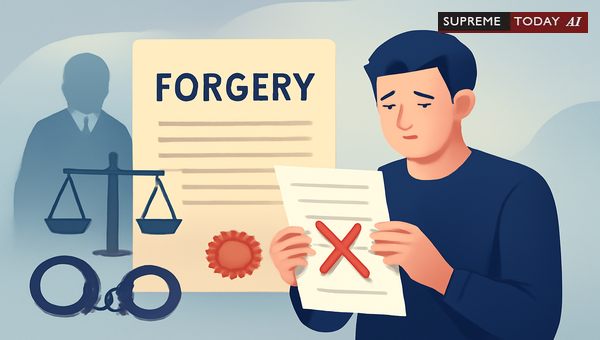
In criminal law, particularly under the (IPC), not all allegations of fraud or deception automatically lead to conviction. A common misconception is that mere claims of fraudulent behavior suffice for serious charges like . But is only victim evidence or bare allegations sufficient for conviction, akin to debates in cases under ? For offences under , the answer is a resounding no. Courts consistently require concrete proof of a false or forged document. This blog explores this critical legal principle, drawing from landmark judgments and analysis.
The question arises: Can conviction under Sections 467 ( of ), 468 ( for cheating), and 471 (using forged document as genuine) be secured based solely on victim statements or fraud allegations? No, the essential ingredient is proof of a false or forged document. Mere fraudulent conduct or false claims, without evidence of such a document, fall short. 2015 0 Supreme(All) 1158
This distinction protects against misuse of stringent laws, ensuring prosecutions are grounded in tangible evidence rather than suspicion.
Conviction under demands proof that the accused created, used, or possessed a false or forged document. The absence of such proof precludes conviction. Courts have quashed proceedings where no forged document was produced or verified. 2023 0 Supreme(P&H) 3409 2009 0 Supreme(SC) 1675
defines as making any or with intent to cause damage, injury, support false claims, or commit fraud. elaborates: a document is false if executed by someone falsely claiming to be another, materially altered, or signed under deception. 2015 0 Supreme(All) 1158
Without meeting these, no exists. As one court held: the offence of is defined under Section 463 of IPC. In order to constitute '', the first essential ingredient is that the accused should have made a or a part of such document.2023 0 Supreme(P&H) 3409
Judgments underscore that allegations of a document being false do not prove . The prosecution must demonstrate the accused's dishonest act on the document itself. In a pivotal case: When a document is executed by a person claiming a property which is not his, he is not claiming that he is someone else nor is he claiming that he is authorised by someone else. Therefore, execution of such a document (purporting to convey some property of which he is not the owner) was not execution of a as defined under .2015 0 Supreme(All) 1158
Similarly, where no forged document was proved: no offence is made out under Sections 467, 468, 471 IPC.2009 0 Supreme(SC) 1675
Mere suspicion or victim claims of deception fail. The allegations in the complaint did not even make out ingredients of an offence under . Order of was quashed insofar as offences under sections 420, 467, 471 and 504 IPC.2009 6 Supreme 470
Courts differentiate fraud (e.g., ) from , often upholding cheating convictions while acquitting on absent document proof.
Recent rulings reinforce this. In one matter, conviction under Section 420 and 471 IPC was upheld, but Section 468 was set aside due to lack of proof for elements. Admittedly, the first ... acquitted the co-accused Jagjit Kaur under Section 468 IPC by observing that when the offence under Section 467 IPC is not proved.
Another case upheld convictions under 420, 467, 468, and 471 where evidence supported : So the conviction of the petitioner for offences under Sections 420, 467, 468 and 471 IPC is hereby upheld.
In proceedings, charges under 465, 467, 468, 471 were scrutinized, emphasizing proof of document creation: If there is no... for the offences under .2022 Supreme(Online)(Mad) 70906
These cases illustrate courts' rigorous scrutiny, often quashing charges when unsupported by document evidence, even alongside cheating allegations.
2022 Supreme(Online)(MAD) 16963
While false claims may support broader offences like cheating (Section 420), they do not trigger Sections 467, 468, or 471 without forged document proof. Courts may sustain proceedings if preliminary evidence exists, but trial hinges on document verification. Generally, suspicion-based cases risk dismissal. 2009 0 Supreme(SC) 1675
Note: This is general information based on judicial precedents and not specific legal advice. Consult a qualified lawyer for case-specific guidance.
,
, 2022 Supreme(Online)(Mad) 70906
In conclusion, without evidence of actual document fraud—making, signing, altering, or using a forged document—conviction under Sections 467, 468, or 471 IPC cannot stand. This safeguards justice from overreach.
#IPCForgery #CriminalLawIndia #LegalInsights


, 468 and 471 IPC. ... 471 IPC. ... and 468 IPC. ... 467, 468 and 471 of Indian Penal Code and Section 420 of Indian Penal Code does under Sections 467 and 468 IPC.

468 IPC, while his conviction under Section 420 and 471 IPC is upheld. ... Admittedly, the first Appellate Court vide its judgment dated 13.09.2017 acquitted the co-accused Jagjit Kaur under Section 468 IPC by observing that when the offence under Section 467 IPC is not proved#HL_E....

Therefore, execution of such document is no execution of a false document as defined under Section 464 of IPC. If what is executed is not a false document, there is no forgery. If there is no forgery, then neither Section 467 nor Section 471 of IPC would attract. ... Though the first respondent/police charged the pet....
second accused under Sections 465, 465 read with 34, 419, 420, 467, 468, 468 read with 34, 471 read with 468, 465 read with 114 read with 34 of the Indian Penal Code and as against the accused Nos.3 and 4, for the offences under Sections 465 read with 114 read with 34, 465, 468, 471, 420 read with 114 ... Be that as it may, now coming to the present ca....
So the conviction of the petitioner for offences under Sections 420, 467, 468 and 471 IPC is hereby upheld. ... Consequently, FIR No.81 dated 22.07.2010 under Sections 420, 467, 468, 471 of IPC was registered in Police Station Gidderbaha. ... While, maintaining the conviction of the petitioner for offences under Sections 420, 467#HL_EN....

If there is no for the offences under Section 465, 468 r/w.109 of IPC. ... , 468, 471 and 420 of IPC. ... , 468, 471 and 420 of IPC, the petitioners were convicted by both the Courts below for the offences creation of a document as defined under Section 464 of IPC....

Section 467 of IPC provides for punishment for the offence of forgery of valuable security, Will, etc. Learned trial Court has convicted the appellant for offence punishable under Section 467/34 of IPC and Section 468 of IPC. ... Learned counsel for the appellant in addition to the ground mentioned in the applicati....

ACMM had correctly framed the charges U/s 420/467/468/471 IPC. He further submitted that the Ld. ... Now it is to be seen whether there is any infirmity in the impugned order or not by virtue of which the Ld. Revisional Court has dropped the charges U/s 467/468/471 IPC. ... Trial Court under Sections 420, 467, #HL_ST....
A-4 was also charged under Section 419 IPC and also under Section 467 read with 471 IPC and also under Section 468 read with 471 IPC. The present appellant/A-3 was also charged under Section 467 read with 471 IPC. ... Act, 1988; (2) A-2 u....
120-B r/w 420, 467, 468 and 471 of I.P.C and section 13(2) r/w 13(1)(d) of P.C Act, 1988 in common and charges under Section 420, 467, 468 and 471 of I.P.C by A2 to A4. ... A1, A2, A4 u/s.120-B r/w 420, 467, 468 and Section 471 ....


An indispensable Tool for Legal Professionals, Endorsed by Various High Court and Judicial Officers
Please visit our Training & Support
Center or Contact Us for assistance

Scan Me!
India’s Legal research and Law Firm App, Download now!


For Daily Legal Updates, Join us on :



 Back to top


