


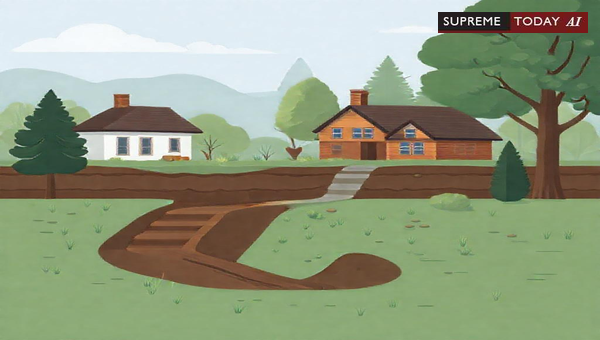
Whether Indian Law Obliges a Landowner to Fill His Land to Support a Neighbour's Building
Boundary disputes between neighbouring landowners often raise a deceptively simple question: can a person be directed to fill up his land for the of adjacent property? A landowner who excavates, levels, or lowers his own soil frequently finds himself facing demands — sometimes court decrees — requiring him to restore earth, construct retaining walls, or otherwise maintain support for a neighbour's land or building. The answer under Indian easement law is generally no, and this post explains why.
The Main Legal Finding
A person cannot, as a matter of natural right, be directed to fill up his land for the of adjacent property bearing . The under the exists only for land in its natural, unburdened condition. Once a neighbour has placed buildings, walls, or other artificial weight upon his land, any right to support for that must be acquired by prescription, typically through 20 years of open, continuous, and 2026 0 Supreme(HP) 483.
Because no natural duty of support exists for , there is no corresponding obligation on the adjoining owner to fill, retain, or maintain his land for that purpose.
How the Works
of the Indian Easements Act, read with , recognizes that every owner of land has the right that such land, in its natural condition, shall have the support naturally rendered by the subjacent and adjacent soil of another person 2011 0 Supreme(Ker) 512 and 2012 Supreme(Online)(KER) 37991. Courts have consistently described this as one of the natural incidents of ownership — a right forming part of the bundle of rights known as the
PEDRIS et al. v. BATCHA et al.
.As articulated in the leading English authority Dalton v. Angus (1881) 6 AC 740, every owner of land has ex jure naturae, as an incident of his ownership, the right to prevent such use of the neighbouring land as will withdraw the support which the neighbouring land naturally affords to his land 2026 0 Supreme(HP) 483.
The Critical Limitation: No Support for
The natural right stops where the artificial burden begins. Courts have held that the owner of land has no natural right to support for buildings or for the additional weight which buildings cause; support for that which is artificially imposed upon land cannot exist ex jure naturae because the thing supported does not itself so exist 2026 0 Supreme(HP) 483.
This principle has been applied repeatedly by Indian courts:
- Where structures imposed artificial pressure on the land, a claim for mandatory and prohibitory injunction was rejected because the appellant had not established a prescriptive right to 2011 0 Supreme(Ker) 512.
- A wall that collapsed after excavation was held not to have been entitled to protection where the owner failed to prove a prescriptive right to for the structure
PEDRIS et al. v. BATCHA et al.
. - A complainant who alleged damage from a neighbouring trench failed because no 20-year prescriptive right to was established, and digging a trench on one's own land, even if it damages a neighbour's property, does not amount to mischief under 1970 0 Supreme(Mad) 241 and 2025 0 Supreme(HP) 1789.
For land burdened by buildings, the right must therefore be acquired as a under , requiring 20 years of enjoyment openly, continuously, and without interruption 2026 0 Supreme(HP) 483 and 2025 0 Supreme(HP) 1789 and 1970 0 Supreme(Mad) 241.
What Happens When an Owner Excavates His Own Land
The position of the excavating owner is strikingly protective. If there is no easement entitling the neighbour to for a structure, the neighbour is within his rights to make an excavation, provided he does not act negligently; in the absence of negligence, the plaintiff is not entitled to damages caused to his building 2026 0 Supreme(HP) 483.
In one reported case, an accused employed an excavator to cut a hill on his own land, causing a landslide that damaged adjacent houses. The court acquitted him, holding that the trial and appellate courts erred by ignoring the absence of negligence and the absence of any easement right 2026 0 Supreme(HP) 483.
Similarly, in a suit where a compound wall collapsed after a defendant levelled his land, the plaintiff was denied damages because there was no malicious intention, though he was permitted to reconstruct the wall without interference 2006 0 Supreme(Kar) 771 and 2006 0 Supreme(Kar) 773. And where a wall collapsed due to its own defective construction — inadequate base width and foundation — the neighbouring owner was not liable at all 1991 0 Supreme(Ker) 65.
Important Qualifications to the Rule
The broad rule that no one can be compelled to fill his land is subject to meaningful exceptions:
- . If a structure has enjoyed for 20 years openly and uninterruptedly, a right may be acquired by prescription, and can become actionable 2026 0 Supreme(HP) 483 and 2025 0 Supreme(HP) 1789.
- Negligence. Excavation carried out carelessly may attract liability under tortious negligence principles or penal provisions such as 2026 0 Supreme(HP) 483.
- Natural land remains protected. For land in its natural, unburdened condition, is actionable. Courts have upheld injunctions restraining removal of soil where the plaintiff's was being denuded of support, and have even restored excavated land to its former position
PEDRIS et al. v. BATCHA et al.
1991 0 Supreme(Ker) 65. - does not destroy the natural right. Courts have clarified that the right of for property in its natural condition is not lost merely because an is imposed; the owner may still claim support for the land itself, though not for the added weight 1971 0 Supreme(Ker) 304 and 1991 0 Supreme(Ker) 65.
- Minor works. Excavation in a small measure or imposing a negligible burden does not change the natural state of land, so the natural right survives routine levelling 1992 0 Supreme(Ker) 460.
Practical Guidance for Landowners and Neighbours
If you are the owner whose land or building depends on neighbouring soil:
- Determine whether your structure has enjoyed support for the prescriptive period — 20 years of open and continuous enjoyment is the threshold 2026 0 Supreme(HP) 483.
- In the absence of prescription, claim support only for your , not for the additional weight of your building 1991 0 Supreme(Ker) 65.
- Document negligence in the excavation itself, since liability often turns on how the work was done rather than on the mere fact of digging.
If you are the owner wishing to excavate:
- You are generally entitled to dig, level, or lower your own land even if a neighbour's structure is affected — provided no exists 2026 0 Supreme(HP) 483.
- Execute the works without negligence and without malicious intent to damage, as carelessness or mischief can expose you to civil and criminal liability 2006 0 Supreme(Kar) 771 and 1970 0 Supreme(Mad) 241.
Key Takeaways
- There is no natural legal duty to fill or retain one's land to support a neighbour's building; the natural right of attaches only to .
- Support for must be acquired by prescription under through 20 years of .
- A landowner may lawfully excavate his own land even if this damages a neighbour's structure, so long as he acts without negligence and no easement exists.
- Protected exceptions include unburdened land, prescriptive rights, , and minor works that do not alter the natural state of the soil.
This article is intended as general legal information and not as advice on any specific dispute; outcomes depend on the facts, evidence, and applicable state-level judicial interpretations.
#LateralSupport #IndianEasementsAct #PrescriptiveEasement #PropertyLaw #LandownerRights












