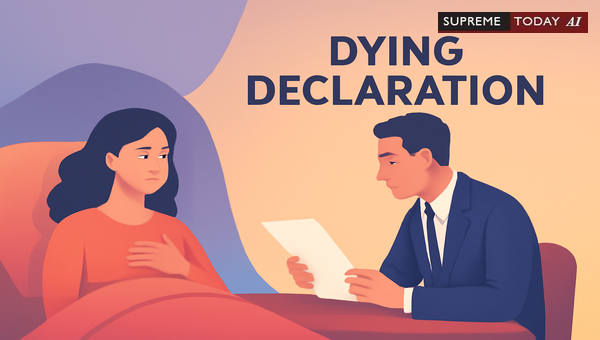
Dying Declaration Reliability - The primary issue in these cases revolves around the reliability and admissibility of dying declarations. Several sources emphasize that a dying declaration must inspire confidence and be free from suspicion to be used as the sole basis for conviction. For instance, it is noted that the dying declaration should inspire confidence of the Court and that great caution must be exercised in considering the weight to be given to this species of evidence ["SMT. SANGAM ESHWARAMMA RR.DT AND ANR. vs THE STATE OF TELANGANA REP PP. - Telangana"]. Additionally, the absence of corroboration, discrepancies, or doubts about the declaration's voluntariness diminish its probative value ["State Of Gujarat VS Ramju @ Ramjan Bhatti - Gujarat"], ["SMT. SANGAM ESHWARAMMA RR.DT AND ANR. vs THE STATE OF TELANGANA REP PP. - Telangana"], ["Arjun Singh S/o Madan Singh VS State Of Rajasthan - Rajasthan"].
Conditions for Admissibility - Courts consider factors such as whether the declarant was in a fit state of mind, whether the declaration was voluntary, and whether it was recorded properly. For example, the content of the dying declaration and the procedure of recording the same cannot be doubted when a doctor certifies the declarant's capacity ["PINKAL @ PINTOO S/O SURESHBHAI RAMJIBHAI CHRISTIAN VS STATE OF GUJARAT - Gujarat"], and the Judicial Magistrate has also put questions to satisfy himself that the deceased was in a fit state of mind ["Rajendran VS State Represented by The Inspector of Police, Nagapattinam - Madras"]. The absence of expert testimony or proper certification about the declarant's mental state can undermine its credibility ["Veeraganti Srinivas vs The State of Telangana - Telangana"], ["Debajit Kalita, S/o. Late Binod Chandra Kalita VS State Of Assam, Represented By PP, Assam - Gauhati"].
Multiple Dying Declarations and Contradictions - When more than one dying declaration exists, inconsistencies between them can cast doubt on their truthfulness. Some judgments state that if there are more than one dying declarations, the dying declarations may entirely agree with one another or there may be dying declarations where inconsistencies between the declarations emerge ["State Of Gujarat VS Shailesh Kalidas Mehta - Gujarat"]. Courts are cautious about relying solely on such declarations, especially if they conflict or appear tutored ["State of A. P. , Rep. by P. P. , Hyderabad VS Repalli Buchanna - Andhra Pradesh"], ["Ram Gopal alias Guddu v. State of U.P. - Allahabad"].
Hostility and Lack of Corroboration - The hostility or uncooperative attitude of witnesses, including relatives, can weaken the case if the dying declaration is not corroborated by independent evidence. Several sources mention that witnesses turned hostile and that without corroboration, the dying declaration cannot be relied upon ["Udhayakumar Vs State Through The The Inspector Of Police - Madras"], ["Jarpula Ravi vs The State of Telangana - Telangana"], ["Banti @ Laxminarayan VS State of Rajasthan - Rajasthan"]. The absence of expert or medical testimony further diminishes the declaration’s weight.
Hostile Evidence and Suspicion - Courts exercise caution where the evidence suggests possible tutoring or suspicion regarding the declaration's truthfulness. For example, the possibility of these two Dying Declarations being an outcome of tutoring cannot be ruled out ["Udhayakumar Vs State Through The The Inspector Of Police - Madras"], and the veracity of the same or the evidence on record shows that the dying declaration is not true ["Veeraganti Srinivas vs The State of Telangana - Telangana"].
Dying Declaration Cannot be Sole Basis for Certain Cases - In cases where the declaration relates to suicide or circumstances not directly implicating the accused, courts have held that it cannot alone sustain a conviction. For instance, a dying declaration cannot be made basis for conviction under Section 498-A IPC as it is not relating to cause of death ["Arjun Singh S/o Madan Singh VS State Of Rajasthan - Rajasthan"], and the dying declaration cannot be the basis for convicting the accused when it suffers from infirmities or inconsistencies ["Pilla Rama Rao Vizianagaram Dt. v. State of A.P. - Andhra Pradesh"], ["Debajit Kalita, S/o. Late Binod Chandra Kalita VS State Of Assam, Represented By PP, Assam - Gauhati"].
Legal Principles on Dying Declarations - The courts recognize that while a dying declaration can be a crucial piece of evidence, it must be scrutinized carefully, especially when there are discrepancies, hostile witnesses, or lack of proper recording procedures. The principle that conviction cannot rest solely upon an uncorroborated and shaky dying declaration is repeatedly emphasized ["SMT. SANGAM ESHWARAMMA RR.DT AND ANR. vs THE STATE OF TELANGANA REP PP. - Telangana"], ["Ram Gopal alias Guddu v. State of U.P. - Allahabad"].
Analysis and Conclusion:The collective insights from these sources establish that dying declarations are valuable but inherently susceptible to doubts regarding their truthfulness, voluntariness, and proper recording. They should be corroborated by other evidence, especially when inconsistencies or hostile witnesses are involved. Importantly, a dying declaration cannot be considered conclusive or solely sufficient to prove guilt, particularly in cases of suspected suicide or when the declaration is suspicious, tutored, or contradictory. The prevailing legal view is that such declarations must inspire confidence and meet procedural safeguards; otherwise, they should not be the sole basis for conviction. This aligns with the principle that a dying declaration cannot be considered a hostile suicide and must be carefully scrutinized before being relied upon in criminal proceedings.