


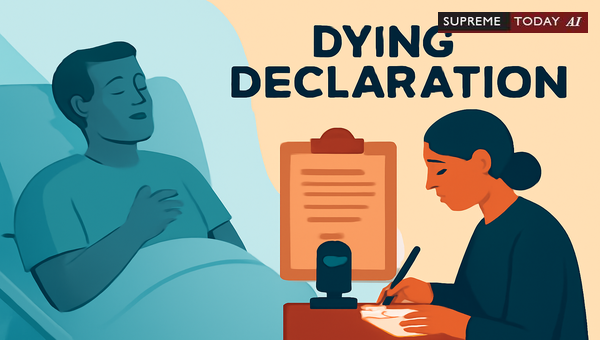
Routine Admissible Without Willingness?
In high-stakes criminal cases, such as those involving murder or assault, dying declarations often serve as pivotal evidence. But what happens when such a statement is recorded as a routine medical or procedural note, without the declarant explicitly expressing willingness or awareness that it's a formal ? Is it still admissible? This question—Routine Admissible Without Willingness?—lies at the heart of evidentiary law, particularly under principles akin to .
This blog post delves into the legal nuances, drawing from key judgments and sources to clarify when such declarations hold weight. We'll examine core criteria like , mental fitness, and trustworthiness, while integrating insights from various cases. Note: This is general information, not specific legal advice. Consult a qualified lawyer for your situation.
Understanding Dying Declarations
A is a statement made by a person who is on the verge of death, regarding the cause of their death or circumstances leading to it. Courts admit these under an exception to the because they carry a presumption of truthfulness—the '' doctrine. However, admissibility isn't automatic.
Key requirements typically include:- The declarant must be in a .- The statement must be voluntary.- It should be overall.
The law doesn't demand rigid formalities. As established in multiple references 2023 0 Supreme(Cal) 267 2022 0 Supreme(All) 1525, substance trumps form.
Core Legal Finding: Routine Recording Doesn't Bar Admissibility
A made as a routine matter, without the declarant expressing willingness or awareness that it is a , may still be admissible if it is shown that the declarant was in a , made the statement voluntarily, and it is otherwise .
Courts emphasize circumstances over formalities. In 2023 0 Supreme(Cal) 267, the judgment clarifies: The requirement of presence of doctor at the time of recording and certification that the declarant was conscious, in senses and in fit condition to make the statement are mere . The ultimate test is whether the can be held to be a truthful one and voluntarily given.
Similarly, 2022 0 Supreme(All) 1525 stresses that essential criteria are and mental state, not whether it was a formal or casual statement. Routine recording—such as by a doctor or magistrate during treatment—doesn't disqualify it if these boxes are checked.
Legal Principles on Admissibility
The framework prioritizes:- : No tutoring, prompting, or coercion.- Mental Fitness: Declarant capable of observing, recalling, and narrating facts.- Trustworthiness: Corroborated by medical evidence, witnesses, or consistency.
Medical opinion guides but isn't mandatory. Witnesses attesting to consciousness suffice 2023 0 Supreme(Cal) 267 2022 0 Supreme(All) 1525. Declarations can be oral, written, or by signs, recorded by anyone satisfied of the declarant's state.
Effect of Routine Recording and No Express Willingness
Routine entries, like those in hospital records, are often accepted. For instance, in 2016 0 Supreme(All) 2479, the deceased's statement was recorded by a doctor and Nayab Tehsildar, proved as a despite routine nature.
In 2016 0 Supreme(Guj) 741, prior to recording, a '' endorsed the patient's consciousness, confirming fitness: In that view of the matter, when her recorded, she was in a fit condition.
Another example from 2010 0 Supreme(MP) 483: An Executive Magistrate recorded the victim's statement in hospital as her , detailing the assault without noted formal willingness.
These align with broader observations: Declarations recorded routinely by police or doctors can qualify if voluntary and coherent 2024 0 Supreme(Chh) 54 2023 0 Supreme(Bom) 2134. However, skepticism arises if delays occur or relatives are present 2023 0 Supreme(Bom) 1815 2023 0 Supreme(Bom) 2134.
Insights from Additional Case Law
Other sources reinforce flexibility:- 2018 0 Supreme(All) 2467: Notes the patient is in a condition to get her recorded, highlighting routine readiness.- 2016 0 Supreme(Mad) 1593: Even without magistrate's explicit satisfaction on fitness, appended doctor's opinion supported it.
On recording methods, courts accept summary forms over strict question-answer if coherent 2023 0 Supreme(Cal) 1303 2023 0 Supreme(Cal) 205 2025 0 Supreme(AP) 55. Promptness boosts credibility 2023 0 Supreme(Bom) 1815 2025 0 Supreme(AP) 55.
Multiple declarations, if consistent, strengthen cases 2023 0 Supreme(All) 843 2023 0 Supreme(Kar) 1228 2023 0 Supreme(Guj) 886. Victims expressing willingness, even casually, aids, but isn't always required if fitness is evident 2023 0 Supreme(Cal) 1303 2023 0 Supreme(Cal) 205 2024 0 Supreme(Chh) 54.
Verification of fitness is key; absence of formal certification doesn't doom it if coherence shows 2025 0 Supreme(AP) 55 2023 0 Supreme(Chh) 46.
Exceptions and Limitations
Not all routine declarations pass muster:- Tutored or Imagined Statements: Challenged if prompted.- Unfitness Evidence: Overrides if proven incoherent.- Suspicious Circumstances: Delays, relative presence, or inconsistencies weaken 2023 0 Supreme(Bom) 1815 2023 0 Supreme(Bom) 2134.
Courts scrutinize holistically, per 2023 0 Supreme(Cal) 267 2022 0 Supreme(All) 1525.
Recommendations for Reliability
To bolster routine declarations:- Secure medical certification of fitness (prudent, not mandatory).- Gather witness testimony on consciousness.- Ensure prompt recording without influences.- Corroborate with circumstantial evidence.
Holistic evaluation ensures justice.
Conclusion: Focus on Substance Over Form
In summary, a recorded routinely, without explicit willingness or awareness, can be admissible if , fit mental state, and trustworthiness are established. Cases like 2023 0 Supreme(Cal) 267 and 2022 0 Supreme(All) 1525 underscore that formalities are secondary to credibility.
Key Takeaways
- Prioritize mental fitness and .
- Routine doesn't mean inadmissible—context matters.
- Use corroboration for strength.
This evolving area demands careful case analysis. For tailored advice, reach out to legal experts.
#DyingDeclaration, #EvidenceLaw, #LegalAdmissibility














