


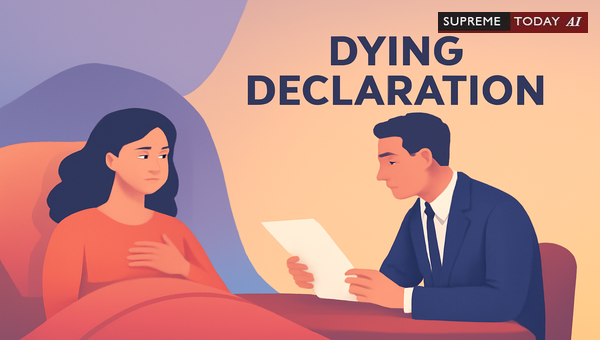
: Hostile in Suicide Cases?
In the intricate world of Indian criminal law, dying declarations hold a pivotal role as powerful evidence, especially in cases involving suspicious deaths like burns or poisonings that may point to homicide or suicide. But what happens when a declaration implicates others, only for the death to be revealed as suicide, or when witnesses turn hostile? Can a be considered hostile suicide? This question often arises in heated courtroom battles, testing the boundaries of .
This blog post delves into the legal nuances, drawing from established principles under the , and real-world case applications. We'll explore why such declarations generally retain value if proven truthful, even amidst hostility or suicide revelations. Note: This is general information, not specific legal advice. Consult a qualified lawyer for your case.
Understanding Dying Declarations in Indian Law
A is a statement made by a person who is at the brink of death, explaining the cause of their impending demise or the circumstances leading to it. It gains under , provided it relates directly to the cause of death or associated circumstances, and the declarant is deceased or unavailable. 2010 6 Supreme 65 2000 5 Supreme 205
The foundational principle is captured in the Latin maxim —a dying person does not lie when meeting their maker. Courts emphasize that for conviction, the declaration must be voluntary, truthful, and made in a fit mental state. 2012 2 Supreme 439 2001 5 Supreme 26 2014 5 Supreme 414
Key reliability factors include:- Mental fitness: Often certified by a doctor, though not always mandatory if circumstances support it.- Consistency: No major contradictions with other evidence.- Voluntariness: Free from tutoring or coercion.
In practice, a reliable can standalone for conviction, but courts scrutinize it rigorously, especially in burn or poisoning cases prone to fabrication claims. 2001 5 Supreme 26
The Role of Hostile Witnesses
Witness hostility—where prosecution witnesses turn unfavorable—complicates trials but does not automatically invalidate a . Under Indian law, hostile witnesses' testimony requires and carries diminished weight, yet it doesn't erase the declaration's core value. 2012 2 Supreme 439 1975 0 Supreme(SC) 469
Importantly, a cannot be corroborated solely by a , as their credibility is suspect. 1975 0 Supreme(SC) 469 The declaration stands on its own merits if proven reliable.
For instance, in cases with multiple prosecution witnesses turning hostile, courts have held that the evidence of the investigating officer or declaration recorder becomes crucial, provided no procedural lapses exist. 2025 0 Supreme(Pat) 1370 As noted, There are in total 14 prosecution witnesses, out of which evidence of 10 prosecution witnesses is of no value as they have turned hostile. 2025 0 Supreme(Pat) 1370
Dying Declarations in Suicide Scenarios: Not Inherently Hostile
The phrase cannot be considered hostile suicide underscores that even if a death is later classified as suicide, a prior declaration implicating others retains evidentiary force if it meets and reliability tests. Suicide does not retroactively render the statement hostile or unreliable; courts evaluate it independently.
Consider cases where victims gave declarations blaming in-laws for burns, only for evidence to suggest self-immolation. Courts have acquitted where defects abound, such as:- No doctor's fitness certificate. 2025 0 Supreme(Pat) 1370- Narrative form instead of question-answer, risking inaccuracies. 2025 0 Supreme(Pat) 1370- Contradictions between declaration and prosecution version: Where the prosecution version differs from the version as given in the , the said declaration cannot be acted upon. 2025 0 Supreme(Pat) 1370 2025 Supreme(Online)(Pat) 1728
In one appeal, the court quashed a conviction due to these infirmities, noting the recorder's admission that victim could not narrate entire incident, and he did not obtain any certificate from doctor. 2025 0 Supreme(Pat) 1370
Conversely, suicide notes can qualify as dying declarations if they explain the cause of death. In a gang rape case leading to suicide, the court treated a handwritten note as valid under Section 32, observing: statement in handwriting of victim—is a as she died same day—admissible not only in relation to cause of death but also to circumstances of transaction which resulted in death. 2018 0 Supreme(MP) 611 2018 0 Supreme(MP) 521
However, lack of naming accused or context can limit impact, though holistic reading is mandated. 2018 0 Supreme(MP) 611
Case Studies: When Declarations Hold or Fail
Real cases illustrate these principles:
Acquittals Due to Infirmities
- Burn Injury Murder Trial: convicted under , but appeal succeeded as 10 of 14 witnesses turned hostile, lacked Q&A format, and no doctor was examined. Major contradictions led to acquittal. 2025 0 Supreme(Pat) 1370
- Dowry Death Case: Declaration rejected for inconsistencies, gestures-based recording (not verbal), and unfit mental state per medical evidence. The said evidence clearly goes to show that the deceased was not in a fit state of mind. 2019 0 Supreme(Kar) 72
- Abetment to Suicide: No or note; mere quarrel allegations failed test. 2021 0 Supreme(Mad) 607
Upholding Declarations
- Conflicting Declarations: In a burns case, trial acquittal affirmed on appeal due to inconsistencies between two declarations—one blaming in-laws, another admitting self-pouring kerosene after quarrel. Lack of , including husband's rescue injuries, justified acquittal. 2024 0 Supreme(Raj) 991
Appeals Against Acquittal
Courts interfere sparingly: An can only overturn an acquittal if it finds a clear error or illegality... maintaining the . 2024 0 Supreme(Raj) 991
These examples highlight that hostility or suicide doesn't doom a declaration—reliability does.
Practical Recommendations for Legal Practitioners
To leverage dying declarations effectively:- Scrutinize authenticity: Verify mental fitness, even via circumstantial evidence.- Seek : Independent witnesses or medicals bolster claims. 2012 2 Supreme 439- Address hostility: Emphasize declaration's independence from turncoat witnesses.- Holistic evaluation: Read in context; isolated lines mislead. 2018 0 Supreme(MP) 611
Prosecution must prove ; doubts benefit the accused. 2021 0 Supreme(Mad) 607 2019 0 Supreme(Kar) 72
Key Takeaways
- Dying declarations under Section 32(1) are potent but demand strict reliability checks. 2010 6 Supreme 65 2000 5 Supreme 205
- Hostile witnesses weaken, not destroy, their value. 1975 0 Supreme(SC) 469
- Suicide classification doesn't make a declaration hostile—truthfulness prevails.
- Common pitfalls: No fitness certificate, contradictions, procedural flaws lead to rejection.
In sum, while a cannot be considered hostile suicide outright, courts demand unwavering proof of its veracity. This balances justice with safeguards against misuse.
References:2010 6 Supreme 65 2000 5 Supreme 205 2012 2 Supreme 439 2001 5 Supreme 26 1975 0 Supreme(SC) 469 2014 5 Supreme 414 2025 0 Supreme(Pat) 1370 2025 Supreme(Online)(Pat) 1728 2024 0 Supreme(Raj) 991 2021 0 Supreme(Mad) 607 2019 0 Supreme(Kar) 72 2018 0 Supreme(MP) 611 2018 0 Supreme(MP) 521
For tailored advice, reach out to a legal expert. Stay informed on evolving jurisprudence!
#DyingDeclaration #IndianEvidenceAct #CriminalLaw









