Searching Case Laws & Precedent on Legal Query..!
Scanned Judgements…!



Searching Case Laws & Precedent on Legal Query..!
Scanned Judgements…!
Constitution of Coparcenary - A coparcenary is formed by male members of a Hindu family from the moment of their birth, with each son automatically acquiring a share in the ancestral property and becoming part of the coparcenary. The coparcenary's existence is continuous and can include current members and those born subsequently. The management and alienation powers are generally vested in the karta (head of the family), but certain rights, such as alienation, require collective consent. ["2023 Supreme(Online)(MAD) 877"], ["2023 Supreme(Online)(Mad) 99148"], ["2025 0 Supreme(Kar) 976"], ["2025 0 Supreme(Kar) 974"], ["
RAMASWAMI IYENGAR V. v. ATTORNEY GENERAL
"], ["2021 0 Supreme(Mad) 1062"], ["Vasumathi VS R. Vasudevan - Current Civil Cases
"], ["Vasumathi VS R. Vasudevan - Madras
"]Effect of Hindu Succession Act, 1956 - Post-1956, property devolving on a Hindu after the intestate death of a father does not automatically constitute HUF property. Instead, such property devolves according to the succession laws, and if it falls to a coparcener, it retains its character as coparcenary property, conferring rights to the sons. The Act clarified that coparcenary rights are acquired by birth, and the property remains coparcenary unless partition occurs. ["2023 Supreme(Online)(MAD) 877"], ["2023 Supreme(Online)(Mad) 99148"], ["2025 0 Supreme(Kar) 976"], ["2025 0 Supreme(Kar) 974"]
Partition and Rights in Coparcenary Property - A member of a joint Hindu family can indicate an intention to partition through a clear and unequivocal act, which leads to the severance of jointness. Once partition occurs, the property ceases to be coparcenary property for the partitioned share, which then can be dealt with independently. Rights are acquired by birth and through partition, with each heir entitled to a specific share. ["2023 Supreme(Online)(MAD) 877"], ["2023 Supreme(Online)(Mad) 99148"], ["
ATTORNEY GENERAL v. RAMASWAMY IYENGAR V.
"], ["2021 0 Supreme(Mad) 1062"], ["Vasumathi VS R. Vasudevan - Madras
"]Legal Precedents and Judicial Interpretations - Courts have consistently held that the moment a son is born, he automatically becomes a coparcener with rights in the ancestral property. The management powers are centered in the karta, but alienation rights typically require collective consent. The character of property as coparcenary or ancestral depends on its origin and the manner of acquisition. Chander Sen & Ors, SCC 1986, ["2023 Supreme(Online)(MAD) 877"], ["
RAMASWAMI IYENGAR V. v. ATTORNEY GENERAL
"], ["2021 0 Supreme(Mad) 1062"], ["Vasumathi VS R. Vasudevan - Current Civil Cases
"], ["Vasumathi VS R. Vasudevan - Madras
"]Implications of the Hindu Succession Act on Coparcenary - The Act emphasizes that coparcenary rights are acquired by birth and that the property remains coparcenary unless partition is explicitly effected. The Act also clarifies the rights of female heirs, who are now recognized as coparceners in certain circumstances. The process of partition can be initiated by a clear act of separation, leading to individual ownership of shares. ["2023 Supreme(Online)(MAD) 877"], ["2023 Supreme(Online)(Mad) 99148"], ["2025 0 Supreme(Kar) 976"], ["2025 0 Supreme(Kar) 974"], ["
ATTORNEY GENERAL v. RAMASWAMY IYENGAR V.
"], ["2021 0 Supreme(Mad) 1062"], ["Vasumathi VS R. Vasudevan - Madras
"]Analysis and Conclusion:Constituting a coparcenary at present involves the automatic inclusion of male members from birth, with rights and powers governed by traditional Hindu law and clarified by the Hindu Succession Act, 1956. The key points include the automatic acquisition of rights by sons, the importance of clear acts of partition to sever jointness, and the management rights vested in the karta. Post-1956, property devolves according to succession laws, but coparcenary character persists if the property is ancestral or acquired as coparcenary property. Modern legal interpretations emphasize that the formation and termination of coparcenary are driven by birth and explicit acts of partition, respectively.
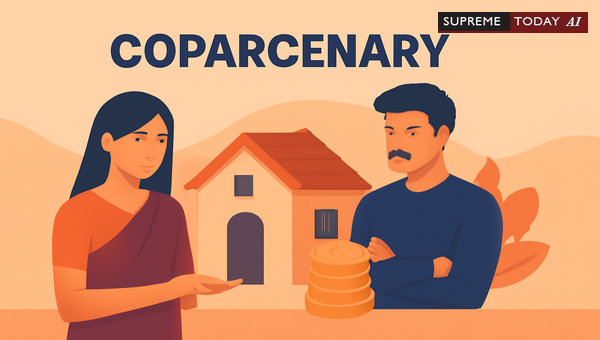
In the evolving landscape of Hindu family law, understanding remains crucial for anyone dealing with . Traditionally rooted in male , has transformed significantly, especially after key legislative changes. If you've ever wondered, How to Constitute at Present Time?, this guide breaks it down step by step, drawing from the Hindu Succession Act and relevant judicial insights.
This article provides general information on formation, eligibility, and practical considerations. It is not a substitute for professional legal advice—consult a qualified lawyer for your specific situation.
refers to a unique form of under Hindu law, where specific family members hold undivided interest in . Governed primarily by the , it has been reshaped by the landmark amendment.
Historically, only male descendants up to four generations formed the . Today, the landscape is more inclusive.
Constituting a involves specific eligibility and formation rules. Here's a detailed overview:
Post- Amendment: Daughters are coparceners by birth, with equal rights to , regardless of marital status. This aligns with gender equality principles under .
How is Constituted:
Irrespective of parents' marital status, the child's to the property holder matters.
Share Distribution:
These principles ensure equitable distribution but often lead to disputes over and .
The , was a game-changer. Daughters gained the same birthright as sons, overturning centuries-old patriarchy. Courts have upheld this in cases like Vineeta Sharma v. Rakesh Sharma (though not directly cited here), reinforcing that rights are not lost upon marriage.
Judicial precedents clarify constitution, especially in share disputes.
In a key ruling, the court examined whether plaintiffs formed a with the defendant, stressing clarity on and of claims. The decision highlighted: the determination of shares among coparceners, specifically addressing the question of whether the plaintiffs constituted a with the defendant 2023 0 Supreme(MP) 178. 2023 0 Supreme(MP) 178
This underscores the need for robust proof in family suits. Similarly, in property disputes turning contentious, courts demand evidence of . For instance, failure to prove can bar relief, as seen where a petitioner was denied due to lack of diligence: Failure to prove and precludes seeking relief through amendment of written statement. 2023 0 Supreme(P&H) 829
In inheritance challenges, proving is vital, akin to validations. One case noted: Appellants could not prove that as to how they inherited property in question—Since maker of Will dies after few days if execution, Will cannot be disbelieved on this ground alone. 2017 0 Supreme(All) 1800
These cases illustrate that claims often hinge on evidentiary rigor, much like criminal or civil proofs where testimony must align: The credibility of eyewitness testimony is crucial in establishing guilt in criminal cases. 2016 0 Supreme(Mad) 208
While forms by birth, formalizing rights—especially amid disputes—requires action:
Prove descent from the original property holder.
Legal Documentation:
File for suit if shares need crystallization.
Seek Legal Validation:
Consider tax implications: Coparceners can claim HUF deductions under .
Disputes arise over:- Illegitimacy claims: Courts scrutinize birth records.- inequities: Post-amendment, daughters' shares can't be denied.- Self-acquired vs. ancestral: Blended families complicate this.
In one evidentiary context, courts caution: Evidence let in by the prosecution has to be assessed carefully and cautiously and it should not be brushed aside. 2022 0 Supreme(Kar) 431 This principle applies to civil family proofs too.
For circumstantial claims, like in property murders or wills: In a case based on , the guilt of the accused must be established beyond reasonable doubt. 2019 0 Supreme(Kar) 733 Analogously, assertions need unassailable facts.
Mediation via or often resolves amicably.
Today, constituting is straightforward yet nuanced: Birth into an -holding HUF makes sons and daughters equal coparceners. Legal clarity on , proper documentation, and court intervention in disputes are pivotal.
Key Takeaways:- Daughters have equal birthrights post-.- Document everything to prove claims.- Consult experts for partitions or challenges.
For tailored guidance, engage a family law specialist. Stay informed on amendments to safeguard your inheritance rights.
Disclaimer: This is general information based on statutes and cases like 2023 0 Supreme(MP) 178, 2023 0 Supreme(P&H) 829, 2022 0 Supreme(Kar) 431, 2019 0 Supreme(Kar) 733, 2017 0 Supreme(All) 1800, 2016 0 Supreme(Mad) 208. Laws vary by facts; seek professional advice.
#Coparcenary #HinduLaw #InheritanceRights


5.Aggrieved by this, the present appeal suit is filed by the appellant/plaintiff. ... Therefore, the property which devolved on a Hindu on the death of his father intestate after the coming into force of the Hindu Succession Act, 1956, did not constitute HUF property consisting of his own branch including his sons. ... Thus, the property which had fallen to the share of the first defendant retained the character of the coparcenory property....

Therefore, the property which devolved on a Hindu on the death of his father intestate after the coming into force of the Hindu Succession Act, 1956, did not constitute HUF property consisting of his own branch including his sons. ... Thus, the property which had fallen to the share of the first defendant retained the character of the coparcenory property and the plaintiffs being his sons have a right in the suit property. ... In the present#HL_END....

So, prayer is made that the present petition be allowed in the interest of justice for just decision of the suit. 7. Present petition is opposed by counsel for respondents No.1 and 2. ... Consequently, the present revision petition is hereby dismissed being devoid of merits. Petition dismissed. ... Brief facts of the case are that the plaintiffs/respondents No.1 and 2 have filed suit for declaration with regard to suit land on the ground t....
That the male " co-parceners" for the time being constitute at any particular point of time a " hedge of trustees " who, while enjoying community of interest and unity of possession in the property, hold it collectively-indeed, as a sub-division of the larger group-for the benefit of the entire family ... Finally, the present assessees could not be made accountable in the present case for any estate....

Thus, the plaintiffs and defendant No.1 constitute the Joint Hindu Family. It is further the case of the plaintiffs that, the agricultural land bearing R.S. ... At the time of partition in the year 1951, 4 acres 15 guntas fell to the share of Kugappa, and the remaining 4 acres 15 guntas fell to the share of Parisappa. ... Thus, the plaintiffs and defendant No.1 constitute a joint Hindu family. The suit properties are the ancestral, coparcen....

Thus, the plaintiffs and defendant No.1 constitute the joint Hindu family. It is further the case of the plaintiff that, agricultural land bearing R.S. ... At the time of partition in the year 1951, 4 acres 15 guntas fell to the share of Kugappa, and the remaining 4 acres 15 guntas fell to the share of Parisappa. ... Thus, the plaintiffs and defendant No.1 constitute a joint Hindu family. The suit properties are the ancestral, coparcenary a....

He would submit that till such time as the properties stood in the name of the 1st defendant neither the plaintiff nor defendants 2 and 3 could claim any right over it. ... Once the existence of the ancestral property is proved it assumes the character of a coparcenory property. He would submit that the defendants have admitted this in paragraph no.8 of their written statement.
In the same way, if there is only a single co-parcener for the time being (as there was in the present case after 9th September 1934) all the unfettered powers of alienation previously vested in the co-parcenary group become centred in the individual. ... An undivided family, being an entity consisting not merely of its co-parcenary members but also of others, must be regarded as " the true owner " of the joint property; the co-parceners for the #HL_....

Understanding its effect will constitute the third layer of the defendants’ arguments. The H.S. Act Implications on Coparcenery & Ancestral Property 16. ... In this narrow sense all that is necessary to constitute partition is a definite and unequivocal indication of his intention by a member of a joint family to separate himself from the family and enjoy his share in severalty . ... And he also has two daughters, his widow and mother, all of whom will #HL....
Understanding its effect will constitute the third layer of the defendants’ arguments. The H.S.Act Implications on Coparcenery & Ancestral Property 16. ... In this narrow sense all that is necessary to constitute partition is a definite and unequivocal indication of his intention by a member of a joint family to separate himself from the family and enjoy his share in severalty . ... And he also has two daughters, his widow and mother, all of whom will #HL_ST....

Since there was darkness he cannot says as to how many persons were present at that time. He states that he does not know what is written in Ex.P5 and on its perusal it shows that it is written in Birur police Station. When the incident occurred there were five persons on his side and five persons on the side of accused persons.
He would submit that the defendants have admitted this in paragraph no.8 of their written statement. He would draw the attention of the Court to the finding of the Trial Court that the plaintiff had not produced any evidence to show that Vembanna Gounder had purchased the suit 1st Item of property with the funds from an ancestral property. He would further submit that a reading of Ex.B.3 Release deed would clearly prove that the 1st Item of property is an ancestral property. Once the....

On the other hand, he has only stated that on the said day, the police had been to the house of the deceased and the accused was with them. Secondly, PW-4 in his evidence has stated that accused produced the said Saree stating that it is using the said Saree, he hanged Yashodamma by tying the Saree around her neck. However, he has not stated as to how come he was present there at that time.

However, he could not disclose as to how many persons were present at that time. This witness has clearly admitted in his cross-examination that the Will was not prepared in his presence. Similarly, Shatrughan who was examined to prove the signatures of the witnesses, had said that he was not present when the Will was prepared. According to him, the Will was executed at about 10.00 in the morning.
He has not offered any explanation as to how he was present at the time of occurrence. By all natural human conduct, anyone, out of P.Ws.1 to 3, who have witnessed the occurrence, would have gone to the hospital accompanying the deceased. P.W.3, the wife of the deceased claims to have witnessed the occurrence is doubtful also for the simple reason that she did not go to the hospital along with her husband/the deceased. P.W.2 lives in a different village and there was no occas....


An indispensable Tool for Legal Professionals, Endorsed by Various High Court and Judicial Officers
Please visit our Training & Support
Center or Contact Us for assistance

Scan Me!
India’s Legal research and Law Firm App, Download now!


For Daily Legal Updates, Join us on :



 Back to top


