


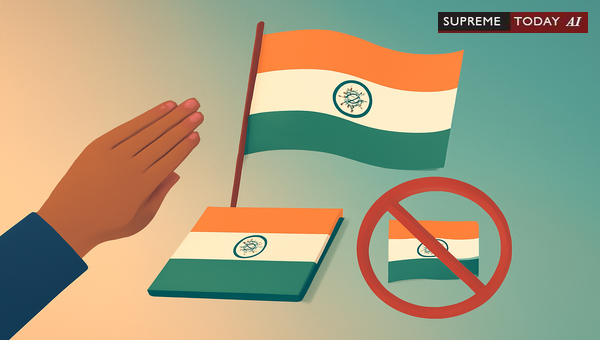
Flag Code India : No Commercial Use or Dipping – Key Cases
The Indian National Flag is a profound symbol of national pride, unity, and sovereignty. However, its use is strictly regulated to maintain its dignity. A common query arises: In Flag Code in India Part 2 Section 1 the Flag Shall Not be Used in any the Flag Shall Not be to any Person or Thing any Case Laws Regarding it? This question touches on critical provisions that every citizen, business owner, and organization must understand to avoid legal pitfalls.
In this comprehensive guide, we delve into the , focusing on Part II, Section 1. We'll examine its prohibitions, the legal status of the Code, relevant case laws, and enforcement mechanisms. Note: This article provides general information and is not a substitute for professional legal advice. Consult a qualified lawyer for specific situations.
Understanding the
The , issued by the , outlines guidelines for the hoisting, display, and use of the Tricolour. Part II, Section 1 explicitly states that the Indian National Flag shall not be used for any and shall not be to any person or thing2018 1 Supreme 291. These directives aim to preserve the Flag's sanctity, ensuring it is not trivialized or subordinated.
While the Flag Code serves as , it is not a statute enforceable like a law under of the Constitution. The in clarified this distinction, holding that the Code provides guidelines but does not impose by itself 2025 0 Supreme(Ker) 2359. Instead, violations may attract action under statutory laws, such as the (PINHA).
Prohibition on Commercial Use of the National Flag
Using the National Flag for trade, advertising, or profit-making activities is strictly forbidden. Section 2 of the PINHA reinforces this by prohibiting any use that disrespects the Flag. The Flag Code emphasizes: the Flag shall not be used for any 2018 1 Supreme 291.
Businesses often inadvertently violate this—think flags on product packaging, promotional banners, or merchandise. Courts have upheld that such misuse undermines the Flag's honor. In Naveen Jindal, the stressed adherence to these guidelines, noting that while flying the Flag is a under , it is subject to including the Flag Code 2025 0 Supreme(Ker) 2359. Violations can lead to penalties under PINHA, which prescribes imprisonment up to three years, a fine, or both 2012 0 Supreme(HP) 284.
Ban on Dipping the Flag in Salute
Another key prohibition: the Flag shall not be to any person or thing2018 1 Supreme 291. This prevents the Flag from being lowered or tilted in deference to individuals, vehicles, or objects, reserving salutes for military protocols only.
A relevant observation from legal discourse highlights: b) dipping the Indian National Flag in salute to any person or thing; or (c) flying the Indian National Flag at except on occasions on which the Indian National ... Therefore, I am of the opinion, that either or are not attracted to the facts 2022 Supreme(Online)(Kar) 54277. This underscores that not every technical violation triggers criminal liability; must be proven under PINHA Section 2 2012 0 Supreme(HP) 284. Courts assess if the act amounts to , rather than mere non-compliance with the Code.
Legal Status and Enforceability of the Flag Code
Is the Flag Code legally binding? The in ruled it is not a law within the meaning of but executive guidelines 2025 0 Supreme(Ker) 2359. It guides respectful usage without standalone penalties. However, breaches like commercial exploitation or improper dipping can invoke PINHA if they constitute an insult 2012 0 Supreme(HP) 284.
Key judicial view: Mere violation of the Flag Code does not automatically constitute an unless it disrespects the Flag under law 2012 0 Supreme(HP) 284. This balanced approach protects fundamental rights while upholding national symbols.
Landmark Case Laws
()
This pivotal decision affirmed the right to fly the Flag freely as part of free speech, subject to Flag Code restrictions. It clarified: the Code's provisions on commercial use and dipping are guidelines to be followed, with statutory backing for enforcement 2025 0 Supreme(Ker) 2359. The ruling democratized Flag hoisting for civilians, but reinforced prohibitions.
Other Judicial Insights
Courts have consistently linked Flag Code violations to PINHA. For instance, acts disrespecting the Flag through commercial means or salutes have faced scrutiny, though prosecution requires evidence of insult 2012 0 Supreme(HP) 284 2022 Supreme(Online)(Kar) 54277. No direct case solely on dipping was isolated, but the principles apply uniformly.
Exceptions and Permissible Uses
The Flag Code is not absolute. Exceptions include:- Hoisting on Independence Day, Republic Day, and other national holidays.- Display in schools, government offices, and during official events.- on mourning occasions notified by the government 2018 1 Supreme 291.
Commercial bans and dipping prohibitions remain absolute to safeguard dignity. Always ensure respectful handling: no printing on cushions, napkins, or uniforms.
Penalties and Enforcement
- PINHA Section 2: Imprisonment up to 3 years for insulting the Flag.
- IPC Section 188: For disobeying public servant orders, if applicable 2022 Supreme(Online)(Kar) 54277.
Enforcement typically follows complaints to police, leading to FIRs. Businesses face reputational damage alongside fines.
Practical Recommendations
To stay compliant:- Avoid commercial use: No Flag motifs on ads, products, or events for profit.- Proper salutes: Never dip the Flag; use military protocols only.- Training: Educate staff on Flag Code.- Report violations: Use helplines or authorities for misuse.
Authorities should prosecute under PINHA for clear insults, while promoting awareness over punitive action.
Conclusion and Key Takeaways
The , Part II, Section 1, unequivocally bans commercial use and dipping the National Flag in salute 2018 1 Supreme 291. Backed by cases like Naveen Jindal2025 0 Supreme(Ker) 2359, these are guidelines enforced via PINHA 2012 0 Supreme(HP) 284. Respecting the Tricolour fosters patriotism—handle with care.
Key Takeaways:- Flag Code: Guidelines, not law, but violations punishable under statute.- No commercial use or dipping—absolute rules.- Consult PINHA for penalties; intent matters.- Fly proudly, but compliantly.
For deeper insights, review official documents. Stay informed, stay respectful.
#FlagCodeIndia, #NationalFlagRules, #LegalCasesIndia












