




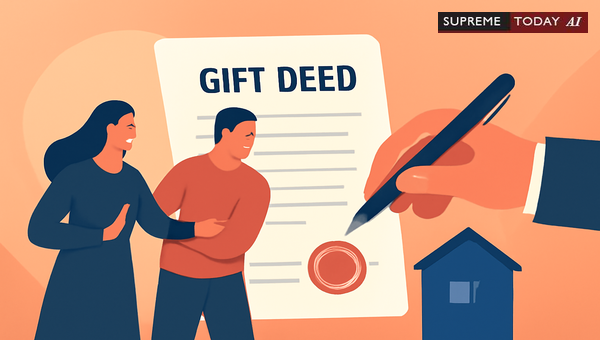
When Is a Invalid Due to ?
Transferring property through a is a common practice in India, often used to pass assets to family members without monetary exchange. But what happens when such a deed is executed under questionable circumstances? The question of acceptance of validity frequently arises, especially when claims of , , or surface. This blog explores the legal framework governing gift deeds under the , and highlights when they may be deemed invalid.
Gift deeds must reflect the donor's free will, , and proper execution. Courts scrutinize these documents closely, particularly in relationships of trust or vulnerability. Let's dive into the core principles, supported by judicial precedents.
Core Legal Principles for Validity
For a to hold up, it requires by a competent donor, acceptance by the donee, and delivery of possession. Registration and further strengthen its position, creating a that challengers must rebut. As established, proper execution, , and the absence of or are essential for a gift to be valid 2007 0 Supreme(SC) 1638 1937 0 Supreme(Cal) 299.
However, deeds executed under the pretext of favors or due to , , or are generally invalid unless the donor’s free will and mental capacity are proven. The law emphasizes that validity hinges on these factors 2019 0 Supreme(Cal) 393.
Key Requirements for a Valid
- Voluntary intent: The donor must act without pressure.
- Mental capacity: Donor understands the transaction's nature and consequences.
- Proper execution: Signed, attested by witnesses, and registered.
- Acceptance and possession: Donee must accept and take possession.
Signs of Invalidity: , , and
Courts often invalidate gift deeds when evidence shows the donor was vulnerable—such as being elderly, infirm, illiterate, or in a with the donee. In cases where the donor is old, infirm, illiterate, or in a with the donee, there is a higher likelihood of or 1937 0 Supreme(Cal) 299.
For instance, the court in 1937 0 Supreme(Cal) 299 found deeds by an old, infirm person under invalid. Similarly, in 2007 0 Supreme(HP) 410, gift deeds obtained through dependency and fiduciary ties were declared void.
Other circumstances indicating invalidity include:- Absence of free will or genuine consent.- Donor’s vulnerability due to age, health, or dependency.- Relationships of trust (e.g., parent-child, guardian-ward).- Lack of proper , registration, or possession transfer.- Presence of misrepresentation, , or during execution.
Evidence of , , misrepresentation, or can render a gift invalid, especially when the donor was vulnerable or under fiduciary relationships 1937 0 Supreme(Cal) 299 2007 0 Supreme(HP) 410.
and
Registered gift deeds enjoy a , but this is rebuttable. The lies on the party challenging the validity, particularly for claims of or 2019 0 Supreme(Cal) 393. Challengers must provide strong evidence, such as the donor-donee relationship, donor's mental state, and conduct at execution 2010 0 Supreme(HP) 815 2007 0 Supreme(HP) 410.
exists for registered deeds, but this can be rebutted by strong evidence of , , or 2019 0 Supreme(Cal) 393. Once rebutted, the onus shifts to prove or lack of capacity 1969 0 Supreme(SC) 354.
Insights from Landmark Cases
Judicial precedents reinforce these principles. In 1969 0 Supreme(SC) 354, transfers admitting estate passage under customary law were not true gifts, underscoring intent's role. Courts in 2010 0 Supreme(HP) 815 invalidated deeds lacking or possession transfer.
Additional cases highlight contextual nuances:- Restrictions: Under , a cannot gift without consent. A under cannot unilaterally dispose of without the consent of other co-parceners, and a deed executed as a gift of is invalid 2024 0 Supreme(Mad) 841. The court deemed such a deed invalid as it violated co-parcenary rules.
No Allowed: Gifts cannot involve ; otherwise, they fail under . If gift is evidenced by , same cannot be valid one within meaning of Section 122 of T.P. Act 2019 2 Supreme 659. A mentioned valuation (e.g., Rs.5,000) for stamp duty doesn't qualify as .
Gifts: Require declaration, acceptance, and possession delivery—even for undivided shares if proven. In 2023 0 Supreme(All) 1990, a prevailed over oral claims, confirming validity through evidence.
Title Transfer Effect: Valid deeds pass , invalidating subsequent deeds by the donor. The under Ex.A-1 passed a valid title in favor of the donees 2023 0 Supreme(AP) 1470.
These cases illustrate how courts assess surrounding circumstances, donor capacity, and relationships 2010 0 Supreme(HP) 815.
Exceptions Where Deeds Are Upheld
Not all suspicious deeds fail. If , proper , and no are proven—even amid vulnerability—the deed stands 1990 0 Supreme(SC) 131. If the donor is found to have voluntarily and knowingly executed the , with proper , and without , the deed is valid 1990 0 Supreme(SC) 131. Mental capacity trumps mere suspicion 2010 0 Supreme(HP) 815.
The presumption holds unless rebutted by clear and convincing evidence.
Practical Recommendations
To safeguard or challenge a :- For Donors/Donees: Ensure , document mental capacity (e.g., medical certificates), use independent witnesses, and register promptly.- Challengers: Gather evidence of vulnerability, trust relationships, and suspicious conduct. Focus on execution-time facts.- Litigation Tip: Courts scrutinize fiduciary ties or donor weakness closely. Consult records like prior wills or family dynamics.
When challenging a alleged to be executed under , focus on establishing the donor’s vulnerability, the relationship of trust, and any suspicious conduct at the time of execution.
Disclaimer: This is general information based on legal precedents and not specific legal advice. Consult a qualified lawyer for your situation.
Conclusion: Key Takeaways
Gift deeds under , , or are typically invalid, with validity resting on free will, capacity, and execution 2019 0 Supreme(Cal) 393. Challengers bear the proof burden, but strong evidence can rebut presumptions. Whether upholding a family transfer or contesting one, understanding these principles is crucial.
- Prioritize proper formalities to avoid disputes.
- Scrutinize relationships and circumstances in challenges.
- Leverage precedents like those on or specific personal laws.
Stay informed on property laws to protect your assets. For personalized guidance, reach out to legal experts.
#GiftDeed #UndueInfluence #PropertyLaw












