


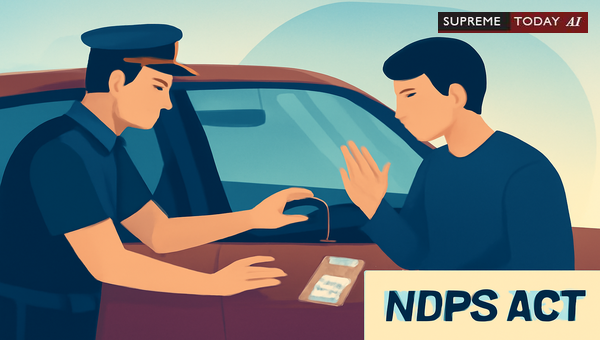
Heroin Recovery from Car Dashboard: Does NDPS Section 50 Apply?
In high-stakes drug enforcement cases under India's , the location of contraband recovery can dramatically alter legal outcomes. Imagine a scenario where authorities recover heroin from the dashboard of a car driven by the accused. Does this trigger the strict of Section 50 , or is it treated differently? This question—recovery of heroine under done from the dashboard of the car in which accused was driving—lies at the heart of many defenses in NDPS trials.
This blog post breaks down the legal nuances, drawing from key judgments and statutory provisions. We'll examine why such recoveries are typically governed by Section 43 rather than Section 50, explore relevant case law, and highlight implications for accused individuals, especially drivers. Note: This is general information based on precedents and not specific legal advice. Consult a qualified lawyer for your case.
vs. Vehicle Search: The Core Distinction
The meticulously differentiates between types of searches to balance enforcement needs with individual rights. Section 50 applies only to personal searches of an individual, mandating that the accused be informed of their right to be searched before a Gazetted Officer or Magistrate. Failure to comply can render evidence inadmissible.
In contrast, Section 43 governs searches of vehicles, vessels, or aircraft in transit. These do not require Section 50's formalities. As established in judgments, Recovery of heroin from a vehicle in transit is not a of the accused but a search conducted during transit, invoking Section 43, not Section 50 2004 1 Supreme 815. Similarly, Section 50 applies only to personal searches of individuals, not to searches of vehicles or containers during transit 2004 1 Supreme 815.
When heroin is found on a car's dashboard—a common hiding spot in moving vehicles—the recovery is classified as a . Courts have consistently held that Section 50 compliance is not mandatory here, provided Section 43 procedures (like authorization and documentation) are followed 2004 1 Supreme 815.
Why the Dashboard Matters
The dashboard is part of the vehicle's interior, not the driver's personal body or clothing. This distinction is crucial. For instance, in one case, A recovery of 100 grams of heroin was made from the dashboard of the car which petitioner was driving 2022 0 Supreme(P&H) 670, emphasizing that the quantity and location influenced considerations without invoking Section 50.
Key Legal Principles from Precedents
Indian courts have clarified this through multiple rulings:
- Vehicle in Transit Rules Section 43: Provisions of apply in case of of a person and does not extend to search of a vehicle, container or bag or premises 2004 1 Supreme 815.
- No Need for Section 50 in Vehicle Cases: Recovery of contraband like 820 grams of charas from a vehicle dashboard meant Section 50 would apply only in case of of a person and would not extend to search of a vehicle or container or a bag or premises 2004 1 Supreme 815.
- Gazetted Officer Searches: If conducted by empowered officers under Section 41, additional compliances like Section 42 may not apply 2003 8 Supreme 582.
These principles ensure that transit searches remain efficient while upholding basic safeguards.
Integrating Insights from Related Cases
Other judgments reinforce this framework, often in contexts where drivers challenge recoveries:
- In a case involving chitta (heroin variant) from a vehicle's dashboard, the search followed NDPS protocols without Section 50 issues, focusing instead on conditions 2025 Supreme(Online)(HP) 7888. The driver disclosed names, and recovery proceeded under Section 42(2) reporting.
- was argued successfully where the State counsel has also argued that compliance of is attracted only in case of a while in the present case the search was of the car and the recovery was made from an envelope lying in the dashboard of the car 2022 0 Supreme(P&H) 1208. Prolonged custody led to grant.
- Drivers without fare better. Courts note, Petitioner neither received contraband nor was contraband handed over to him... At no point of time was the petitioner in of the contraband 2021 0 Supreme(Del) 293. Mere driving doesn't imply knowledge or control.
Conversely, non-compliance can doom cases: The present petition is filed on the ground that search/recovery... was not held in accordance with the procedure prescribed under Section 50 of 2020 0 Supreme(Del) 1375, leading to considerations due to procedural lapses.
Implications for Accused Drivers
Many dashboard recovery cases involve drivers seeking under Section 37 NDPS, which is stringent for . Key factors courts weigh:- Lack of : A mere driver without of contraband cannot be implicated in drug trafficking under the
Rajender Kumar vs NCD
. granted if no direct link.- Quantity and Antecedents: (e.g., 100g heroin) relax rigors 2022 0 Supreme(P&H) 670.- Trial Delays: Incarceration since 2019/2020 with slow trials favors release 2022 0 Supreme(P&H) 1208.In one instance, money (not drugs) from the dashboard was recovered, further distancing the accused from possession 2022 0 Supreme(Raj) 1616.
Exceptions and Challenges
While Section 50 typically doesn't apply, pitfalls exist:- If It Evolves into : If officers then search the accused's body, Section 50 kicks in.- Procedural Lapses Under Section 43: Unauthorized searches or poor documentation can invalidate evidence.- Conspiracy Charges (Section 29): Even drivers may face liability if knowledge proven, as in transactions with African nationals 2021 0 Supreme(Del) 2119.
Accused must challenge via cross-examination, procedural motions, or applications emphasizing these distinctions.
Practical Recommendations
For law enforcement:- Document vehicle searches meticulously under Section 43.- Avoid blurring lines into personal searches without Section 50 notice.
For defense lawyers:- Argue vehicle transit status to sidestep Section 50.- Highlight lack of for drivers.- Cite precedents like 2004 1 Supreme 815 for admissibility challenges.
Conclusion and Key Takeaways
Recovery of heroin from a car's dashboard generally falls under Section 43 as a , not requiring Section 50 compliance2004 1 Supreme 815. This protects procedural integrity without hindering enforcement. However, outcomes hinge on facts like possession, quantity, and compliance.
Key Takeaways:- Dashboard = Vehicle search → Section 43 applies 2004 1 Supreme 815.- No ? No Section 50 needed.- Drivers: Prove no for
Rajender Kumar vs NCD
.- Always verify procedures to avoid challenges.This analysis draws from documented judgments 2003 8 Supreme 582 2004 1 Supreme 815 2022 0 Supreme(P&H) 670 and related sources. For tailored advice, engage a specialist in NDPS law. Stay informed—legal landscapes evolve with new rulings.
#NDPSAct, #DrugRecoveryLaw, #Section50NDPS












