


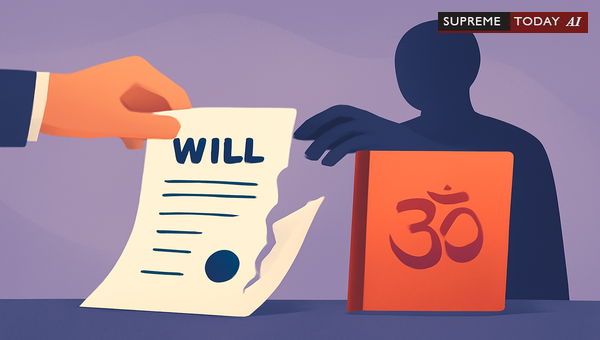
How to Cancel a Hindu Will in India: A Comprehensive Legal Guide
In the realm of and inheritance, wills serve as crucial documents outlining a person's wishes for after death. For Hindus in India, governed primarily by the , questions often arise about modifying or canceling these wills. If you've ever wondered, How a Hindu will can be canceled?, this guide breaks down the legal principles, methods, and court precedents. Note that this is general information and not specific legal advice—consult a qualified lawyer for your situation.
Wills are by nature, but revocation must follow strict legal formalities to ensure validity. Whether through personal acts or court intervention, understanding these processes can prevent disputes among heirs. Let's explore the key ways a Hindu will can be revoked or declared invalid.
Legal Principles for Revoking a Hindu Will
Under the , which applies to wills made by Hindus (with exceptions for certain tribals), revocation can occur through specific acts. outlines primary methods. Here's a detailed look:
1. Revocation by Marriage of the
Marriage automatically revokes a prior will unless the will explicitly states otherwise or is revoked by a later document. Under of the , a Hindu Will can be revoked upon the marriage of the , unless explicitly stated otherwise in the Will or unless the Will is revoked by a subsequent document or act 2021 0 Supreme(Kar) 921.
This protects new family members but requires clear intent in the original will to override.
2. Execution of a New Will or
The simplest way: draft a new will or (an amendment) that expressly or impliedly revokes the old one. It must be executed with the same formalities—signed by the and by two witnesses. A Will can be revoked if the executes a subsequent Will or a that expressly or implicitly revokes the previous Will, provided it is executed in the prescribed manner 2021 0 Supreme(Kar) 921.
3. Written Declaration
A formal written statement revoking the will, executed like a will itself (signed and witnessed), suffices. The may declare an intention to revoke the Will in writing, which must be executed with the same formalities as the original Will 2021 0 Supreme(Kar) 921.
4. Destruction with Intent
Physically destroy the will—by burning, tearing, or otherwise—in the 's presence or at their direction, with clear intent to revoke. The Will can be revoked by burning, tearing, or otherwise destroying it in the presence of the or by someone else at his direction, with the intention to revoke 2021 0 Supreme(Kar) 921.
These methods ensure the 's intent is unambiguous and documented.
Cancellation Through Court Proceedings
Not all revocations are self-initiated. Courts can declare a will invalid, effectively canceling it:
, , or : If proven, the will is . Challengers must provide evidence like witness testimonies or documents. If a Will is found to be procured by , , or , it can be challenged and potentially declared invalid or revoked by a court of law .
Formal Defects: Lack of proper attestation (two witnesses) or non-compliance with renders it invalid. A Will lacking proper attestation or executed contrary to statutory requirements can be invalidated, effectively canceling its legal effect .
In practice, scrutinize these during will validation.
Specific Circumstances Impacting Validity
Certain situations tied to identity or status can lead to challenges:
False Claims or Fraudulent Identity: Wills based on false caste or identity claims may be canceled if is proven. If a Will is based on false caste or identity claims, and such claims are proven to be fraudulent, the Will can be canceled or declared invalid, as seen in cases where employment or property rights obtained through false caste claims are canceled 2008 0 Supreme(Bom) 745. Relatedly, community certificates for Hindus have been canceled upon scrutiny, highlighting how identity affects legal documents 2024 Supreme(Online)(MAD) 12045.
Religious Conversion: Conversion doesn't automatically revoke a will, but it may challenge inheritance if the will assumed Hindu status. Conversion to another religion does not automatically revoke a Will but may affect inheritance rights. However, if the Will was made under the assumption of Hindu status, and the person ceases to be Hindu, the Will's validity may be challenged 2006 0 Supreme(Ker) 499 1928 0 Supreme(Mad) 267. Courts affirm that converts to Hinduism via rites can validly make wills: Courts have recognized that a person who converts to Hinduism and marries according to Hindu rites can validly execute a Will, and such Will remains valid if properly executed 1928 0 Supreme(Mad) 267.
Note: excludes Scheduled Tribes unless Hinduized pre-codification 2023 1 Supreme 652.
Judicial Precedents and Insights
Courts provide clarity:
- No automatic revocation by : The birth of a posthumous son does not revoke a Hindu Will unless explicitly provided by law or specific provisions, which are absent in the or related legislation 1906 0 Supreme(Mad) 32.
Other Hindu-related cancellations, like temple renovation permissions or land pattas, underscore procedural rigor: The 3rd respondent, by the order dated , canceled the permission granted to the petitioner for renovation, without any notice to the petitioner
. Such cases parallel will challenges, emphasizing notice and evidence 2022 Supreme(Online)(MAD) 7195.
Administrative cancellations of circulars or deeds due to errors further illustrate: permissions revoked post-review 2022 0 Supreme(Guj) 936 2025 Supreme(Online)(Mad) 69799.
Integrating Broader Contexts from Legal Sources
Hindu documents face cancellations for procedural lapses. For instance, land titles on temple land or community certificates have been revoked 2025 0 Supreme(Mad) 5165, mirroring will invalidations. Courts direct reconsideration in writs if lapses occur . Religious identity is protected; Hindu rites affirm status
.
Key Takeaways and Recommendations
- Primary Revocation Methods: Marriage, new will/, written declaration, or destruction—all under 2021 0 Supreme(Kar) 921.
- Court Challenges: , , or defects lead to invalidation .
- Special Cases: Fraudulent claims or conversion may impact validity but require proof 2008 0 Supreme(Bom) 745 2006 0 Supreme(Ker) 499.
- No Automatic Triggers: Like posthumous births 1906 0 Supreme(Mad) 32.
Summary: A Hindu will can typically be canceled through formal revocation acts or judicial declaration of invalidity due to , , or procedural defects. Always document intent clearly and seek probate advice.
Disclaimer: This article provides general insights based on legal principles and cases. Laws evolve, and outcomes depend on specifics. Consult a legal professional for personalized guidance.
#HinduWillRevocation, #CancelHinduWill, #IndianSuccessionLaw















