


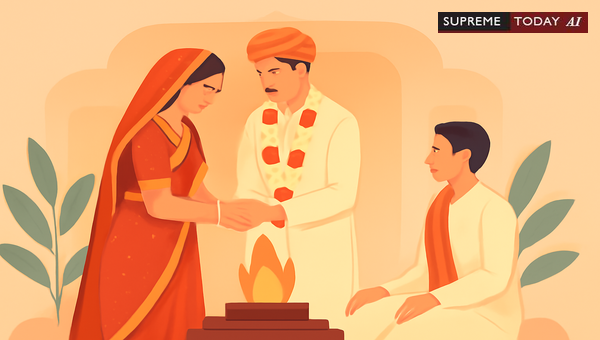
Is Marriage at Home Invalid in India? Legal Guide
In today's fast-paced world, many couples opt for intimate ceremonies at home rather than grand venues. But does the location make a marriage invalid? The question Marriage Held at Home is Invalid One often arises, sparking concerns about legal recognition, especially under Indian law. This blog post dives deep into the validity of home marriages, drawing from key legal principles, court precedents, and practical advice. Note: This is general information, not specific legal advice. Consult a qualified lawyer for your situation.
Understanding Marriage Validity Under Indian Law
The validity of a marriage in India primarily hinges on compliance with personal laws governing the parties involved. For Hindus, Buddhists, Jains, and Sikhs, the (HMA) sets the standard. A marriage isn't invalidated just because it's held at home—the key is proper .
Essential Ceremonies for Validity
Under , a Hindu marriage is valid only if solemnized according to and ceremonies. The has emphasized that (seven steps around the sacred fire) is the essential ceremony in most Hindu traditions. A valid Hindu marriage requires according to the provisions of the . This includes the performance of essential ceremonies, such as (the seven steps) 2017 0 Supreme(HP) 881 2008 0 Supreme(Mad) 3208.
- If these rites are performed at home with witnesses, family, and priests, the marriage holds legal weight.
- Mere exchange of garlands, rings, or vows without won't suffice in orthodox customs.
Customary practices also play a role. Marriages conducted according to customary practices, even if held at home, can be valid if they adhere to the essential ceremonies required by the applicable laws 1997 0 Supreme(HP) 270. For instance, tribal or regional customs might vary, but they must align with the HMA.
Role of Marriage Registration
A common myth is that unregistered marriages are invalid. Courts have clarified otherwise: registration is evidentiary, not a validity requirement.
- The omission to register a marriage does not render it invalid. The courts have repeatedly held that the validity of a marriage is not affected by the lack of registration 1984 0 Supreme(Ker) 263 1962 0 Supreme(MP) 107.
- Mere registration of a marriage without the necessary ceremonies does not confer legal status to the marriage 2008 0 Supreme(Mad) 3208.
The HMA's promotes registration for proof (e.g., visas, inheritance), but its absence doesn't the union. However, in contrast, under Malaysia's , an unregistered customary marriage post-1976 is : The court ruled that a customary marriage unregistered post the is , denying claims for spousal status and property
. This highlights why Indian couples should register proactively, even if not mandatory.
Fraud, Consent, and Other Grounds for Invalidity
Can fraud—like concealing pregnancy or prior relationships—invalidate a home marriage? Not automatically.
- A marriage may not be declared invalid solely on the grounds of fraud unless it can be shown that the fraud vitiated the consent necessary for a valid marriage 1926 0 Supreme(Nagpur) 81.
- In pregnancy cases: In cases where one party was pregnant at the time of marriage, the courts have indicated that such circumstances do not automatically invalidate the marriage unless fraud is established 1960 0 Supreme(Mad) 283.
Under HMA , marriages (e.g., due to impotence or fraud) require a petition within one year. But bigamy or prohibited relationships make it ab initio ().
Other sources echo consent's primacy. When consent to a marriage has been obtained by force or fraud, the marriage is invalid unless it is ratified 2020 0 Supreme(Cal) 386. In Muslim law contexts, interfaith marriages may be irregular (), not : Marriage of a Muslim with a Hindu woman – Neither a valid () nor a () marriage, but is merely an irregular () marriage. Son born of such irregular () marriage – Cannot be termed as 2019 1 Supreme 625. Children from such unions may inherit, unlike fully marriages.
Lessons from Court Cases
Indian courts prioritize substance over form. In a succession dispute, validity turned on ceremonies, not venue: If one marriage is held valid, which one is liable to be termed as invalid marriage? 2018 0 Supreme(Tri) 205. Evidence like photos, witness affidavits, or invitations from home weddings strengthens claims.
Conversely, incomplete rites doom cases. A desertion-linked fraud plea failed without proof: Therefore, he failed to establish the plea that by false representation and fraud, he had been given in marriage with respondent-wife. Under such circumstances, the marriage could not be held invalid or 2013 0 Supreme(Ori) 240.
Under Mohammedan law, technical flaws like missing witnesses create marriages: An invalid marriage ( marriage) is described as one which is not unlawful in itself, but unlawful 'for something else', as here the prohibition is temporary or relative, or when the invalidity arises from an accidental circumstance such as the absence of a witness 2019 1 Supreme 625 2007 0 Supreme(Ker) 479. This underscores ceremonies' universality.
Practical Tips for Home Marriages
To ensure validity:
- Perform Essential Rites: Invite a priest for or equivalent; document via video/photos.
- Gather Evidence: Affidavits from witnesses, invitation cards, and receipts.
- Register Promptly: Visit the Sub-Registrar within 30-90 days (state-specific).
- Address Fraud Risks: Full disclosure prevents future challenges.
- Special Laws Check: For Muslims/Christians, follow respective acts (e.g., for civil unions).
If disputes arise, courts presume validity from cohabitation and repute, but proof is key: the proof of a marriage so contracted arose, were not invalid by reason of the provisions...
.
Conclusion and Key Takeaways
A marriage held at home is not inherently invalid in India. Focus on essential ceremonies, not location. Registration aids proof, fraud needs substantiation, and customs matter. By adhering to these, couples can confidently tie the knot at home.
Key Takeaways:- Ceremonies > Venue: validates under HMA 2017 0 Supreme(HP) 881 2008 0 Supreme(Mad) 3208.- No Registration Panic: Optional for validity 1984 0 Supreme(Ker) 263 1962 0 Supreme(MP) 107.- Fraud Threshold High: Prove vitiated consent 1926 0 Supreme(Nagpur) 81.- Document Everything: Safeguard against challenges.
For personalized guidance, consult a family law expert. Stay informed, marry wisely!
References:- 1926 0 Supreme(Nagpur) 81 1984 0 Supreme(Ker) 263 1960 0 Supreme(Mad) 283 1997 0 Supreme(HP) 270 1962 0 Supreme(MP) 107 2008 0 Supreme(Mad) 3208 2017 0 Supreme(HP) 881
2020 0 Supreme(Cal) 386 2019 1 Supreme 625 2018 0 Supreme(Tri) 205 2013 0 Supreme(Ori) 240 2007 0 Supreme(Ker) 479 #HomeMarriage, #HinduMarriageAct, #MarriageValidity















