SupremeToday Landscape Ad

AI Overview

AI Overview...

  • Duty of Railway to Clean Platforms and Responsibility for Injuries - Main points and insights:
  • The railway's obligation to maintain clean and safe platforms is implied but not explicitly detailed in the provided documents. However, the general principle is that railway authorities are responsible for ensuring passenger safety, including platform conditions ["2024 Supreme(Online)(RCT) 1037"].
  • Several cases emphasize that the railway administration is liable for untoward incidents occurring on the premises, especially when negligence in maintenance or safety measures is established. For example, in cases where accidents happen due to unsafe conditions at unmanned level crossings, the railway can be held responsible if negligence is proved ["2023 Supreme(Online)(RCT) 554"], ["INDRCT00000055436"].
  • The responsibility extends to areas within the station that are accessible to passengers, such as platforms, foot over-bridges, lifts, and escalators. If an incident occurs due to failure to maintain these areas or due to negligence, the railway can be held liable ["2025 Supreme(Online)(RCT) 4"].
  • The courts have held that the railway's responsibility is particularly significant when accidents occur due to defective infrastructure or unsafe platform conditions, and negligence or failure to take adequate safety precautions can lead to liability ["2023 Supreme(Online)(RCT) 1008"].
  • In cases involving injuries or death, the railway's liability is often determined under Section 124A of the Railways Act, 1989, which states that the railway administration is responsible for untoward incidents in the course of working, regardless of wrongful act or default, unless it can be proven that the incident was due to external factors or the victim's own negligence ["2023 Supreme(Online)(RCT) 554"], ["2025 Supreme(Online)(RCT) 1280"].
  • The responsibility does not extend to incidents caused by external factors or when the injured or deceased was not in a designated or accessible area, or if the incident resulted from the victim's own negligence (e.g., crossing tracks improperly) ["2024 Supreme(Online)(RCT) 1037"], ["2023 Supreme(Online)(RCT) 554"].
  • The courts also recognize that safety measures, such as unmanned level crossings, require strict adherence to rules like Section 131 of the Motor Vehicle Act, which mandates drivers to stop at unguarded crossings to prevent accidents ["2023 Supreme(Online)(RCT) 554"].

  • Analysis and Conclusion:

  • The railway department has a duty to ensure platform cleanliness and safety, and failure to do so can result in liability if an injury occurs due to unsafe platform conditions.
  • The liability to clean platforms and prevent injuries is supported by legal principles that hold railway authorities responsible for maintaining safe environments, especially where negligence or unsafe conditions are proven.
  • However, liability is also contingent upon establishing negligence or breach of duty; incidents caused solely by passenger negligence or external factors may exempt the railway from liability.
  • In cases where injuries occur due to the railway's negligence—such as unsafe platform conditions, unmanned crossings, or defective infrastructure—the railway can be held responsible for damages and compensation ["2024 Supreme(Online)(RCT) 1037"], ["2023 Supreme(Online)(RCT) 1008"], ["2023 Supreme(Online)(RCT) 554"].
  • Overall, the legal framework underscores the railway's obligation to maintain safety and cleanliness of platforms and to prevent untoward incidents, with liability arising primarily from negligence or failure to uphold safety standards.

References:- ["2024 Supreme(Online)(RCT) 1037"]- ["2023 Supreme(Online)(RCT) 1008"]- ["2023 Supreme(Online)(RCT) 554"]- ["2025 Supreme(Online)(RCT) 4"]- ["2025 Supreme(Online)(RCT) 1280"]

Indian Railways Liability for Platform Injuries: Strict Liability and Compensation Rules

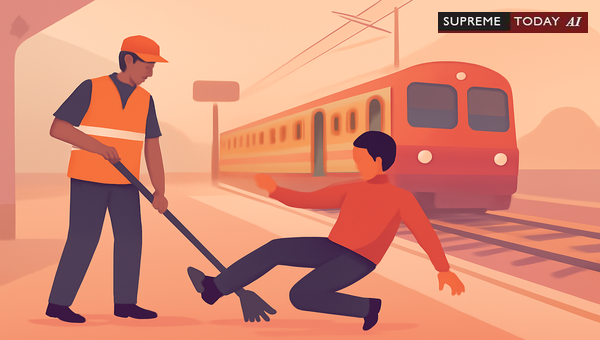
Railway's Duty to Clean Platforms: Are They Liable for Injuries?

Imagine hurrying across a crowded railway platform, only to slip on litter or debris and suffer a serious injury. Questions immediately arise: Does Indian Railways have a specific duty to keep platforms clean? If someone gets hurt due to unclean platforms, is the Railway Department responsible? These concerns are common for millions of daily commuters relying on India's vast rail network.

In this post, we delve into the legal framework governing the duty of railway to clean platforms and the Railway Department's responsibility for injuries. Drawing from the Indian Railways Act and key judicial precedents, we'll clarify the general obligations, liability rules, and practical implications. Note: This is general information based on legal sources and not specific legal advice—consult a qualified lawyer for your situation.

The General Duty of Railways to Ensure Platform Safety

While the Indian Railways Act, 1890, and its successor, the Railways Act, 1989, do not explicitly mandate cleaning platforms, the railway administration bears a general duty to ensure the safety of passengers and the public2011 0 Supreme(Raj) 1072 2003 0 Supreme(Raj) 20. This overarching responsibility implies reasonable precautions against hazards, which logically extends to maintaining clean and hazard-free platforms.

Key aspects include:- Preventing accidents through maintenance: Railways must take steps to avoid injuries, potentially encompassing regular cleaning to remove slippery substances, litter, or obstacles. 2003 0 Supreme(Raj) 20- Warning systems and precautions: This duty also covers adequate signage and measures at high-risk areas like level crossings, which parallels platform safety needs. 2003 0 Supreme(Raj) 20 2003 0 Supreme(Raj) 16

In practice, unclean platforms—cluttered with waste, water spills, or uneven surfaces—can constitute a breach if they foreseeably cause harm. Courts have emphasized that railways operate as a common carrier with heightened care obligations.

Strict Liability for Passenger Injuries: No Negligence Required

A cornerstone of railway law is the strict liability for injuries from untoward incidents. Under Section 124A of the Railways Act, 1989, the railway administration is liable for compensation to injured passengers, even without proven negligence2023 0 Supreme(SC) 528 1984 0 Supreme(SC) 222. Untoward incidents include accidental falls, which could occur on platforms.

  • Compensation limits: Liability is capped at a maximum of Rs. 50,000 per person for certain passenger train accidents 1984 0 Supreme(SC) 222. However, higher awards are possible in proven cases, as seen in appeals granting Rs. 8,00,000 2022 0 Supreme(Bom) 1961.
  • Burden on railways: The administration must prove exceptions, such as acts of God or that they exercised reasonable foresight and care 2007 0 Supreme(Raj) 2043.

For platform injuries, if a fall is deemed an untoward incident, victims may claim without fault attribution. One ruling states: the Railway Administration is strictly liable for compensation in cases of untoward incidents under Sec. 124-A of the Railways Act 2022 0 Supreme(Bom) 1961.

Insights from Key Cases on Railway Liability

Judicial precedents reinforce railways' responsibilities, though few directly address platform cleaning. Related cases illustrate broader duties:

  • Untoward incidents and falls: In a case involving a fatal fall from a train, courts upheld strict liability, noting ticket absence doesn't bar claims. The burden shifts to railways to disprove exceptions 2022 0 Supreme(Bom) 1961. The court awarded Rs. 8,00,000, emphasizing: the deceased's death fell within the definition of an untoward incident under Sec. 124-A 2022 0 Supreme(Bom) 1961.

  • Composite negligence at crossings: Incidents at unmanned level crossings highlight shared duties. In one, an auto got stuck on tracks, leading to deaths; courts apportioned 50% negligence to railways and driver, holding them jointly and severally liable2023 0 Supreme(AP) 181 2023 0 Supreme(AP) 172. Tribunal witnesses from railways failed to examine eyewitnesses, weakening their defense 2023 0 Supreme(AP) 181.

  • Medical care duty: Railways must treat injured passengers within precincts, reimbursing expenses: It is the duty of the railways to take every care to attend them medically and to provide every medical treatment till they are cured 2002 0 Supreme(Bom) 213.

  • Platform-specific incidents: A claim involving a fall on Mehsana station platform noted the applicant's failure to rule out self-fault, but underscored railways' duty to maintain records and safety 2024 Supreme(Online)(RCT) 446.

These cases show courts interpret safety duties broadly, potentially covering unclean platforms as negligence contributors.

Exceptions and Limitations to Railway Liability

Railways aren't absolute insurers. Liability may be excused if:- Proven act of God or passenger fault (e.g., intoxication) 2007 0 Supreme(Raj) 2043.- No untoward incident fits definitions under Section 123(c), like stone-throwing by outsiders, which isn't railways' fault 2002 0 Supreme(Bom) 213.- For goods, railways avoid liability by showing reasonable foresight and care, but this principle applies analogously to passengers 2004 0 Supreme(Mad) 180.

Interest on compensation runs from the award date, not filing, per Section 127 2002 0 Supreme(Bom) 213.

Claiming Compensation: Practical Steps

If injured on a platform:1. Report immediately to station authorities for medical aid.2. File with Railway Claims Tribunal under the 1987 Act.3. Gather evidence: photos, witnesses, medical records.4. Note strict liability eases proof burdens.

Specific cases demonstrate success even without direct negligence proof 1991 0 Supreme(SC) 130 1997 0 Supreme(Raj) 137.

Conclusion and Key Takeaways

Indian Railways holds a general duty to maintain safe platforms, impliedly including cleaning to prevent slips and falls 2011 0 Supreme(Raj) 1072 2003 0 Supreme(Raj) 20. For injuries, strict liability applies to untoward incidents, with compensation available even sans negligence, subject to caps and exceptions 2023 0 Supreme(SC) 528. Courts consistently prioritize passenger safety, as in level crossing and fall cases.

Key Takeaways:- Platforms must be reasonably safe; uncleanliness may breach duty.- Claim compensation via Tribunal—railways bear proof burdens.- Exceptions exist, but victims often prevail.

Stay vigilant on platforms, but know your rights. For personalized guidance, contact a legal expert familiar with railway laws.

This article references legal documents like 2003 0 Supreme(Raj) 20, 2023 0 Supreme(SC) 528, and others for informational purposes only.

#RailwayLiability, #PassengerSafety, #IndianRailways
Chat Download
Chat Print
Chat R ALL
Landmark
Strategy
Argument
Risk
Chat Voice Bottom Icon
Chat Sent Bottom Icon
SupremeToday Portrait Ad
logo-black

An indispensable Tool for Legal Professionals, Endorsed by Various High Court and Judicial Officers

Please visit our Training & Support
Center or Contact Us for assistance

qr

Scan Me!

India’s Legal research and Law Firm App, Download now!

For Daily Legal Updates, Join us on :

whatsapp-icon Back to top