


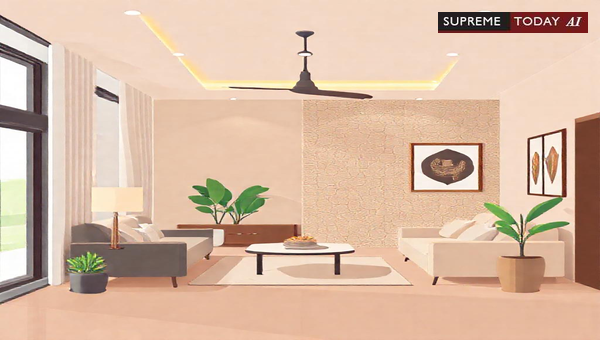
Interior Works in a Residential House and Their Classification as Artistic Works Under Section 2(c)
When a homeowner commissions a designer to craft bespoke furniture, sculptural panelling, murals, or handcrafted décor for a residence, a question often arises: can these interior works be protected as artistic works under the ? The answer is nuanced. The statute does not expressly mention interior works, but its definition of is broad enough that certain elements of a home's interiors may well qualify — while others may be pushed into the narrower, design-focused regime of the .
What Counts as an in Indian Copyright Law
defines expansively. It covers:
- a painting, a sculpture, a drawing (including a diagram, map, chart or plan), an engraving or a photograph — whether or not any such work possesses artistic quality2009 0 Supreme(SC) 107
- a work of architecture
- any other
Courts have repeatedly emphasized that the definition has a very wide connotation as it is not circumscribed by any limitation of the work possessing any artistic quality. Even an abstract work, such as a few lines or curves arbitrarily drawn, would qualify as an 2025 0 Supreme(SC) 628. The definition also reaches two-dimensional works such as drawings, paintings, photographs and engravings, as well as three-dimensional works like sculptures and models
Microfibres Inc. vs Girdhar & Co.
.Applying this framework, several categories of interior works in a residential house could potentially fall within Section 2(c):
- Original paintings and murals installed on walls
- Sculptural elements, reliefs, and installations
- Handcrafted or bespoke furniture exhibiting artistic craftsmanship
- Decorative panelling, screens, and ornamental elements that are original creations
- Interior design layouts and drawings, which may be protected as artistic works — courts have entertained disputes over interior design layouts between property owners and interior designers 2014 0 Supreme(Bom) 2537
However, originality remains a precondition under , which confines copyright to original literary, dramatic, musical and artistic works. Not everything in a home earns protection: purely functional articles — commercial hardware, electronic accessories, machine components — have been held not to constitute artistic or literary works at all 2026 0 Supreme(Guj) 1871. A minimal degree of creativity is also required to sustain a copyright claim 2020 0 Supreme(Mad) 2363.
The Copyright–Design Divide That Shapes Interior Works
The classification question cannot be answered in isolation from the . expressly excludes any as defined in Section 2(c) of the Copyright Act. As one judgment explains, if a party can bring its case within Section 2(c) of the Copyright Act, the suit for infringement of copyright is maintainable 2008 0 Supreme(Del) 1188.
The legislative intent is deliberate: greater protection is granted to pure original artistic works such as paintings and sculptures, and lesser protection to design activity that is commercial in nature 2025 0 Supreme(SC) 628. The emerging position stated by courts is that an , so long as it qualifies as one, continues to enjoy copyright in any form of reproduction — but when it is used as the basis for designing an article by application of an , it enjoys only the shorter design-protection period under 2018 0 Supreme(Guj) 747.
: The Fifty-Times Threshold
of the Copyright Act provides that copyright in any design capable of registration under the but not so registered, ceases as soon as any article to which the design has been applied is reproduced more than fifty times by an 2023 0 Supreme(Del) 446. For interior works, this matters greatly: mass-produced items such as patterned wallpapers, machine-made textiles, or commercially replicated décor elements may lose copyright protection if industrially reproduced beyond that threshold without design registration. Importantly, however, the operation of does not exclude the underlying itself from copyright protection
Microfibres Inc. vs Girdhar & Co.
.The from Cryogas
In , the Supreme Court addressed the copyright-versus-design conundrum through a two-pronged approach INDBOM000000159:
- vs Design Derivation — determine whether the work is purely an entitled to copyright, or a design derived from an for industrial application under .
- — if not copyrightable as a pure , ascertain whether the work's dominant purpose is functional or whether it possesses aesthetic appeal qualifying it for design protection INDBOM000000159.
The Court also held that classifying an article as either a design or an is a , requiring detailed examination at trial rather than dismissal at the threshold 2024 0 Supreme(Guj) 2046.
Practical Implications for Homeowners and Interior Designers
For works created within a residential house, the analysis typically turns on three factual questions:
- Originality — was the work independently created with a minimal degree of creativity?
- Nature of the work — is it a painting, sculpture, drawing, or , or is it a functional article with features applied to it?
- Mode of production — was it uniquely crafted for the residence, or industrially reproduced more than fifty times?
Unique, handcrafted interior works are more viably protected as artistic works under Section 2(c). Industrially produced items may instead require registration under the for continued protection. Practitioners should also preserve evidence of originality, authorship, and first ownership under , since mere registration of a trademark is insufficient to establish copyright ownership 2026 Supreme(Online)(Del) 21933, and even registration under the Copyright Act does not displace the burden of proving first ownership in disputes over the Register of Copyrights.
Key Takeaways
- Interior works in a residential house may qualify as artistic works under , if they are original and fall within categories such as paintings, sculptures, drawings, or works of artistic craftsmanship 2009 0 Supreme(SC) 107.
- The definition of is deliberately wide, and artistic quality is not a statutory requirement 2025 0 Supreme(SC) 628.
- Purely functional or mass-produced items risk being classified as designs under the , triggering the fifty-times industrial reproduction bar in 2023 0 Supreme(Del) 446.
- The Supreme Court's from the Cryogas decision — derivation analysis followed by the — offers the governing framework INDBOM000000159.
Whether a particular interior work qualifies as an is ultimately a fact-specific determination, and this general information may not apply to your specific circumstances — consulting a qualified intellectual property professional is advisable for any concrete dispute.
#CopyrightAct1957 #InteriorDesign #ArtisticWorks #DesignsAct #IntellectualProperty









