


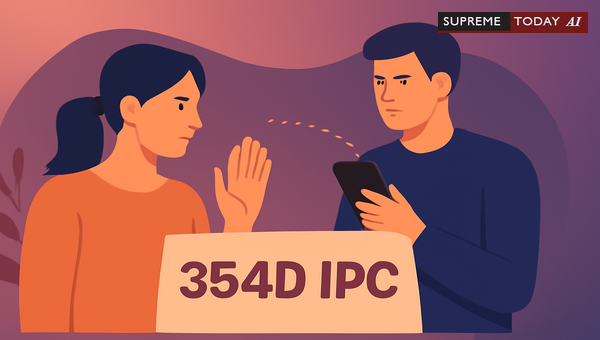
Understanding 'Repeatedly' in Section 354D IPC: A Guide to Laws
In today's digital age, —whether physical or online—has become a pressing concern, leading to significant emotional distress for victims. A key question often arises in legal proceedings: Define 'repeatedly' in Section 354D IPC. This provision, introduced under the , criminalizes by defining it as a man following a woman and contacting or attempting to contact her repeatedly to foster personal interaction, despite clear disinterest. But what exactly does repeatedly mean? This blog post breaks it down with judicial insights, legislative intent, and practical guidance. Note: This is general information and not specific legal advice. Consult a qualified lawyer for your situation.
What is ?
Section 354D IPC addresses , stating: whoever follows a person and contacts, or attempts to contact such person to foster personal interaction repeatedly, despite signals of disinterest. This targets persistent behavior aimed at personal interaction or harassment. The term repeatedly is pivotal, distinguishing isolated incidents from punishable patterns. Courts emphasize that the offense requires more than a one-off event to align with the law's goal of curbing ongoing harassment 2023 0 Supreme(Ker) 430.
As per legal documents, the offense involves repeated attempts or repeated conduct that causes fear or distress 2023 0 Supreme(Ker) 430. This interpretation prevents misuse for single disagreements while protecting victims from sustained pursuit.
The Core Meaning of 'Repeatedly' in Section 354D IPC
The word repeatedly in Section 354D IPC is understood to mean doing an act multiple times or on multiple occasions, indicating a pattern or frequency of contact or following, rather than a single instance. It signifies:
- Multiple acts over time: Contact or following on more than one occasion.
- A pattern of behavior: Demonstrating persistence despite disinterest.
- Alignment with legislative intent: To prevent ongoing harassment causing mental distress 2024 0 Supreme(Ker) 1536.
In essence, repeatedly refers to conduct occurring on more than one occasion, establishing a , distress, or alarm. Courts have clarified that allegations of a single incident or threats, without evidence of multiple acts, do not fulfill the criteria2023 0 Supreme(Ker) 430 2024 0 Supreme(Ker) 1536.
For instance, the prosecution must prove persistent acts despite clear disinterest, such as repeated calls, messages, or physical tailing intended to foster unwanted interaction 2023 0 Supreme(Ker) 430 2024 0 Supreme(Ker) 1078 2024 0 Supreme(Ker) 1536. Mere contact without this persistence falls short.
Judicial Perspectives on 'Repeatedly'
Indian courts have consistently interpreted repeatedly as requiring . In analyzed cases:
- Pattern over isolation: A single act, unless extremely egregious, typically does not qualify. Repeated acts show harassment patterns 2023 0 Supreme(Ker) 430.
- Intent matters: The conduct must aim to foster personal interaction or , with persistence key 2024 0 Supreme(Ker) 1078 2024 0 Supreme(Ker) 1536.
One ruling quotes Section 354D directly: 354D. . and stresses absence of disinterest as a factor, reinforcing that repeated contact despite signals constitutes the offense 2025 Supreme(Online)(Chh) 8145. Courts uphold convictions only where prosecution demonstrates this repetition, as in cases of ongoing following or messaging 2023 0 Supreme(Ker) 430.
Conversely, lack of proof for multiple instances leads to acquittal, underscoring repeatedly as a threshold ingredient 2024 0 Supreme(Ker) 1536.
Exceptions: When a Single Act Might Suffice
While repeatedly generally implies multiples, courts acknowledge rare exceptions. A single act may amount to if it is of such gravity or nature that it causes significant fear or distress, but this is not the rule2023 0 Supreme(Ker) 430. Such scenarios are exceptional, requiring overwhelming evidence of impact.
Integrating Broader Context from Related Cases
Though focused on 354D, insights from nearby provisions like (assault to ) highlight intent's role. For example, convictions under Section 354 demand proof of intent to , paralleling 354D's emphasis on persistent intent 2024 0 Supreme(Ker) 1325 2025 0 Supreme(Ker) 1383. However, 354D uniquely targets repetition in , distinguishing it from one-time assaults.
In -related matters, similar scrutiny applies, but 354D stands alone for adult with its repeatedly clause 2024 Supreme(Online)(MP) 858 2024 0 Supreme(MP) 640. These cases reinforce that without pattern evidence, charges fail.
The term also ties to public morality, as Sections 354 and 509 reference modesty without defining it explicitly, yet courts infer from context—much like repeatedly in 354D 2017 0 Supreme(Mad) 3482.
Practical Recommendations for Victims and Practitioners
To build a strong case under Section 354D:
- Gather evidence of multiples: Screenshots, call logs, witness statements showing pattern.
- Prove disinterest: Clear rejections followed by continued contact.
- Demonstrate intent: Link acts to fostering interaction or harassment.
Legal practitioners should highlight repeated conduct in arguments, while prosecutors substantiate patterns 2023 0 Supreme(Ker) 430 2024 0 Supreme(Ker) 1536. Victims: Report promptly, preserve digital trails.
Key Takeaways
- Repeatedly means multiple occasions forming a pattern, not singles.
- Essential for : Persistence despite disinterest 2023 0 Supreme(Ker) 430 2024 0 Supreme(Ker) 1536.
- Courts prioritize evidence; exceptions are rare.
- Introduced in to combat modern harassment forms.
Conclusion
Grasping repeatedly in Section 354D IPC empowers better navigation of claims. It protects against trivialization while ensuring genuine persistent threats are addressed. Stay informed, document thoroughly, and seek professional counsel. For evolving case law, monitor judicial updates.
Word count: 1028. References are from provided legal documents for illustrative purposes.
References
- 2023 0 Supreme(Ker) 430: Core explanation of repeatedly as multiple acts.
- 2024 0 Supreme(Ker) 1536: Need for repeated conduct.
- 2024 0 Supreme(Ker) 1078: Persistence despite disinterest.
- 2025 Supreme(Online)(Chh) 8145: Section 354D text and application.
















