
Searching Case Laws & Precedent on Legal Query..!
Scanned Judgements…!
Searching Case Laws & Precedent on Legal Query..!
Scanned Judgements…!
Sale Deed vs. Release Deed - A sale deed is a legal instrument that transfers ownership of property from one party to another, typically involving consideration (payment). In contrast, a release deed is a document where a party relinquishes or renounces their rights or claims over a property, often without transfer of ownership or consideration. The decisive factor is the nature of the transaction: sale deeds create rights of ownership, while release deeds involve renunciation of rights or claims ["2024 0 Supreme(Mad) 2426"], ["2022 0 Supreme(Guj) 1485"], ["2022 0 Supreme(AP) 394"].
Who Can Execute a Release Deed - Generally, a person holding rights or interest in a property, such as an owner, co-owner, or legal heir, can execute a release deed to relinquish their claim. For example, co-owners or tenants-in-common may execute a release deed to renounce their interest. Additionally, a person authorized through a Power of Attorney can execute a release deed if explicitly permitted; however, authority must be clearly specified in the POA ["2024 0 Supreme(Guj) 2085"], ["2025 0 Supreme(Ker) 2193"].
Legal Validity and Formalities - Release deeds can be executed with or without consideration and must be properly stamped and registered to be valid. They are distinguishable from sale deeds by their intent and the rights they create or relinquish. Improper or fraudulent execution, such as executing a release deed under coercion or without proper description of property, can render the deed invalid ["2024 0 Supreme(Mad) 2426"], ["2023 0 Supreme(Raj) 1982"], ["2023 0 Supreme(Mad) 991"].
Execution by Authorities and Legal Heirs - Government bodies like the Tamil Nadu Housing Board may execute sale deeds in favor of heirs of the original allottee, and such transactions are subject to legal procedures. In disputes, courts may cancel or set aside sale deeds if improperly executed or if they violate legal norms, and parties may seek re-conveyance through a re-sale or re-conveyance deed ["2024 0 Supreme(Mad) 2426"], ["2025 0 Supreme(Mad) 2824"].
Analysis and Conclusion:The primary difference between a sale deed and a release deed lies in their purpose: sale deeds transfer ownership, while release deeds relinquish rights without transfer of ownership. Both can be executed by the rightful owner, co-owners, or heirs, provided they have the authority and follow legal formalities. Proper registration and stamping are essential for validity. Understanding these distinctions helps in legal clarity, especially when dealing with property rights, inheritance, or settlement of disputes.
References:- 2024 0 Supreme(Mad) 2426, 2022 0 Supreme(Guj) 1485, 2022 0 Supreme(AP) 394, 2023 0 Supreme(P&H) 1731, 2025 0 Supreme(Mad) 2824, 2024 0 Supreme(AP) 1570, 2024 0 Supreme(Guj) 2085, 2023 0 Supreme(Raj) 1982, 2025 0 Supreme(Ker) 2193, 2023 0 Supreme(Mad) 991
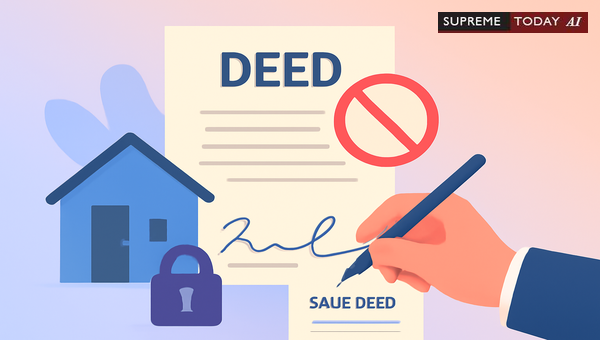
In the complex world of property transactions, questions often arise about what can be done with a property after it's been sold. A common query is: Are there legal restrictions on executing a gift deed for a property after it has been sold to someone else? This issue touches on fundamental principles of property ownership, deed types, and potential criminal implications like forgery.
Executing a gift deed—or any transfer document—after a valid sale can lead to serious legal challenges. Typically, once a property is sold via a sale deed, ownership transfers to the buyer, leaving the original owner without rights to gift or otherwise dispose of it. Attempting to do so may invalidate the new deed or expose parties to disputes. This post breaks down the key differences between relevant deed types, eligibility rules, and court insights to help you navigate these restrictions.
Understanding the distinction between a sale deed and a release deed is crucial, as misclassifying a transaction can have tax, stamp duty, and validity implications. These deeds serve different purposes and apply in different scenarios.
A gift deed, similar to a sale deed but without consideration, transfers absolute ownership gratuitously. After a sale deed, the original owner generally loses the right to execute a gift deed, as they no longer hold title.
Not everyone can execute a release deed. It requires a pre-existing interest:- A co-owner with a valid right in the property can release in favor of another co-owner or claimant. 1983 0 Supreme(All) 290 1972 0 Supreme(AP) 176- No conveyance deed is needed when releasing to a co-owner.- It can be without consideration, focusing on relinquishment. 1972 0 Supreme(AP) 176 2004 0 Supreme(Bom) 1214- Crucially, a person without an existing interest cannot execute a release deed to transfer a non-existent right. 2019 0 Supreme(Mad) 2894
Attempting a release (or gift) deed post-sale, without ownership, risks invalidation. Courts emphasize pre-existing rights for such instruments.
Post-sale gift deeds often stem from disputes over title. Courts distinguish between honest claims and fraudulent acts. For instance, There is a fundamental difference between a person executing a sale deed claiming that the property conveyed is his property, and a person executing a sale deed by impersonating the owner or falsely claiming to be authorised or empowered by the owner, to execute the deed on owner's behalf. 2022 0 Supreme(Raj) 1321 2018 0 Supreme(Guj) 1088 2016 0 Supreme(Pat) 1592
For gift deeds post-sale, if the executant lacks title, it may not be forgery if they claim it as theirs—but the deed remains invalid civilly. However, bad faith could invite criminal scrutiny. In one case, suspicious release deeds among co-owners were questioned when a joint sale deed could suffice, leading to remand for fact-finding. 2019 0 Supreme(Mad) 3386
Under laws like the Kerala Stamp Act, release deeds between specific relatives (e.g., grandchildren) may attract lower duties, but relationships must align precisely. Thus there should be relationship of 'grandchildren' in favour of both the persons... 2015 0 Supreme(Ker) 966
Generally, after a valid sale deed:- Ownership vests with the buyer; original seller cannot gift the property.- Any subsequent gift deed is typically void or challengeable.- Use release deeds only for pre-existing co-owner interests, not post-sale transfers.
Recommendations:- Verify pre-existing interest before drafting release deeds.- Distinguish transaction type for correct stamp duty and implications.- Prefer sale/conveyance deeds for ownership transfers; release for co-owner relinquishments.
Consult records, titles, and professionals to avoid pitfalls. Pending civil suits often resolve title disputes over criminal probes.
Executing a gift deed after selling property faces strict restrictions due to ownership transfer via sale deed. Release deeds offer a narrow exception for co-owners with prior rights but cannot circumvent sales. Missteps risk civil invalidity or, in fraud cases, criminal liability—though courts differentiate bona fide claims from impersonation.
Key Takeaways:- Sale deeds transfer ownership for consideration; release deeds relinquish existing interests. 2019 0 Supreme(HP) 1323- Only those with pre-existing rights can release; no new transfers post-sale.- Forgery requires impersonation, not mere ownership claims. 2022 0 Supreme(Raj) 1321- Always clarify deed type to avoid disputes.
This is general information based on legal precedents and not specific legal advice. Consult a qualified lawyer for your situation.
#GiftDeed #PropertyLaw #RealEstateLegal
We find, this problem is recurring in almost all cases where the Slum Clearance Board or the Tamil Nadu Housing Board execute a sale deed in favour of one of the heirs of the original allottee. ... On the said conclusion, the learned single Judge found that the treatment of the release deed as sale deed by the Registering Authority is unsustainable. Therefore, the Writ ....
Bheema Gowder[(1959) 2 MLJ 3247] the question was whether a covenant of further assurance should be enforced by directing the defendant to execute a release deed or a deed of conveyance, and the Court held that the defendant should execute a deed of conveyance. ... It would make no difference even where the release is without consideration. 22. ... It ....
possession of plaint schedule property with a stipulation to receive sale consideration of Rs.4,00,000/- within three months and execute registered sale deed which he failed due to that he filed suit for specific performance. ... The document dated 19.07.2009 containing the recital to execute another document having recital of delivery of possession which also mentioned in pleading by the respondent/plain....
The defendant had paid the same to her and she had to execute sale deed in his favour on 25.05.2000. ... He pleaded that as he was serving Border Security Forces and had to leave to join his duty at Jammu & Kashmir on 28.05.2000 and as stamp papers for execution of sale deed were not available, therefore, on the instructions of the plaintiff herself, instead of sale deed#HL_END....
2011 (2) CTC 1, once the sale deed is executed, it cannot be nullified by means of a cancellation deed even if both the parties agree to it, that the only way of reversing such a sale is to execute a document by re-conveying the property in favour of the original vendor ... ORDER : This writ petition has been filed seeking for the issuance of a Writ of Mandamus directing the first respondent to consider t....
Both the Writ Petitioners (Vendors and Vendee) have sought to execute the Sale Deed dated 02.03.2024 and register the same. ... When the sale deed was presented for registration, Respondent No.4 herein had refused to receive, register and release the Sale Deed presented by the Writ Petitioners on the ground that W.P.No.868 of 2024 is pending before the....
of rectification in Sale-deed is executed. ... Sale-deed and made his signature in presence of Witnesses confirming the same. ... The recital in the deed of release that the husband was clearly desirous of acceding to the request of his wife in view of the fact that nominal title under the sale deed stood solely in his name. 11. ... It was observed by ....
The present dispute pertains only to 2 bighas 11 biswas of land qua which the release deed was executed by the plaintiff in his favour and no proceedings for sale of any plots on the said land are being taken by him. ... The brief facts of the case are that a suit for cancellation of the release deed was preferred by plaintiff-Soni Devi being mother of the defendants. ... gift deeds in favour of her daugh....
(ii) Whether an attorney who is only authorized by the Power of Attorney deed to execute a partition deed can execute release deed relinquishing the right of the Principal donor and thereby can act against the interest of the Principal ? ... Later, in the year 2002, Smt.Santha Bai executed a sale deed in favour of Sri.A.A.Prakasan, the plaintiff in O.....
After demise of the father of the first plaintiff, there was dispute among the family members as such the fifth defendant was coerced and compelled to execute the release deed dated 29.01.1983 registered vide document No.6 of 1983 in respect of the suit schedule property. ... No schedule of property mentioned in the release deed, so as to register the sale deed at Pattu....
The first is that he bonafide believes that the property actually belongs to him. The relevant paras thereof are reproduced hereunder: "There is a fundamental difference between a person executing a sale deed claiming that the property conveyed is his property, and a person executing a sale deed by impersonating the owner or falsely claiming to be authorised or empowered by the owner, to execute the deed on owner's behalf. When a person executes a document conveying a propert....
When there was a decision to sell property to the First Defendant what is the necessity for the Defendants 2 to 6 to execute a Release Deed in favour of Sundaram when they all can jointly execute a Sale Deed. This fact also is not explained by the Respondents.
From the aforesaid decisions, it can be said that there is a fundamental difference between the person executing a sale deed claiming that the property conveyed is his property and a person executing a sale deed by impersonating the owner or falsely claiming to be authorised or empowered by the owner, to execute the deed on owner's behalf.
There is basic difference between a person executing a sale deed claiming that the property is his property and a person executing a sale deed by impersonating the owner or claiming to be authorized or empowered by the owner, to execute the deed on owner’s behalf. When a person executes a document conveying the property describing it as his, there are two possibilities. The first is that he bona fide believes that the property actually belongs to him.
Thus there should be relationship of "grandchildren" in favour of both the persons. Grandchildren has been mentioned in the context of relationship between the persons who execute the release deed and the person in whose favour release deed is executed.
Login now and unlock free premium legal research
Login to SupremeToday AI and access free legal analysis, AI highlights, and smart tools.
Login
now!
India’s Legal research and Law Firm App, Download now!
Copyright © 2023 Vikas Info Solution Pvt Ltd. All Rights Reserved.







