


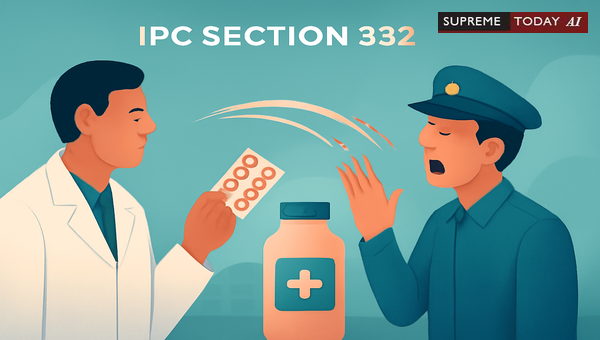
Does Throwing a Medicine Strip at a Government Hospital Pharmacist Violate ?
In the bustling corridors of government hospitals, interactions between patients (or visitors) and staff can sometimes escalate. But what happens when a simple act like throwing a medicine strip towards a pharmacist crosses into legal territory? This post dives deep into a pressing legal question: Whether entering into a Govt Hospital and throwing a medicine strip to the pharmacist will amount to Section 332 IPC.
We'll break down the relevant laws, analyze key provisions, and draw insights from judicial precedents and regulations. Whether you're a healthcare professional, a patient advocate, or simply curious about protections, this analysis provides clarity—note: this is general information, not specific legal advice. Consult a qualified lawyer for your situation.
Understanding : The Core Provision
Section 332 of the targets acts that to any person, intending to deter that person from performing their duty as a . Punishment can extend up to three years imprisonment, a fine, or both. Pharmacists in government hospitals qualify as public servants when dispensing medicines, making their role critical.
The question hinges on whether 'throwing a medicine strip' constitutes 'voluntarily causing hurt' with intent to disrupt duties. As per legal analysis, this could potentially amount to an offense under Section 332 IPC if it is established that the act was intended to deter the pharmacist from performing their duties and caused hurt2022 0 Supreme(Ker) 546. Context matters: Was it aggressive? Did it cause physical discomfort or fear? 2014 0 Supreme(Tri) 255
Key Elements Required for IPC 332 Conviction
- Voluntary Hurt: Any bodily pain, disease, or infirmity (). Throwing an object might qualify if it strikes or intimidates.
- Intent to Deter: Must prove the act aimed to hinder the pharmacist's duty, like proper dispensing.
- Status: Confirmed for govt hospital staff. 2014 0 Supreme(Tri) 255
The Role of Pharmacists: Protected Under Law
Pharmacists aren't just dispensers; they're medication experts responsible for interpreting prescriptions, ensuring safe supply, and monitoring patient health. The term 'dispensing' is defined in the as the interpretation, evaluation, supply, and implementation of a prescription, which includes delivering a drug to a patient in a suitable container2022 0 Supreme(Ker) 546.
, restricts dispensing to registered pharmacists only. Violations invite penalties, underscoring their protected professional standards. In government hospitals, this role is even more vital, as lapses can endanger public health.
Judicial emphasis reinforces this: Running hospitals/dispensaries in absence of any registered Pharmacist and/or running such hospitals by fake Pharmacist... will ultimately affect health of citizens2022 8 Supreme 702. Courts have quashed inaction by state pharmacy councils, remanding matters for detailed probes into fake pharmacists in govt facilities 2022 8 Supreme 702.
Only registered pharmacists are authorized to dispense medicines, and any contravention of this provision can lead to penalties under the Pharmacy Act2022 0 Supreme(Ker) 546. Disruptions, like aggressive patient behavior, directly threaten this duty.
Contextual Analysis: When Does Throwing Cross the Line?
Not every toss is criminal—context is king. The context in which the act occurs is crucial. If the act of throwing the medicine strip is perceived as an aggressive or disruptive action towards the pharmacist, it may support a charge under Section 332 IPC. However, if the act is seen as a non-threatening gesture, it may not meet the threshold for voluntarily causing hurt2014 0 Supreme(Tri) 255.
Consider similar scenarios:- In a Kerala case, throwing bleaching powder at a victim treated in a govt hospital led to charges under , highlighting how assaults on or near medical staff invoke protections 2024 Supreme(Online)(KER) 11878. PW1 was treated by one Dr.Praythiesh Bruce at the Govt.Hospital, Kalpetta... The other offences, namely, under Sections 224, 332 and 308 of the IPC2024 Supreme(Online)(KER) 11878.- Courts stress qualified dispensing: The dispensing of medicine will have to be carried out only by a qualified person, since a wrong dispensation of medicine or distribution of medicine by an unqualified person, in the absence of a qualified pharmacist2017 0 Supreme(Ker) 904.
Public interest litigations underscore govt hospitals' accountability. In Bihar, the Supreme Court intervened against fake pharmacists, noting State Government and cannot be permitted to play with health and life of citizens2022 8 Supreme 702. Such rulings elevate pharmacist duties, making interferences potentially prosecutable.
Factors Courts Consider
- Intent: Was it to hurry dispensing or express frustration disruptively?
- Manner: Forceful throw vs. casual hand-over.
- Impact: Did it cause hurt, fear, or duty hindrance? Witness statements are key.
- Pharmacist's Testimony: Stock availability, prescription handling 2020 0 Supreme(Guj) 219.
Broader Implications for Hospitals and Patients
Government hospitals often face manpower issues, like rotational postings or demands for pay parity with allopathic pharmacists
. Yet, protections remain robust. In selection disputes for drug inspectors, courts upheld processes emphasizing pharmacist expertise: A pharmacist has to learn the effects of the medicine as well as the ways in which medicine can be introduced into the body2023 0 Supreme(SC) 287.
Patient disputes, like wrong medicine due to illegible scripts, highlight tensions but affirm pharmacist gateskeeping
. The whole controversy... hinges on the point whether illegible writing of the doctor resulted in pharmacist issuing him medicine contrary to the one prescribed
.
Disciplinary cases against medical staff for delays in treatment further stress timely, protected dispensing 2020 0 Supreme(Guj) 219. Pharmacist Shri Nileshbhai A. Parekh has deposed that sufficient stock of medicine was available in the hospital2020 0 Supreme(Guj) 219.
Recommendations and Legal Strategy
- For Investigations: Gather witness statements, CCTV, and incident context to assess intent and hurt 2014 0 Supreme(Tri) 255.
- Defense Arguments: Lack of intent to cause hurt; argue it was a non-threatening gesture. Demand proof of 'voluntary hurt'.
- Prevention: Hospitals should train staff on reporting, use counters for safe interactions.
It is advisable to gather more context regarding the incident, including witness statements and the circumstances surrounding the act, to assess the intent and impact accurately2022 0 Supreme(Ker) 546.
Key Takeaways
- Throwing a medicine strip may invoke IPC 332 if aggressive and intent to deter is proven, protecting pharmacists as public servants.
- Pharmacist roles are strictly regulated; disruptions endanger public health 2022 8 Supreme 702.
- Courts prioritize evidence of hurt and context—typically requiring thorough probes.
- Always prioritize respectful communication in hospitals to avoid escalation.
This analysis guides understanding but isn't exhaustive. For case-specific advice, seek professional legal counsel. Stay informed, stay safe.
References: 2022 0 Supreme(Ker) 546 2014 0 Supreme(Tri) 255 2022 8 Supreme 702 2024 Supreme(Online)(KER) 11878 2017 0 Supreme(Ker) 904 2020 0 Supreme(Guj) 219
2023 0 Supreme(SC) 287 #IPC332, #HospitalLaw, #PharmacyLegal















