


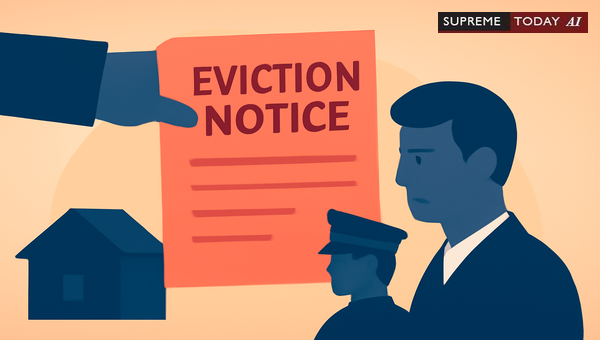
Can Courts Invalidate Eviction Notices ?
Imagine receiving an eviction notice that seems off—perhaps it skips mandatory details or ignores key statutory rules. As a tenant or property owner, you might wonder: does it matter if you didn't explicitly challenge its validity in your court filings? The answer lies in the courts' powerful ability to act (on their own motion), ensuring justice even when parties overlook procedural flaws.
This post dives into a specific legal query: Eviction of Trespasser. It explores whether an invalid eviction notice contravening statutory provisions can be deemed invalid by the court, even without an explicit plea in the written statement. Drawing from judicial precedents and related cases, we'll unpack the principles of , , and their application to eviction scenarios. Note: This is general information, not legal advice. Consult a qualified lawyer for your situation.
What Makes an Eviction Notice Invalid?
Eviction notices must strictly comply with statutory requirements, such as those under rent control acts, public premises laws, or specific provisions like , which may relate to fees for suits involving eviction of trespassers. Common defects include:
- Failure to specify grounds for eviction properly.
- Violation of mandatory procedural timelines or formats.
- Inherent flaws rendering the notice (from the beginning).
An eviction notice that is invalid and contravenes statutory provisions can be considered invalid even if the plea challenging its validity has not been explicitly raised in the written statement, provided that the defect is apparent from the notice itself and the principles of or statutory requirements are violated. Courts can take judicial note or act in such cases. 2021 0 Supreme(Ker) 322
For instance, if the notice misstates property details—like using an incorrect old number without clarity—it may still be scrutinized, as parties did not put forth the plea that the quit notices were invalid because the old number was wrongly shown as 'Old No.1606'. Yet, courts noted both numbers were indicated, highlighting how apparent defects invite review. 2024 Supreme(Online)(KAR) 22635
Courts' Powers: in Action
Indian courts possess inherent powers to examine fundamental violations independently of pleadings. This stems from the duty to uphold and statutory compliance. The law recognizes that violations of statutory provisions or principles of can be noticed by courts even if not specifically pleaded. 2022 0 Supreme(Telangana) 533
Key Principles
- Scrutiny: Courts can intervene when defects are apparent from the record, ensuring proceedings aren't tainted by illegality.
- : Implicit in every statute, breaches like lack of opportunity to be heard can be raised . In , the held that principles of are implicit in statutory rules and that the adjudicating authority must give full opportunity to the affected person. Violations here are noticeable even without pleadings. 2021 0 Supreme(Ker) 322
- : Fundamental errors going to the root of the jurisdiction render proceedings void. As in , such issues can be considered . 1973 0 Supreme(SC) 86
This power extends to eviction matters. In , the Supreme Court affirmed that writs challenging orders breaching are maintainable, with courts examining facts and law . 2022 0 Supreme(Telangana) 533
Landmark Precedents on Invalid Notices
Several cases illustrate this doctrine:
- 2021 0 Supreme(Ker) 322: Emphasized notice of violations apparent on record.
- 2022 0 Supreme(Telangana) 533: Courts can scrutinize administrative actions for procedural fairness independently.
- 2022 0 Supreme(Telangana) 533: Procedural lapses in notices under the invite challenge, especially for government-managed properties.
- : Procedural fundamentals affecting jurisdiction are voidable .
Related sources reinforce this. In trademark disputes, pleas of invalidity aren't restricted to written statement alone, as seen in Satish Kumar Jain (2023 SCC Online Delhi 424), where such challenges were entertained beyond initial pleadings. 2024 Supreme(Online)(MAD) 10260 Similarly, in eviction defenses, courts consider statutory compliance even if not pleaded upfront, provided the violation is evident. 2024 Supreme(Online)(Bom) 257
Integrating Pleas Beyond Written Statements
While ideal practice involves raising issues in the written statement, courts aren't bound by this. The plea taken with regard to the invalidity... can be taken through any form not restricted to written statement alone. 2024 Supreme(Online)(MAD) 10260 In eviction suits, defendants admitting tenancy but denying grounds may still benefit from review if notices are defective.
- Rajasthan
However, some cases stress timely pleas: In Nareshkumar-I, absent a written statement plea, certain government-related defenses weren't entertained. 2024 Supreme(Online)(Bom) 257 This underscores balance—courts prioritize substance over form for fundamental rights but expect diligence.
Other examples include refusals of rent tenders deemed invalid and time barred, where courts examined records beyond statements. 2025 Supreme(Online)(P&H) 7289 And in municipal eviction defenses, failure to plead repeal of old acts didn't bar consideration if apparent.
- Rajasthan
Practical Implications for Eviction Proceedings
For tenants facing eviction under laws like the for trespassers:- Document notice defects thoroughly.- Even without explicit pleas, courts may intervene if violations are glaring.
For landlords:- Ensure notices meticulously follow statutes to avoid invalidation.- Judicial admissions in pleadings can bind parties. 2024 Supreme(Online)(Bom) 6832
In public premises or rent-controlled properties, this power safeguards against arbitrary actions, as permits must be in force and not revoked or otherwise rendered invalid. 2025 Supreme(SRI)(CA) 321 2025 Supreme(SRI)(CA) 322
Key Takeaways
- Courts generally can invalidate eviction notices for apparent statutory or breaches, even sans written statement pleas.
- Precedents like Sohan Lal Singh2021 0 Supreme(Ker) 322 and Binapani Dei2022 0 Supreme(Telangana) 533 empower this oversight.
- Pleas of invalidity aren't confined to initial filings, promoting fairness. 2024 Supreme(Online)(MAD) 10260
- Always prioritize compliance to mitigate risks.
In conclusion, while procedural rigor matters, the judiciary's mantle ensures invalid eviction notices—especially under provisions like Section 7(VI)(a) of the —don't derail justice unchecked. This balances party diligence with systemic integrity. For personalized guidance, seek professional legal counsel.
#EvictionLaw #SuoMotu #LegalRights















