


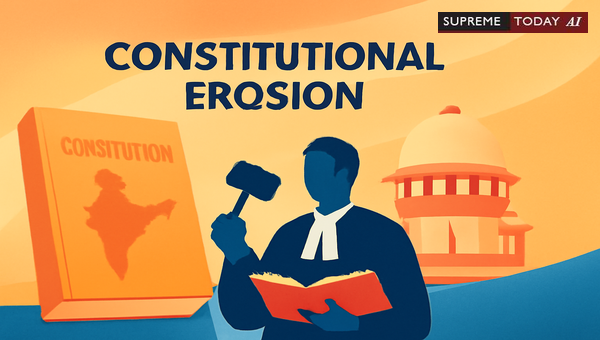
Understanding in India: A Threat to Democratic Balance
In the world's largest democracy, the Indian Constitution stands as a bedrock of governance, ensuring a delicate balance among the legislature, executive, and judiciary. Yet, the concept of —the gradual undermining of this framework—poses a significant risk. What exactly is ? It refers to actions that weaken core constitutional principles, such as the and , often through or other infringements on .
This blog delves into how judicial encroachment into legislative or executive domains can erode India's constitutional structure. Drawing from landmark judgments and related cases, we'll examine safeguards, risks, and broader implications, including erosion of individual dignity and environmental rights. Note: This is general information and not specific legal advice. Consult a qualified lawyer for personalized guidance.
The Core of : and
is a core component of the of the Constitution and cannot be abrogated or ousted by legislation or executive action 2014 7 Supreme 331. The doctrine of , established in the landmark case, limits Parliament's amendment powers to protect features like , , and the 2014 7 Supreme 331.
Any attempt to undermine these—such as by creating tribunals that replace constitutional courts—threatens the constitutional order 2014 7 Supreme 331. Courts have emphasized that and are part of the of the Constitution, and encroachment by courts through erodes this 2014 7 Supreme 331.
This erosion isn't abstract; it disrupts the balance essential for democracy. When the judiciary ventures beyond interpretation into law-making, it risks invalidating the constitutional mandate.
: The Cornerstone Under Threat
India's constitutional framework strongly safeguards the among its three organs 2009 7 Supreme 569. As held in , functions must remain within their spheres: legislatures enact laws, executives implement them, and courts interpret and review 2009 7 Supreme 569.
Encroachment, particularly —where courts issue orders creating or enforcing laws—is unconstitutional 2009 7 Supreme 569. The judgment warns that passing orders that amount to creating or enforcing laws () violates this doctrine 2009 7 Supreme 569. Courts cannot perform legislative functions, as doing so constitutes an unconstitutional erosion of the constitutional balance 2009 7 Supreme 569.
Key Risks of
- Policy Implementation: Directing executive actions, like in the case, amounts to overreach 2009 7 Supreme 569.
- Election Interventions: Court directives on procedures question judicial limits 2009 7 Supreme 569.
- Vishaka Guidelines: While addressing gaps, such judicial directives as law have been critiqued as overreach 2009 7 Supreme 569.
These examples highlight how activism, if unchecked, leads to erosion.
Broader Dimensions: Erosion of Rights and Environmental Safeguards
extends beyond institutional balance to . For instance, the erosion of individual dignity and choice is seen as a direct constitutional violation. The choice of an individual is an extricable part of dignity, for dignity cannot be thought of, where there is erosion of choice 2024 Supreme(Online)(J&K) 1791. Such rights, sanctioned by constitutional law, must be protected by courts as , preventing infringement by societal pressures
.
Environmental degradation exemplifies another facet. Excessive mining causing riverbed and road erosion undermines livelihoods and ecology. Infact the roads in the village chipaner are seen to have been undergoing erosion on the top most surface resultantly due to the excessive mining in the River Narmada
. The incorporated and , making environmental protection a constitutional right and duty, guarding against such erosion
.
Courts must vigilantly weigh these against constitutional touchstones, ensuring no hollowness enters the framework
.
Exceptions and Judicial Restraint
Courts may scrutinize actions for constitutionality but cannot legislate or policymake 2009 7 Supreme 569.
Limitations include:- No substitution of legislative judgment.- Interpretation, not creation, of laws—even for social issues 2009 7 Supreme 569.- Invalidity of orders resembling 2009 7 Supreme 569.
The independence of the judiciary, vital for the , demands restraint to avoid self-inflicted erosion 2014 7 Supreme 331.
Recommendations to Prevent Erosion
To maintain balance:- Courts should exercise restraint, avoiding legislative-like orders.- Confine to constitutional limits 2009 7 Supreme 569.- Defer policy to elected branches; courts as guardians only.- Refer constitutional matters to larger benches 2009 7 Supreme 569.
The case discusses the limits of , the prohibition of , and the importance of maintaining the constitutional balance among the organs of the State. It also highlights the importance of judicial restraint and the dangers of leading to 2009 7 Supreme 569.
Conclusion: Safeguarding India's Constitutional Integrity
, whether through , dignity infringements, or environmental neglect, jeopardizes democracy. By upholding and , India can prevent this. Key takeaways:- protects, but overreach erodes 2014 7 Supreme 331.- Rights to dignity and environment are constitutionally enshrined—erosion invites violation 2024 Supreme(Online)(J&K) 1791
.- Restraint ensures balance.
Stay informed on these evolving dynamics. For deeper insights, review referenced judgments.
References:- 2014 7 Supreme 331- 2009 7 Supreme 569- 2024 Supreme(Online)(J&K) 1791-
-
#ConstitutionalErosion, #JudicialReview, #SeparationOfPowers












