


KAAPA Sec 6(1) & 19: Prosecution Arguments Guide
Introduction
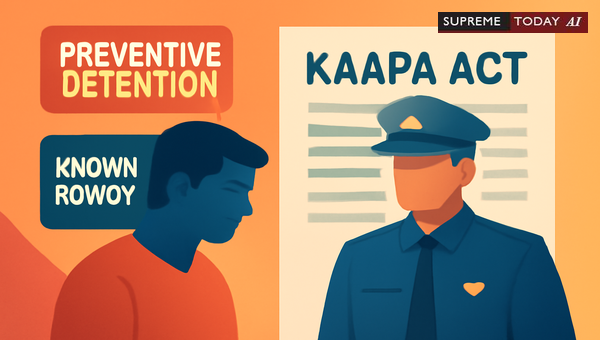
In , maintaining often requires tough measures against habitual offenders. The Anti-Social Activities (Prevention) Act, 2007 (KAAPA), empowers authorities to detain '' or '' preventively. A common legal question arises: What is the argument under Sec 6(1), 19 KAAPA Act in favour of prosecution? This blog delves into the prosecution's robust stance on validating detention orders under these sections, drawing from key provisions, judicial interpretations, and case precedents. While this provides general insights, it is not legal advice—consult a qualified lawyer for specific cases.
KAAPA balances individual rights with societal safety, allowing detention when a person's activities threaten public tranquility. Sections 6(1) and 19 play pivotal roles in procedural validity and , often contested in court. Prosecution typically succeeds by linking the detainee's history to ongoing risks. Let's break it down.
Key Legal Provisions of KAAPA
KAAPA's framework is preventive, not punitive. Here's a snapshot:
Section 3(1): Authorizes the or Commissioner to detain a 'known rowdy' if satisfied their acts prejudice . Importantly, it considers activities leading to classification, not just . 2010 0 Supreme(Ker) 590
Section 6(1): Mandates communicating detention grounds to the detainee, enabling representation. This ensures under . Delays here don't automatically vitiate orders if grounds are solid. 2009 0 Supreme(Ker) 839
Section 19: Empowers the government to frame rules for detention procedures, reviews, and implementation, reinforcing the Act's administrative backbone.
These sections interlink: Section 3 initiates detention, Section 6 handles communication and representation, and Section 19 supports overarching rules. Prosecution leverages them to uphold orders against challenges. 2022 Supreme(Online)(KER) 62039 notes, for invoking Sec.3(1), the respondent.... highlighting authority's belief in preventing prejudicial activities under Sec.2(a).
Prosecution's Core Arguments Under Sec 6(1) and 19
Prosecutors build a compelling case by emphasizing historical patterns over isolated incidents. Key arguments include:
Relevance of Prior Activities: Courts affirm that acts leading to 'known rowdy' classification under Sec.2(t) or 2(p)—like multiple pending cases—form valid grounds. The court has held that prior activities are relevant for establishing the required under . 2010 0 Supreme(Ker) 590
Nexus Between Past and Present Threat: Even without fresh crimes, a pattern justifies detention. The court has rejected the argument that only can be considered, emphasizing that prior actions contribute to the assessment of risk. 2010 0 Supreme(Ker) 590 For instance, cases like Chalakudy PS Cr.789/2008 u/s Sec.3 of KAAPA and Cr.127/2009 u/s 363, 393 IPC & Sec.27 of illustrate the criminal history bolstering classification. 2025 Supreme(Online)(KER) 7008
Sufficiency of Classification: Pending cases in serious offenses suffice for detention under Sec.3. The detenu's classification as a known rowdy is supported by multiple pending cases, which fall within the definitions provided in Section 2(t) and . 2010 0 Supreme(Ker) 1
Handling Delays in Representation: Under Sec.6(1), minor delays don't invalidate if based on credible info. While the detenu may argue delays in considering representations under , the prosecution can counter that any such delays do not invalidate the grounds for detention if the initial classification was justified. 2009 0 Supreme(Ker) 839
Additional cases reinforce this: Detention reports under Sec.3(1), like one dated from , lead to valid orders by . 2010 0 Supreme(Ker) 534 Procedural compliance, such as orders under Sec.3(3) and Sec.10(4), ensures continuity till expiry. 2010 0 Supreme(Ker) 553
Insights from Related Cases and Procedural Safeguards
Judicial scrutiny upholds prosecutions when criteria are met. Sec.6(1)(19)—often linked in arguments—focuses on preventive measures for per Sec.2(a). Detention under Sec.3(1) is justified by past offenses establishing rowdy/goonda status, even post-acquittal if pattern persists. 2022 0 Supreme(Ker) 1090 2022 0 Supreme(Ker) 904 2023 Supreme(Online)(KER) 24116
Safeguards include:- Communicating documents within 5 days (Sec.7(2)).- review (Sec.10), though advisory only. 2022 Supreme(Online)(KER) 17554
Offenses under Sec.2(t) exclude some like POCSO unless notified, narrowing but not nullifying grounds. 2022 0 Supreme(Ker) 1090
Real-world examples: Kuruppampadi PS Crime No.885/2020 u/s 212,468,471,307,34 IPC & Sec.3(a) shows the breadth of qualifying acts. 2021 Supreme(Online)(KER) 40155 Representations to Advisory Boards, like dated , are considered but don't override strong grounds. 2021 Supreme(Online)(KER) 40155
Prosecution often cites initiation via police reports, as in proceedings by 3rd respondent on 's input. 2010 0 Supreme(Ker) 534
Counterarguments and Rebuttals
Defense may claim no recent activities or procedural lapses. Prosecution rebuts:- Historical offenses suffice for '.'- Acquittals don't erase patterns; preventive focus prevails. 2024 Supreme(Online)(KER) 18485
Courts reject narrow post-classification limits, prioritizing .
Conclusion and Key Takeaways
Prosecution under Sec 6(1) and 19 KAAPA thrives on proving prior anti-social patterns justify detention, backed by Sec.3(1) satisfaction. Courts reinforce this, as in 2010 0 Supreme(Ker) 590 2010 0 Supreme(Ker) 1 2009 0 Supreme(Ker) 839, ensuring procedural adherence balances liberty and safety.
Key Takeaways:- Prior crimes classify and ground detention.- Delays rarely vitiate if substantive merits hold.- Prepare evidence of patterns and anticipate representation challenges.
This analysis draws from precedents; outcomes vary. For tailored advice, seek professional counsel. Stay informed on KAAPA evolutions for advocacy.
References:2010 0 Supreme(Ker) 590 2010 0 Supreme(Ker) 1 2009 0 Supreme(Ker) 839 2025 Supreme(Online)(KER) 7008 2022 Supreme(Online)(KER) 62039 2021 Supreme(Online)(KER) 40155 2010 0 Supreme(Ker) 553 2010 0 Supreme(Ker) 534 2022 0 Supreme(Ker) 1090 2022 0 Supreme(Ker) 904
#KAAPAAct, #PreventiveDetention, #KeralaLaw












