


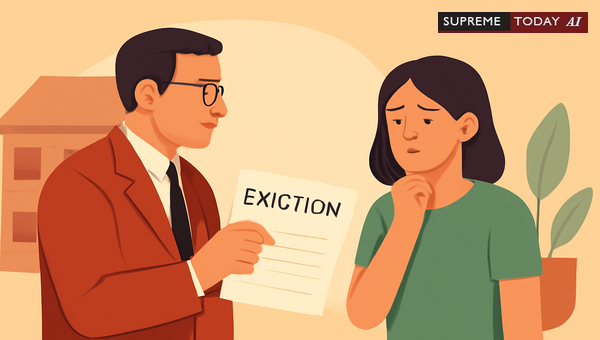
Tenant Eviction: Why Landlords Must Prove Grounds with Solid Evidence
Introduction
Can a tenant be evicted if the landlord doesn't establish a ground with proper evidence? This question strikes at the heart of tenant protections under rent control laws in India, particularly in states like Tamil Nadu. Eviction isn't a landlord's whim—it's a legal process demanding genuine need backed by credible proof. Failing this, courts typically deny eviction petitions, safeguarding tenants from arbitrary actions.
In this post, we explore the legal criteria landlords must meet, drawing from statutory provisions, judicial precedents, and key case analyses. Whether you're a tenant facing eviction or a landlord seeking possession, understanding these rules is crucial. Note: This is general information, not specific legal advice—consult a qualified lawyer for your situation.
Understanding Grounds for Eviction
A reason means a genuine, honest, and sincere need for eviction, free from pretext or malice. Courts rigorously examine the landlord's motives to ensure fairness. Without this, eviction claims collapse.
Key Statutory Framework
Under the :- : Covers in rent payment.- : Allows eviction for the landlord's own occupation if .- : Permits use for landlord's business or residence with proof of need.- : Empowers tenants to challenge claims. 2025 0 Supreme(Mad) 4680
Similar protections exist in other laws, like the , where eviction requires established grounds such as non-payment or necessity. 2024 0 Supreme(P&H) 1377
Judicial Principles: What Courts Demand
Courts emphasize that landlords bear the . Mere assertions won't suffice—evidence must convince of genuine necessity.
Proving Requirement for Own Occupation
In one case, the court held that even if the eviction provisions are cited incorrectly, a landlord’s claim for need for their own occupation should prevail if supported by credible evidence. 2025 0 Supreme(Mad) 4680 Key factors include:- Absence of other commercial properties nearby.- Landlord's business or residence needs.- Mere rent hike demands don't negate claims.
Another ruling clarified: tenant challenges like partial vacating don't override proven need—the tenant can't dictate property use. 2021 0 Supreme(Mad) 1029
Handling Denial of
Tenants sometimes deny the relationship, claiming loans or permissive use. Courts test if this denial is .
The court examined whether the tenant’s denial of was . It was held that a false or ... warrants eviction. 2025 0 Supreme(Mad) 4318
In a Punjab case, evidence in rebuttal was allowed when tenants alleged forgery of rent notes, affirming the landlord's right to counter such claims. 2024 0 Supreme(P&H) 1377 Similarly, under Tamil Nadu law, title denial leads to eviction, with landlords proving ownership via documents like Ex.P2. 2015 0 Supreme(Mad) 63
A related judgment stressed: The landlords have not established and even if the tenant could not establish his right, the Rent Controller cannot hold that the respondent is a tenant. Yet, denial scrutiny and under , apply. 2015 0 Supreme(Mad) 63 2013 0 Supreme(UK) 568
Evidence Required to Support Claims
Landlords typically need:- Proof of ownership/title: Documents like deeds or attornment letters. 2019 0 Supreme(Mad) 3328- Actual need demonstration: Business expansion, family residence.- No alternatives: Lack of suitable properties.- Consistency: Claims matching property nature.- Honesty: No malice or harassment.
In cases, courts examine conduct: The respondent's conduct amounted to wilful default. Surrender of prior possession must be established. 2019 0 Supreme(Mad) 3328
Limitations and Tenant Defenses
- Insufficient evidence: Bare claims fail. 2025 0 Supreme(Mad) 4680
- : Justifies eviction, unlike genuine disputes. 2025 0 Supreme(Mad) 4318
- Alternative arrangements: Tenant suggestions don't bind if landlord's need holds. 2021 0 Supreme(Mad) 1029
Under , alone can ground eviction, but only with proof. 2005 0 Supreme(All) 636
Landlords choose which premises to reclaim: ... is of the landlord and it is the choice of the landlord where he will reside. Tenants can't demand eviction of others first. 2004 0 Supreme(Cal) 313
Case Law Highlights
| Case ID | Key Holding ||---------|-------------|| 2025 0 Supreme(Mad) 4680 | Incorrect provision citation doesn't bar claim if evidenced. || 2025 0 Supreme(Mad) 4318 | Dishonest relationship denial warrants eviction. || 2021 0 Supreme(Mad) 1029 | Tenant can't negate need via partial use challenges. || 2024 0 Supreme(P&H) 1377 | Rebuttal evidence allowed on reframed issues like forgery. || 2015 0 Supreme(Mad) 63 | Burden on landlords for title; non- denial vulnerable. |
These precedents underscore evidence's primacy.
Summary of Criteria for Successful Eviction
To evict, landlords generally must prove:1. Genuine need: Own use or business. 2025 0 Supreme(Mad) 46802. Valid title: Documents. 2015 0 Supreme(Mad) 633. No ulterior motives: Free of harassment.4. Strong evidence: Alternatives absent, claims consistent.5. Honest facts: Especially against denials. 2025 0 Supreme(Mad) 4318
Conclusion and Key Takeaways
Eviction hinges on landlords establishing grounds with irrefutable evidence. Courts protect tenants from sham claims, as seen in Tamil Nadu and other rent acts. Tenants: Challenge weak petitions. Landlords: Gather robust proof early.
Key Takeaways:- means genuine, proven need.- Evidence trumps assertions.- Denials must be honest or risk eviction.- Consult professionals—laws vary by state.
Stay informed, protect rights. Share if helpful!
Sources: 2025 0 Supreme(Mad) 4318 2025 0 Supreme(Mad) 4680 2021 0 Supreme(Mad) 1029 2024 0 Supreme(P&H) 1377 2019 0 Supreme(Mad) 3328 2015 0 Supreme(Mad) 63 2013 0 Supreme(UK) 568 2005 0 Supreme(All) 636 2004 0 Supreme(Cal) 313
#TenantEviction, #BonaFideGrounds, #RentControlLaw












