


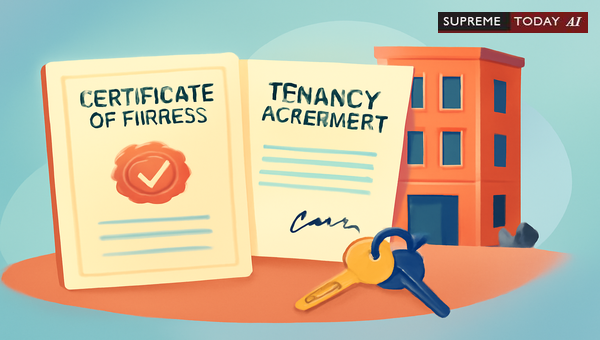
Can a Landlord Enforce a Without a ?
In the world of renting, few issues spark as much debate as the validity of a when the premises lack a (also known as an ). Imagine signing a lease for a commercial space, only to later discover it doesn't have this essential certification—and you knew about it upfront. Can a landlord still enforce the against such a tenant?
This question arises frequently in landlord-tenant disputes, particularly in jurisdictions like India where building regulations play a crucial role. While local laws vary, we'll dive into key legal principles, court documents, and precedents to provide clarity. Note: This is general information based on analyzed cases and should not be taken as specific legal advice—consult a qualified attorney for your situation.
Understanding the
A certifies that a building complies with safety, health, and structural standards, making it fit for occupation. It's typically required for commercial premises under municipal laws like those in Mumbai or other Indian cities. Without it, premises may face penalties, but does this invalidate the itself?
The core issue: Does the absence of this certificate render the lease unenforceable, especially if the tenant was aware?
Legal Enforceability of Tenancy Agreements
Primary Legal Principles from Key Documents
Analysis of relevant court documents reveals that tenancy agreements are generally enforceable based on and , not necessarily on certification status. For instance, the document 2011 0 Supreme(Ori) 616 clarifies that can be used as evidence for and that after expiry, no notice is required to terminate the lease. Continuing post-expiry creates a , who can be evicted without prior notice. 2011 0 Supreme(Ori) 616
This suggests enforceability hinges on the agreement's validity and rather than ancillary certificates. Similarly, 1997 1 Supreme 324 discusses leasehold rights, transfers, and bequeathments, noting that may be , but the landlord is not bound by , and transfers must align with policy. It emphasizes the object of is to provide residence, subject to , without mandating a . 1997 1 Supreme 324
Key takeaway: Neither document explicitly requires a for enforceability. 1997 1 Supreme 324 2011 0 Supreme(Ori) 616
Insights from Additional Precedents
Expanding beyond the core documents, other cases reinforce this view. In
, the court upheld that the explicit terms of the are binding, dismissing claims for extension due to non-compliance with timelines. This Malaysian case stresses that parties are bound by clear contractual language, regardless of external factors like certifications, as long as the agreement stands.
Likewise,
involved a tenancy where landlord works, including aspects tied to a , were preconditions. The court struck out a premature rent claim because all stipulated conditions for rent commencement must be fulfilled. However, this highlights interpretation of contract terms rather than outright invalidation due to missing certificates.
In Indian contexts,
notes that landlord-tenant disputes regulate relationships with a public purpose, but do not tie enforceability directly to or certificates.
These sources collectively indicate that while certifications matter for compliance, they do not automatically void tenancy agreements.
Detailed Analysis: When Does Absence Matter?
Contractual vs. Statutory Requirements
Under general Indian law (e.g., ), a is a contract. Its enforceability depends on , , , and . The absence of a might building bylaws, but unless the lease explicitly conditions validity on it, the agreement typically holds—especially if the tenant knew and proceeded. 2011 0 Supreme(Ori) 616
considerations from 1997 1 Supreme 324 suggest regulations (potentially including certificates) apply to transfers, but in the absence of specific restrictions, the leasehold interest remains valid. 1997 1 Supreme 324
Tenant Knowledge and
If the tenant knew of the missing certificate yet signed and occupied, principles of may prevent them from challenging enforceability. Courts prioritize the parties' intent and over post-hoc regulatory complaints.
Exceptions and Limitations
While generally enforceable, exceptions exist:- Local Laws: Municipal corporations (e.g., in Mumbai) may deem uncertified premises illegal, potentially affecting commercial tenancies.- Commercial vs. Residential: Stricter for commercial spaces.
- Specific Clauses: If the lease mandates the certificate, non-compliance could be a .- Health/Safety Risks: Courts may intervene if occupancy endangers public safety.
Vehicle-related cases (e.g., 2017 0 Supreme(Ker) 819, 2015 0 Supreme(Ker) 1070) analogize that missing fitness certificates invalidate operations there, but premises law differs—focusing on contract over operation bans. 2017 0 Supreme(Ker) 819 2015 0 Supreme(Ker) 1070
Practical Implications for Landlords and Tenants
- Landlords: Enforce via suits post-expiry; use unregistered agreements as evidence. 2011 0 Supreme(Ori) 616
- Tenants: Awareness doesn't waive rights, but challenging on certification alone may fail.
- Risk Mitigation: Obtain certificates proactively to avoid fines or disputes.
Recommendations
- Verify Local Regulations: Check municipal rules for your area.
- Include Clauses: Specify certification responsibilities in leases.
- Seek Compliance: Even if not required for enforceability, certifications protect against liabilities.
- Professional Advice: Engage lawyers for tailored guidance.
Conclusion and Key Takeaways
Based on the analyzed documents, a landlord can typically enforce a without a , even against a knowing tenant, as enforceability rests on contract and . 1997 1 Supreme 324 2011 0 Supreme(Ori) 616
Key Takeaways:- Unregistered leases serve as collateral evidence. 2011 0 Supreme(Ori) 616- Explicit terms bind parties.
- Conditions must be met for claims like rent.
- Always prioritize compliance for safety and legality.
This analysis draws strictly from provided sources. Laws evolve—stay informed and consult experts.
References:1. 1997 1 Supreme 3242. 2011 0 Supreme(Ori) 6163.
4.
5.
#TenancyLaw #LandlordRights #FitnessCertificate















