


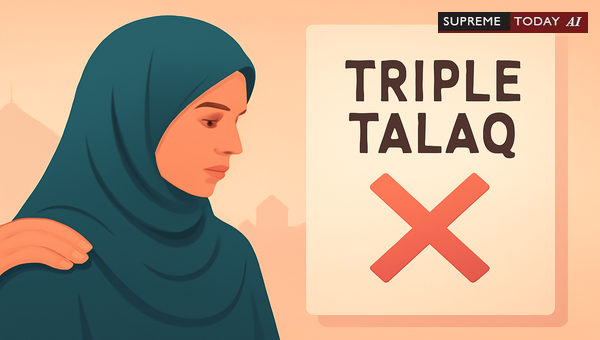
Is Valid in India? Verdict Explained
Disclaimer: This blog post provides general information on the legal status of based on landmark judgments and statutes. It is not legal advice. Consult a qualified lawyer for advice specific to your situation.
In the realm of Muslim personal law in India, few issues have sparked as much debate as , also known as . This practice, where a husband pronounces talaq three times in one sitting to instantly and irrevocably end a marriage, has long been controversial. But whether is valid now? The resounding answer from Indian courts and legislation is no—it's and .
This post dives deep into the evolution of this ruling, key judgments like , the , and insights from subsequent cases. We'll explore why was struck down, what constitutes valid talaq, and the protections now available to Muslim women.
The Landmark Shift: 's Ruling in Shayara Bano
The turning point came in with the 's judgment in 2012 7 Supreme 683. A five-judge bench, by a 3:2 majority, declared instant . The Court held that , involving pronouncing talaq thrice in a single sitting, is manifestly arbitrary and violates (equality), 15 (non-discrimination), and 21 (right to life and dignity) of the Indian Constitution 2012 7 Supreme 683
01500061422
.The majority observed: The practice of is bad in theology... instant and irrevocable, it is obvious that any attempt at reconciliation is ruled out. 2012 7 Supreme 683. This arbitrary power vested solely in the husband, without safeguards like reconciliation attempts, was deemed against 2012 7 Supreme 683.
Prior to this, the , had recognized , but the Court set it aside, emphasizing that must align with 2012 7 Supreme 683.
Forms of Talaq Under Islamic Law: Valid vs. Invalid
Islamic law recognizes three main forms of talaq, but not all are equal under Indian scrutiny:
- : Most approved form—one pronouncement during wife's (non-menstrual period), followed by (waiting period) for reconciliation. Revocable during 2025 0 Supreme(Ker) 112
01500061422
. - : Three pronouncements over three successive tuhrs, revocable after first two 2017 5 Supreme 577.
- (): Instant triple pronouncement in one sitting—irrevocable and arbitrary, now invalid 2025 0 Supreme(Ker) 112.
The Court stressed that valid talaq requires attempts at reconciliation and non-instantaneous pronouncement, which blatantly violates 2012 7 Supreme 683
01500061422
. As noted in judicial analysis, , pronounced instantaneously and irrevocably, lacks these safeguards 2025 0 Supreme(Ker) 112.The Legislation: Criminalizing
Building on Shayara Bano, Parliament enacted the . declares void and . Pronouncing it is punishable with up to three years' imprisonment and a fine 2025 0 Supreme(Ker) 112.
This Act operates , as affirmed in cases like the ruling where a plaint seeking validation of a was rejected. The Court held: is void and under the , and the 's judgment in , which declared , operates (from case summary in 2023 Supreme(Online)(AP) 28682).
Insights from Subsequent Judgments
Post- rulings reinforce this stance:
- In a case, the Apex Court was cited as holding is against the basic tenets of Quran... The practise of - was set aside
S.W.AABITH BASHA vs ZEENATHUNNISA - Supreme(Online)(MAD) 47961
. - distinguished valid single talaq: The court upheld the validity of a single talaq pronouncement despite the term 'irrevocably', citing fulfillment of reconciliation attempts 2021 Supreme(Online)(Ker) 59391 2021 Supreme(Online)(KER) 25466. Here, evidence of reconciliation made it akin to , and the wife was awarded maintenance under and the 1986 Act.
- Another Kerala ruling emphasized: A single pronouncement of talaq can be valid under Islamic law if reconciliation attempts are documented, and its 'irrevocability' does not preclude retraction during the permissible period 2021 Supreme(Online)(KER) 25466.
These cases highlight that while is banned, other forms remain valid if procedural safeguards are followed. Courts also uphold divorced Muslim women's under secular laws like 2021 Supreme(Online)(Ker) 59391.
Implications for Muslim Women and Society
The rulings empower Muslim women by curbing unilateral, instant divorces. In Shayara Bano, the Court noted 's impact: leaving women destitute without recourse 2012 7 Supreme 683. The Act provides and custody rights, ensuring dignity.
However, challenges persist, like enforcement and social acceptance. Recent cases show courts rejecting suits based on , directing rejection under if barred by law (e.g., in 2023 Supreme(Online)(AP) 28682).
Key Takeaways
- is invalid: Declared in Shayara Bano2012 7 Supreme 683 and criminalized by the Act 2025 0 Supreme(Ker) 112.
- Valid alternatives exist: and Hasan, with reconciliation periods 2017 5 Supreme 577
01500061422
. - Retrospective effect: Applies to past pronouncements 2023 Supreme(Online)(AP) 28682.
- Women's rights protected: Maintenance under CrPC and special Acts 2021 Supreme(Online)(Ker) 59391.
In summary, Indian law has firmly rejected the arbitrariness of , aligning Muslim personal law with constitutional values. For those navigating marital issues, understanding these distinctions is crucial—always seek professional legal counsel.
References:1. 2012 7 Supreme 683: Shayara Bano judgment.2. 2025 0 Supreme(Ker) 112: Modes of talaq and Act.3.
01500061422
: Arbitrariness of .4. 2017 5 Supreme 577: Forms of talaq.5.S.W.AABITH BASHA vs ZEENATHUNNISA - Supreme(Online)(MAD) 47961
, 2023 Supreme(Online)(AP) 28682, 2021 Supreme(Online)(Ker) 59391, 2021 Supreme(Online)(KER) 25466: Supporting cases. #TripleTalaq, #ShayaraBano, #MuslimDivorce












