


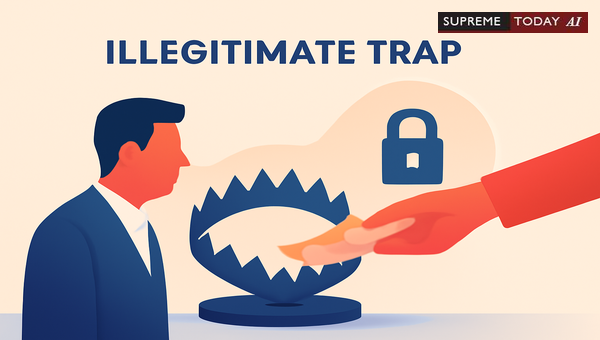
Understanding Illegitimate Traps in Corruption Cases
In the fight against corruption in India, trap operations play a crucial role. These are sting-like procedures where authorities catch public servants red-handed accepting bribes. But not all traps are created equal. The concept of an —often called a 'fishing' or ''—raises serious legal questions. What exactly is an , and why can it derail a prosecution?
This blog dives deep into the legal nuances, drawing from court judgments and statutory provisions. Whether you're a public servant, a complainant, or simply interested in anti-corruption law, understanding this distinction is vital. Note: This is general information and not specific legal advice. Consult a qualified lawyer for your situation.
What is an ?
The term '' isn't statutorily defined but emerges from judicial interpretations in corruption cases under the (). It refers to that lack prior credible evidence of demand for a bribe, resembling a fishing expedition rather than a response to a genuine complaint.
Courts have consistently held that while traps are necessary to detect hidden crimes, they must be conducted fairly. An might involve tempting an official without a prior demand, motivated by suspicion alone or ulterior motives. As one judgment notes: While one may not conclude that laying such a trap which can be called as ‘illegitimate’ or ‘’ by itself may result in acquittal of an accused... the evidence obtained by laying such a trap, is always considered to be extremely vulnerable and expected to be viewed with extreme caution. 2015 0 Supreme(Bom) 2531
In contrast, legitimate traps are based on a specific complaint where the accused has already demanded a bribe. Here, the complainant reports to authorities, who then arrange witnesses for the payment. This is seen as wholly laudable and admirable. 2008 0 Supreme(Del) 880
Legitimate vs. Illegitimate Traps: Key Differences
Indian courts, particularly in cases under , distinguish traps based on their origin and execution. Here's a breakdown:
- Legitimate Trap:
- Triggered by a specific complaint of bribe demand. 1985 0 Supreme(Ker) 384
- Pre-trap formalities include independent witnesses and documentation. 2024 0 Supreme(Telangana) 284
- Complainant assists to eradicate corruption, with corroborative evidence. 1988 0 Supreme(Ker) 452
Courts accept witness evidence cautiously but without mandatory corroboration if credible. 1983 0 Supreme(SC) 294 2009 6 Supreme 166 1984 0 Supreme(SC) 317
:
- No prior demand; based on general suspicion or 'chance' complaints. 2015 0 Supreme(Bom) 2531
- Arranged at the instigation of interested parties, making it suspicious. 2015 0 Supreme(Ker) 938
- Lacks independent corroboration or involves non-examination of key witnesses, leading to acquittals. 2015 0 Supreme(Bom) 2531
- Evidence viewed with 'extreme caution,' often resulting in dismissal due to illegalities. 2006 9 Supreme 818
For instance, in a case involving a policeman, the court acquitted the accused because the '' on highway corruption lacked specific information, highlighting vulnerabilities in such evidence. 2015 0 Supreme(Bom) 2531
Legal Framework and Court Scrutiny
Trap success hinges on the . The prosecution must prove demand and acceptance . 1987 0 Supreme(SC) 643 Key requirements include:
- Integrity of independent witnesses. 1982 0 Supreme(SC) 170
- Proper pre-trap formalities, like drafting proceedings in the presence of mediators. 2024 0 Supreme(Telangana) 284
- Valid sanction under , proved independently. 2015 0 Supreme(Ker) 938
Courts exercise 'caution and circumspection' with trap witness evidence. Illegalities, such as suspicious motives, can vitiate the entire case. In one ruling: A trap for a trap arranged by the vigilance at the instigation of somebody... cannot be said to be a genuine or legitimate trap. 2015 0 Supreme(Ker) 938
The burden often shifts to the accused to disprove possession of once recovery is shown. However, in illegitimate setups, this presumption weakens. 2024 0 Supreme(Telangana) 284
Impact on Prosecutions
Illegitimate traps don't automatically acquit but cast doubt:- Acquittal Examples: - Village Secretary case: Trap upheld due to clear demand evidence, but defense of false implication rejected. 2024 0 Supreme(Telangana) 284 - Panchayat Secretary: Suspicious complainant evidence and improper sanction led to acquittal. 2015 0 Supreme(Ker) 938 - Policeman: '' doubts and missing witnesses resulted in acquittal. 2015 0 Supreme(Bom) 2531
- Conviction Examples:
- Executive Engineer: Legitimate trap with valid sanction confirmed guilt. 1988 0 Supreme(Ker) 452
- Assistant Engineer: Proven demand and recovery upheld conviction under . 1985 0 Supreme(Ker) 384
These cases underscore that while traps are tools against corruption, procedural fairness is paramount. 2023 3 Supreme 636
Broader Context: Illegitimate Children and Misconceptions
Sometimes confused, 'illegitimate' also refers to children from . Under , such children are deemed legitimate for parental inheritance, shedding social stigma. 2022 3 Supreme 127 2003 1 Supreme 441 However, they can't inherit from collaterals. 2023 6 Supreme 202 This is distinct from trap law but highlights evolving protections. 2023 3 Supreme 418
Key Takeaways for
- For Complainants: Report specific demands promptly; assist with independent witnesses.
- For Accused: Challenge trap legitimacy if no prior demand or procedural flaws exist.
- For Authorities: Avoid fishing traps; ensure specific info and Manual compliance (e.g., guidelines). 2015 0 Supreme(Bom) 2531
The and emphasize: Traps must not tempt but expose existing crimes. Evidence from illegitimate traps is 'vulnerable,' demanding rigorous scrutiny.
Conclusion
An undermines justice, potentially freeing the corrupt while eroding public trust. Courts balance anti-corruption zeal with , ensuring only fair traps lead to convictions. As corruption battles intensify, understanding these principles protects all parties.
Stay informed on developments. For personalized guidance, seek professional legal counsel. This analysis draws from established judgments—always verify latest law.
#IllegitimateTrap, #CorruptionLaw, #PCAct















