


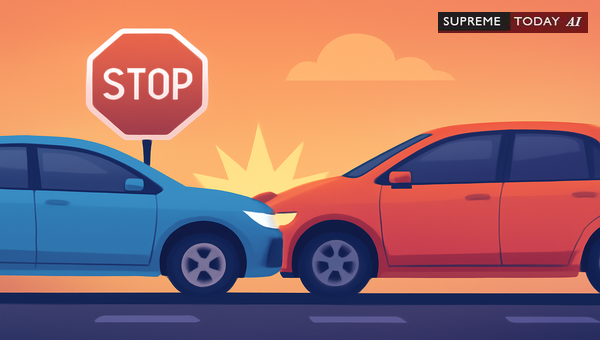
Roadside Stops Without Emergency: Rear Collision Risks
Driving on busy roads requires constant vigilance, but what happens when a sudden roadside stop without an emergency leads to a rear-end collision? The question arises: Stop Road Side Without Emergency Cause a Rear Collision Accident – can the stopping driver be held liable? In this post, we dive into Malaysian traffic laws, key legal principles, and real case examples to unpack this issue. While this provides general insights, it's not legal advice – consult a professional for your situation.
Rear-end collisions are common, often involving debates over who bears responsibility: the trailing driver for not maintaining distance, or the lead vehicle for an abrupt, unnecessary stop? Under Malaysia's , drivers must avoid and stop only in safe, designated areas. Let's break it down.
Legal Principles Governing Roadside Stops and Rear Collisions
Obligation to Avoid Unnecessary Obstruction
Drivers have a duty to prevent hazards. Stopping roadside without an emergency – like a breakdown or hazard – especially outside bus stops or parking zones, may be if it obstructs traffic or creates danger. emphasizes safe stopping practices.
In such scenarios, if the stop lacks a valid reason and no indicators (e.g., hazard lights) are used, it can contribute to accidents. For instance, vehicles stationary without parking lights at night heighten risks, as seen in cases where poor visibility played a role. 2024 0 Supreme(Cal) 1414 WB 65B/ was stationary on the pucca road facing towards Malda side without any parking light or indicator and it was a dark night...
Liability in Rear-End Collisions
Traditionally, the trailing driver is presumed in rear-end crashes due to failure to keep a safe distance. However, this presumption can shift if the lead vehicle stopped unlawfully or suddenly without cause. Courts assess if the stop breached rules, making the stopping driver .
A classic example: There is no doubt that this is a case of a rear collision. The plaintiff had collided into the rear of the car driven by the defendant.
Here, evidence like witness accounts helped determine , showing how sudden stops without warning tip the scales.
Key Cases Illustrating Liability
Real-world cases highlight how unlawful roadside stops factor into fault determination. These often involve sudden braking or stationary vehicles without signals.
Sudden Braking Leading to Rear Impacts
In one incident, a vehicle (BNF3798) braked suddenly, causing a following motorcycle (WWC1267) to crash into its rear. Witnesses noted: BNF3798 then suddenly brakes and stopped causing WWC1267 to crash into straight into its rear.
The deceased driver's horn was heard, but the collision was inevitable – underscoring how abrupt stops without emergency create hazards for followers.
Stationary Vehicles and Visibility Issues
Poor lighting exacerbates risks. A truck stopped without indicators on a dark road led to a collision: ...and there was no street light at the place of accident and road was not visible from distance... 2024 0 Supreme(Cal) 1414 Courts stressed mandatory rear parking lights, ruling such stops .
Emerging from Junctions and Stopping
Drivers emerging from junctions must yield properly. If they stop or proceed unsafely onto main roads, liability may attach post-collision, especially after moving a significant distance.
Other factors like lane changes contribute: Damage on the rear left side suggested improper maneuvering before impact.
However, the damage was found on the rear left side, suggesting that the Defendant may have already been in the left lane before the collision.
Broader Negligence Contexts
Failing to stop after accidents or ignoring signals worsens outcomes. One driver fled, citing shock, but this implied wrongdoing under the .
for failing to stop in an accident and provide particulars. Her explanation that she was 'shocked and afraid' suggested a consciousness of wrongdoing.
Non-compliance, like driving through stop markings without looking, adds layers: ...he drove through the junction without looking to either side... the word 'Stop' was painted in large white letters...
Application to Your Scenario
If you stop roadside without emergency – no breakdown, no hazard – and it causes a rear collision:- Negligence Likely: Especially in non-designated areas or without signals. The stop may be unlawful, shifting some blame from the rear driver. - Key: Courts examine if the stop was the . Sudden, unmarked halts often make the stopper liable.
- Defenses for Trailing Driver: Proof of unlawful stop (e.g., no lights, middle lane) can rebut presumption.
Road conditions matter too – dark roads without lights amplify fault. 2024 0 Supreme(Cal) 1414 Always use hazard lights and move to shoulders if possible.
Recommendations to Mitigate Risks
To avoid liability:- Stop Only When Necessary: Use designated areas; activate hazard lights immediately.- Maintain Visibility: Especially at night – rear lights, reflectors essential. 2024 0 Supreme(Cal) 1414- Signal Intentions: No sudden brakes without cause; check mirrors.- Following Drivers: Keep safe distance, stay alert – presumption favors you, but prove unlawful stop if needed.- Post-Accident: Stop, exchange details per . Don't flee.
Conclusion and Key Takeaways
Stopping roadside without emergency can indeed contribute to rear collisions, potentially making you under Malaysian rules. Cases like sudden braking
or unlit stops 2024 0 Supreme(Cal) 1414 show courts apportion blame based on conduct, visibility, and rules adherence. While rear-enders often carry the burden, unlawful stops flip the script.
Key Takeaways:- Unnecessary stops = heightened liability risk.- Use signals, lights; stop safely.- Document everything post-accident.- Liability varies – seek expert advice.
Drive responsibly to keep roads safe. Share your thoughts below!
References:- -
-
-
- 2024 0 Supreme(Cal) 1414-
-
-
-
(Word count: 1028. General information only; not legal advice.)
#RearEndCollision #RoadsideStop #TrafficLiability















