


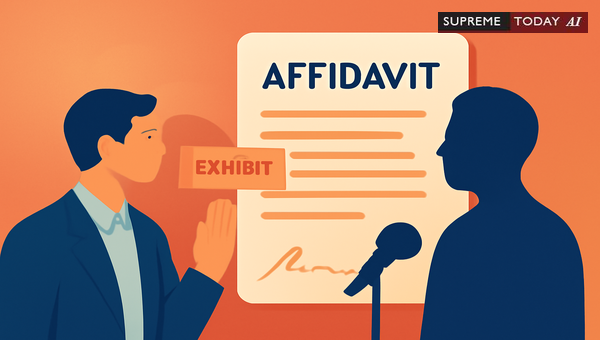
Why Living Person Need Court Examination
In legal proceedings, are commonly used to present evidence efficiently. But what happens when the person who filed the affidavit is still alive? Can their affidavit simply be filed, , and treated as ? The question arises: A Living Person Affidavit Cannot be Marked as Exhibit Rather he should be Examined. This principle is crucial in Indian courts, ensuring fairness through examination and .
This blog post delves into the legal rationale behind this rule, drawing from key judicial pronouncements and related cases. We'll explore why marking an affidavit as an exhibit is insufficient for proof and what steps litigants must take to validate such evidence. Whether you're a lawyer, litigant, or simply interested in evidence law, understanding this can prevent costly procedural errors.
Main Legal Finding
Generally, a living person's affidavit filed in evidence cannot be merely ; it must be examined in court to be considered part of the evidence, unless confirmed or acted upon through or other . 2015 0 Supreme(SC) 971
This stems from the , which distinguishes between procedural marking for identification and of contents. Marking alone does not prove the affidavit's truthfulness, as it deprives the opposing party of challenging the deponent's statements.
Key Points to Remember
- An affidavit of a living person is not automatically proved by marking it as an exhibit.
- It requires confirmation via examination, , or judicial action to become evidence.
- Marking serves only for identification, not proof. 2024 6 Supreme 482
- Without proper examination, the affidavit remains unproved and inadmissible for substantive reliance.
These principles ensure , protecting against unchallenged assertions.
Detailed Analysis: and the Role of Examination
Marking vs. Proof: A Critical Distinction
Courts have repeatedly clarified that endorsing an exhibit number on a document, including an affidavit, is merely for identification. As held: The marking of a document as an exhibit... is only for the purpose of identification... Endorsement of an exhibit number on a document has no relation with its proof.2024 6 Supreme 482
In another ruling: Once a document has been in the case and has been used by the parties in examination and of their witnesses... it is not open... to go behind that order.2002 0 Supreme(SC) 2309 However, this applies only after proper use in examination; mere marking falls short.
Necessity of Examination or
For a living person's affidavit to be evidence, the deponent typically must appear for . The appearance of a witness, who filed the affidavit; for , and his having been subjected to would, undoubtedly, be a step towards confirmation.1966 0 Supreme(SC) 147
Even if doesn't occur, the affidavit must be acted upon by the court, such as through marking documents mentioned therein with judicial endorsement. Yet, this doesn't equate to full proof without scrutiny. 2015 0 Supreme(SC) 971
A Full Bench observed: An affidavit becomes part of evidence only on its being confirmed by the person who filed it... as to when an affidavit of this nature can be said to have been confirmed or denied... there is possibility for the existence of some untouched areas.2012 0 Supreme(AP) 815
Insights from Related Cases on Document Admissibility
Supporting this, cases on and reinforce that exhibits require foundational proof. For instance, photocopies cannot be marked as exhibits without fulfilling , like proving loss of originals. 2024 0 Supreme(Pat) 939
In disputes over : ...the documents marked A5 to A8... cannot in law be regarded as '' within the meaning of .
STASSEN EXPORTS LIMITED V. BROOKE BOND GROUP LTD. AND TWO OTHERS
This highlights strict proof standards beyond marking.Another case addressed in lieu of : Courts may mark documents produced therein as exhibits subject to proof of contents and execution under . However, if the witness lacks personal knowledge, proof fails. 2019 0 Supreme(Bom) 333 2019 0 Supreme(Bom) 64
In , an unmarked affidavit used for signature comparison was noted but not exhibited, underscoring proof requirements. 2017 0 Supreme(Cal) 853
Even in will disputes, mere marking of a document as an exhibit does not dispense with its proof.2016 0 Supreme(P&H) 1156 The party must exhibit documents via court order after laying foundation.
These examples illustrate a consistent judicial stance: and documents demand active proof, not passive marking.
Exceptions and Judicial Discretion
Limited exceptions exist. If the court acts upon the affidavit—relying on it in judgment or using it extensively in proceedings—it may form part of the record. 1966 0 Supreme(SC) 147 or those under (30-year-old documents) might bypass some rigors, but living deponents still need confirmation. 2016 0 Supreme(P&H) 1156
In gift deed cases via power of attorney, documents were marked post-execution proof, not merely on affidavit filing.
Indira Rajguru VS Balkrishna K. Rajguru
Discretion lies with courts, but the default demands examination to uphold fairness.
Practical Recommendations for Litigants
- Ensure Deponent Availability: Call the living person for (often via affidavit under ) followed by .
- Build Foundation: Prove execution, contents, and genuineness before marking.
- Avoid Over-Reliance on Marking: Use it for ID only; pursue .
- Caution: Comply strictly with for copies. 2024 0 Supreme(Pat) 939
Courts should enforce this to prevent miscarriage of justice.
Conclusion and Key Takeaways
In summary, while streamline evidence, a living person's affidavit demands court examination or for proof—marking as an exhibit alone won't suffice. This upholds the 's integrity, as echoed across judgments. 2015 0 Supreme(SC) 971 2024 6 Supreme 482 1966 0 Supreme(SC) 147
Key Takeaways:- Filing ≠ Proof.- Examination/ = Essential for living deponents.- Marking = Identification only.
This post provides general information based on judicial precedents and is not legal advice. Consult a qualified lawyer for case-specific guidance. Laws may vary by jurisdiction and evolve.
References:1. 2015 0 Supreme(SC) 971: acted upon via examination.2. 2024 6 Supreme 482: Marking for ID, not proof.3. 1966 0 Supreme(SC) 147: confirmation.4. 2012 0 Supreme(AP) 815: Affidavit confirmation requirements.
Stay informed on evidence law to strengthen your cases!
#AffidavitProof #EvidenceLaw #CourtExamination















