Searching Case Laws & Precedent on Legal Query.....!
Analysing the retrieved Case Laws
Scanned Judgements…!



Searching Case Laws & Precedent on Legal Query.....!
Analysing the retrieved Case Laws
Scanned Judgements…!
Legal Principles on Winding Up and Disputed Debts - The Supreme Court in Madhusudan Gordhandas & Co. v. Madhu Woollen Industries Pvt. Ltd. (1971) 3 SCC 632 established key principles regarding winding up petitions based on debts. It clarified that where the debt is undisputed, the court will not act upon a defence that the company has the ability to pay the debt but did not choose to pay that particular debt ["2012 Supreme(Online)(Guj) 1469"]. The case emphasizes that a winding-up order can be made even if the exact amount of the debt is disputed, provided the debt itself is admitted ["2012 Supreme(Online)(Guj) 1469"].
Rules for Disputed Claims and Court Discretion - The Court highlighted that a case for winding up in accordance with Section 433(1)(e) of the Act is made out when the company is unable to pay its debts, and the dispute is bona fide and substantial. However, if the claim is disputed in good faith, the court generally refrains from winding up the company ["2012 Supreme(Online)(Guj) 1469"]. The decision reinforces that winding-up proceedings are not meant for enforcing disputed claims, and the existence of a bona fide dispute prevents winding-up orders ["
ROSEBYS INTERIORS INDIA LTD vs SAATCHI & SAATCHI PVT LTD - Gujarat
"].Application of Case Law in Subsequent Judgments - The Madhusudan Gordhandas case has been consistently followed and reiterated in later judgments, such as Vijay Industries v. NATL Technologies Ltd. (2009) 3 SCC 527, where the Court reaffirmed that if the claim is disputed in bona fide, winding up is not justified ["2012 Supreme(Online)(Guj) 1469"]. Courts have also held that the defence pleaded by the company is not bona fide, the debt remains valid for winding-up purposes ["1998 0 Supreme(Guj) 841"].
Jurisdiction and Conditions for Winding Up - The case clarified that provisions of Section 433(1)(e) of the Act are satisfied when the company is unable to pay its debts, and this includes situations where disputes are genuine and substantial. The Court observed that the winding-up petition cannot be used as a means of enforcing recovery of a disputed claim ["2012 Supreme(Online)(Guj) 1469"].
Main Insights - The Madhusudan Gordhandas ruling underscores that winding-up proceedings are based on the company's inability to pay debts, not on disputed claims. The Court's discretion is guided by whether the debt is admitted and whether disputes are bona fide. It also emphasizes that the mere existence of assets or solvency does not preclude winding up if the debt is undisputed or the claim is admitted ["2012 Supreme(Online)(Guj) 1469"].
Analysis and Conclusion:The case of Madhusudan Gordhandas & Co. v. Madhu Woollen Industries Pvt. Ltd. (1971) remains a foundational judgment establishing that winding-up proceedings are appropriate when a company cannot pay its admitted debts, and disputes over the debt are bona fide and substantial. The Court clarifies that disputes over the amount or validity of the debt do not necessarily bar winding-up if the debt itself is not genuinely contested. This principle ensures that winding-up is used as a remedy for genuine insolvency, not as a tool for resolving disputed claims ["2012 Supreme(Online)(Guj) 1469"].
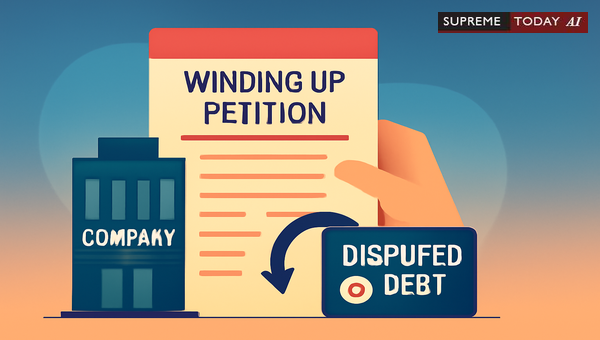
In the complex world of corporate insolvency, can be a powerful tool for creditors seeking to recover debts. But what happens when a company admits owing a debt, yet disputes the exact amount? The 's landmark decision in provides crucial guidance. This case clarifies when courts may still order winding up under , even amid quantification disputes. Understanding this precedent is essential for businesses, creditors, and legal practitioners navigating insolvency proceedings.
This article breaks down the ruling, its key principles, and its lasting impact, drawing from judicial analysis and related precedents. Note that this is general information and not specific legal advice—consult a qualified lawyer for your situation.
The question at the heart of revolves around winding-up proceedings where a debt is acknowledged but its precise is contested. Typically, a and substantial dispute over a debt can halt , as courts avoid using such proceedings to pressure solvent companies. However, the Supreme Court held that uncertainty over the exact amount does not automatically bar relief if the debt's existence is undisputed and the dispute is genuine. 2009 1 Supreme 280
In essence, the main legal finding is: if a debt is admitted to be owed but the amount is disputed on substantial grounds, courts should not dismiss the petition solely due to quantification issues. Instead, they can proceed to winding up if the debt is proven due and the dispute is . 2009 1 Supreme 280
The judgment outlines clear criteria for handling such disputes:
These principles ensure winding-up is not abused as a debt recovery tactic but remains available when companies neglect legitimate obligations.
Not every disagreement qualifies as a barrier to winding up. Courts scrutinize:
If these are absent, the petition may succeed despite amount disputes. This approach balances creditor rights with protecting viable companies from frivolous actions. 2010 0 Supreme(SC) 1555
Under , winding up may be ordered if a company is unable to pay its debts. The Madhusudan Gordhandas ruling interprets this: mere non-payment due to a genuine dispute doesn't invoke the statutory presumption of insolvency under Section 434, but admitted debts with minor disputes can still lead to winding up. The question as to when is satisfied was directly addressed, emphasizing the company's inability to pay despite admissions. 2002 0 Supreme(SC) 2416
In practice, courts examine commercial . If a company is profitable and the dispute is substantial, winding up is typically refused. However, if the defence appears weak, proceedings advance. 2002 0 Supreme(SC) 2416
The Madhusudan Gordhandas principles have been widely followed:
These citations show the ruling's enduring role in preventing arm-twisting via petitions when disputes exist, as in software refund scenarios under . 2010 0 Supreme(Del) 818
In one instance, non-payment of undisputed dues justified petitions, but disputes over quality or breaches led to dismissals if . 2016 0 Supreme(Mad) 18
The sets a vital precedent: can proceed despite disputes over debt amounts if the debt is admitted, the dispute is and substantial, and the company shows inability to pay. Courts prioritize genuine insolvency over precise figures at the initial stage.
Key Takeaways:- , substantial disputes generally bar winding up. 2010 0 Supreme(SC) 1555- Admitted debts with issues may still lead to orders. 2009 1 Supreme 280- Always assess good faith, substance, and proof.- Subsequent cases consistently uphold this balance.
This framework promotes fair insolvency resolutions. For tailored advice, seek professional legal counsel, as outcomes depend on specific facts.
#WindingUpPetition, #CompaniesAct, #BonaFideDispute


Madhusudan Gordhandas & Co. v. Madhu Woollen Industries Pvt. Ltd. [(1971) 3 SCC 632], this Court upon considering Amalgamated Commercial Traders (P.) Ltd. (supra) and various other English cases opined as under: "20. Two rules are well settled. ... Ltd.)" The Court furthermore opined: (Madhusudan case, 4/5 JUDGMENT SCC....

Madhusudan Gordhandas & Co. v. Madhu Woollen Industries Pvt. Ltd. [(1971) 3 SCC 632], this Court upon considering Amalgamated Commercial Traders (P.) Ltd. (supra) and various other English cases opined as under: "20. Two rules are well settled. ... Ltd.)" The Court furthermore opined: (Madhusudan case, 4/5 JUDGMENT SCC....

The question as to when the provisions of Section 433(1)(e) of the Act can be held to have been satisfied conferring jurisdiction on a Company Judge to direct winding up has been considered by this Court in the case of Madhusudan Gordhandas v. Madhu Woollen Industries Pvt. Ltd. ... 1971 (3) SCC 632] which has been followed and reiterated in the case of Pradeshiya Industrial & Investment Corpn of U....

The above mentioned decision was later followed by this Court in Madhusudan Gordhandas and Co. v. Madhu Woollen Industries Pvt. Ltd. (1971) 3 SCC 632. ... The Supreme Court, in the celebrated case, Madhusudan Gordhandas and Co. versus Madhu Woollen Industries Pvt. Ltd. (#HL....

The Apex Court in M/s Madhusudan Gordhandas & Company vs. Madhu Woollen Industries Pvt Limited 1971(3) SCC 632 held as under:- 14. ... North India Petrochemicals Limited & Another (1994) 3 SCC 348; and Goel Brothers and Company Private Limited vs Yashodan Chit Fund Ltd 1979 Mh. ... However in Indo Alusys Industries#HL_END....
The Apex Court in M/s Madhusudan Gordhandas & Company vs. Madhu Woollen Industries Pvt Limited 1971(3) SCC 632 held as under:- 14. ... North India Petrochemicals Limited & Another (1994) 3 SCC 348; and Goel Brothers and Company Private Limited vs Yashodan Chit Fund Ltd 1979 Mh. ... However in Indo Alusys Industries#HL_END....
The Apex Court in M/s Madhusudan Gordhandas & Company vs. Madhu Woollen Industries Pvt Limited 1971(3) SCC 632 held as under:- 14. ... North India Petrochemicals Limited & Another (1994) 3 SCC 348; and Goel Brothers and Company Private Limited vs Yashodan Chit Fund Ltd 1979 Mh. ... However in Indo Alusys Industries#HL_END....
(iii) The winding" up petition cannot be used as a means of enforcing recovery of a disputed claim as held by the apex court in the case of Madhusudan Gordhandas and Co. v. Madhu Woollen Industries Pvt. ... In view of the fact that the defence pleaded by the company is not bona fide, the decisions in the case of Madhusudan Gordhandas and Co. v. Madhu Woollen Industries Put. Ltd.....

... ( 12. ) In the case of M/s Madhusudan Gordhandas and Co. Vs. Madhu Woollen Industries Pvt. Ltd. ... Reliance has been placed on the judgment of the Supreme Court in the case of M/s Madhusudan Gordhandas and Co. Vs. Madhu Woollen Industries Pvt. Ltd. [AIR 1971 SC 2600]. ... ... ( 15. ) In this view of the matter in terms o....
The Rules as regards the disposal of winding up petition based on disputed claims are thus stated by this Court in Madhusudan Gordhandas & Co. vs. Madhu Woollen Industries Pvt. Ltd.[AIR 1971 SC 2600]. ... 9/ The Supreme Court in the matter of M/s Madhusudan Gordhandas & Co. Vs. Madhu Woolen Industries Pvt. ... Madhusudan Gordhandas#....

[See – M/s. Madhusudan Gordhandas & Co. Vs. Madhu Woollen Industries Pvt. Ltd. - 1971(3) SCC 632]. Fourthly, and perhaps most importantly, the Company Court will not wind up a company where the defense raised by the company is in good faith, one of substance, is likely to succeed in point of law and the company adduces prima-facie proof of the fact on which the defense is based.

The above mentioned decision was later followed by this Court in Madhusudan Gordhandas and Co. v. Madhu Woollen Industries Pvt. Ltd, (1971) 3 SCC 632. v. Proxima Medical Systems GmbH, (2005) 7 SCC 42 wherein this Court held that the defence raised by the appellant-company was a substantial one and not mere moonshine and had to be finally adjudicated upon on the merits before the appropriate forum. The principles laid down in the above mentioned judgment have again been reiterated by this Court in Mediquip Systems (P) Ltd. A petition presented ostensibly for a winding up ord....

(i) M/s. Madhusudan Gordhandas & Co., v. Madhu Wollen Industries Pvt. Ltd.(1971 (3) SCC 632)" 20. First, if the debt is bona fide disputed and the defence is substantial one, the court will not wind up the company.
The above mentioned decision was later followed by this Court in Madhusudan Gordhandas and Co. v. Madhu Woollen Industries Pvt. Ltd., (1971) 3 SCC 632. The principles laid down in the above mentioned judgment have again been reiterated by this Court in Mediquip Systems (P) Ltd. Reported in (2010) 10 SCC 553, has observed thus:- "22. v. Proxima Medical Systems (GMBH), (2005) 7 SCC 42, wherein this Court held that the defence raised by the appellant-company was a substantial one and not mere moonshine and had to be finally adjudicated upon on the merits before the appropriate....

(c) Madhusudan Gordhandas & Co. vs. Madhu Woollen Industries Pvt. Ltd. 1971 (3) SCC 632 (Vide Buckley on the Companies Acts, 13th edition, page 451)."


An indispensable Tool for Legal Professionals, Endorsed by Various High Court and Judicial Officers
Please visit our Training & Support
Center or Contact Us for assistance

Scan Me!
India’s Legal research and Law Firm App, Download now!


For Daily Legal Updates, Join us on :



 Back to top


