Searching Case Laws & Precedent on Legal Query..!
Scanned Judgements…!



Searching Case Laws & Precedent on Legal Query..!
Scanned Judgements…!
Witness Testimony and Cross-Examination Limitations - Evidence untested by cross-examination cannot be used to establish facts, but it is not automatically inadmissible. The death of a witness after partial cross-examination raises questions about the admissibility of their remaining evidence. Courts may consider whether the opportunity to cross-examine was sufficient and whether the evidence was properly expunged or allowed to survive. ["2023 0 Supreme(Pat) 144"]
Cross-Examination of Documents and Evidence Admissibility - Documents introduced during cross-examination must be relevant and not inadmissible; otherwise, they cannot be used to impeach or contradict witnesses. Supreme Court clarified that statements or documents not subject to cross-examination are not admissible for contradicting witnesses or impeaching credit. Proper objection and adherence to procedural rules are essential. ["2023 0 Supreme(Del) 3752"], ["2024 0 Supreme(Bom) 1091"]
Effect of Hostile and Turning Hostile Witnesses - Cross-examination aims to test veracity; witnesses may turn hostile or be declared hostile by the court, allowing the prosecution or defense to explore contradictions. It is preferable to conduct cross on the same day as examination-in-chief to prevent memory lapse and to ensure truthfulness. Hostile witnesses can be cross-examined to reveal discrepancies. ["2023 0 Supreme(Del) 5197"]
Witnesses Volunteering Information and Identification - Witnesses may volunteer details during cross-examination, such as identification or location, which can influence case credibility. For example, witnesses admitting to seeing or not recognizing accused, or describing lighting conditions, impact the strength of identification evidence. Cross-examination can expose inconsistencies and challenge assumptions. ["2025 0 Supreme(Chh) 117"]
Cross-Examination and Document Production - Witnesses may volunteer to produce documents or clarify facts during cross-examination. The process allows for clarification, identification, or challenging the authenticity of evidence, but documents must be relevant and properly introduced. Cross-examination is a critical tool for testing the reliability of documentary evidence. ["2025 Supreme(Online)(Kar) 19236"], ["2023 0 Supreme(Del) 5197"]
Overall Analysis and Conclusion - Cross-examination of witnesses is a fundamental aspect of trial procedure, aimed at testing credibility, revealing inconsistencies, and ensuring a fair trial. However, witnesses who die or are declared hostile require careful handling to determine whether their remaining evidence remains admissible. Documents or statements not properly subjected to cross-examination are generally inadmissible for contradiction purposes. The effectiveness of cross-examination depends on timely, proper, and relevant questioning, which can significantly influence case outcomes. Courts balance the rights of parties to challenge evidence with procedural rules to uphold justice. ["2023 0 Supreme(Pat) 144"], ["2023 0 Supreme(Del) 3752"], ["2023 0 Supreme(Del) 5197"], ["2025 0 Supreme(Chh) 117"], ["2024 0 Supreme(Bom) 1091"]
References:- 2023 0 Supreme(Pat) 144- 2023 0 Supreme(Del) 3752- 2023 Supreme(Online)(MP) 18242- 2025 0 Supreme(Chh) 117- 2024 0 Supreme(Bom) 1091- 2023 0 Supreme(Del) 5197- 2023 Supreme(Online)(Kar) 28478- 2025 Supreme(Online)(Kar) 19236- 2022 Supreme(Online)(Kar) 46233
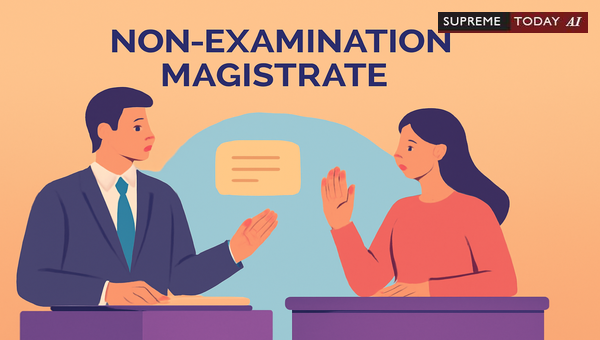
In criminal trials, the proper examination of witnesses is foundational to justice. But what happens when the court overlooks examining the magistrate who initially recorded witness statements? This issue often arises in cases involving under or statements under What are the consequences of non-examination of magistrate by the court who examined witnesses? Understanding this can prevent that undermine or .
This blog delves into the , the critical , and the pitfalls of procedural shortcuts, drawing from key judicial precedents. While courts generally prioritize , deviations can lead to being deemed inadmissible or trials being vitiated.
Witness testimony, especially voluntary or volunteer statements made during cross-examination, is typically admissible if the witness is properly summoned and examined in court. Courts exercise discretion to allow such statements to uncover the truth, particularly when they clarify or contradict earlier testimony. 1991 0 Supreme(Ori) 257
However, the is fundamental and extends even to court-summoned witnesses, not just those called by parties. Without it, testimony may lose credibility or admissibility. Once a witness is fully examined-in-chief and , recalling them is restricted unless justified by inconsistencies. 2008 7 Supreme 231
Statements recorded by a magistrate during inquiries (e.g., under ) are not automatically admissible. They cannot corroborate or impeach unless properly incorporated under the . Failure to examine the recording magistrate can exacerbate this, as it deprives parties of challenging the statement's authenticity or voluntariness. 2004 2 Supreme 140
Courts permit cross-examination of their own witnesses if statements contradict known facts, allowing voluntary statements beyond direct questions. This is admissible to reveal truth. For instance, the court may permit cross-examination of its own witnesses when their statements are contrary to what they knew. 1991 0 Supreme(Ori) 257
Non-examination of the magistrate who first recorded such statements can question the foundation. If the magistrate isn't called, parties lose the chance to probe recording circumstances, potentially leading to exclusion of related .
In cases with , testimony remains usable if . One precedent notes a complainant who turned hostile during cross-examination but whose earlier statements supported prosecution when backed by ballistic . The court upheld conviction, stressing, the testimony of a hostile witness could be relied upon if by other . 2023 0 Supreme(P&H) 1635
Yet, if the examining magistrate isn't produced, corroboration weakens, especially for Section 164 statements where voluntariness is key.
Failure to subject key witnesses to cross-examination undermines . In a motor accident case, an eyewitness (PW.2) testified but this witness is not subjected to cross-examination, casting doubt on reliability. 2017 0 Supreme(Kar) 711
Similarly, in murder appeals, contradictory sole eyewitness testimony led to acquittal due to lack of credibility: the testimony of the sole eyewitness did not deserve any credence or credibility. 2022 0 Supreme(Del) 1184
Non-examination of the magistrate amplifies this, as courts rely on those statements without scrutiny.
Statements to commissions or under Cr.P.C. inquiries can't contradict witnesses unless admissible wholly. It cannot be admissible in and inadmissible in cross examination of same witness. Affidavits or statements must be treated entirely admissible or not, ensuring defense opportunities. 2018 0 Supreme(Guj) 486
If the magistrate isn't examined, such statements risk total inadmissibility, prejudicing the case.
Additional precedents highlight consequences:
These illustrate that procedural fairness demands examination opportunities; skipping the magistrate invites appeals or reversals.
To mitigate consequences:- Ensure magistrate examination: Especially for inquiry statements, to affirm voluntariness.- Exercise cross-exam rights judiciously: Request for court witnesses if contradictions arise.- Corroborate hostile testimony: Use independent to bolster cases.- Limit re-exams: Only for clarifications, avoiding prejudice. 2008 7 Supreme 231
Courts should judiciously permit cross-exams for truth, as the other side is given opportunity to cross-examine the witness. 2023 0 Supreme(P&H) 1635
The consequences of non-examining the magistrate who examined witnesses can be severe—ranging from inadmissibility to overturned . While during cross-exam is generally admissible 1991 0 Supreme(Ori) 257, procedural rules under Cr.P.C. and demand full opportunities. Cases like hostile witness reliance 2023 0 Supreme(P&H) 1635 or unchallenged eyewitnesses 2017 0 Supreme(Kar) 711 show balance is key.
This is general information based on precedents and not specific legal advice. Consult a qualified lawyer for your case. By understanding these nuances, parties can strengthen trials and uphold justice.
References:1. 1991 0 Supreme(Ori) 257 – Court discretion on cross-exam.2. 2008 7 Supreme 231 – Exam/cross-exam rules.3. 2004 2 Supreme 140 – Inquiry statement limits.4. 2023 0 Supreme(P&H) 1635, 2022 0 Supreme(Del) 1184, 2018 0 Supreme(Guj) 486, 2017 0 Supreme(Kar) 711, 2016 0 Supreme(Pat) 606, 2015 0 Supreme(Bom) 452 – Supporting cases on testimony credibility.
#WitnessExamination, #CrossExaminationLaw, #CriminalEvidence


The evidence untested by cross-examination can have no value but the evidence cannot be rejected as inadmissible. ... During the trial the plaintiffs brought on Padma Raman Pathak (P.W.-3) whose examination-in-chief was filed on 23.05.2017 thereafter the defendant partly cross-examined the said witness and it was deferred for further cross-examination....

However, in the present case, it was during the cross examination of the witness by the defense that the documents/affidavits were brought on record for the first time. ... is not permitted to be subject to cross-examination cannot be read in evidence. ... (iii) No objection was raised by any of the parties regarding the admissibility of the documents either during the examination-in-ch....

Devendra, in his cross-examination says that his house is situated in the next lane but however volunteers a statement that from his house he could still see the house of PW-3, Khoob Singh. PW-1 and PW-3 are related to each other. ... Besides, PW-3 Khoob Singh is his cross-examination says that between his house and that of PW-1 is an area of darkness. The incident has taken place is in the month of Janua....

Has completely resiled, the other witness i.e. the complainant though did depose against the appellant in his examination-in-chief but when he stepped into the witness box for cross-examination, he also turned hostile and did not support the case of prosecution. ... and the other side is given opportunity to cross-examine the witness. ... More so, when the defence filed....

In her cross-examination she admits that the accused had covered his face with a scarf and therefore, he was not identifiable. She further volunteers that she had pulled the scarf and saw his face. ... Learned trial court ought to have appreciated the fact that the complainant in her cross-examination admitted that the person who entered her house had covered his face with scarf and his face was not iden....

An inadmissible and speculative document cannot be used for cross-examination of the witness as the witness may be incapable to answer the same and an inadmissible document will be read in evidence. ... the limited purpose of cross-examination or jogging the memory of the witness." ... of a witness when document goes....

The cross-examination of the witness merely consists of suggestions given to the witness which were denied by the witness. ... In fact, it is not at all appreciable to call a witness for cross examination after such a long span of time. It is imperative if the examination-in-chief is over, the cross- examin....

and the relevant portion of the cross-examination reads as under: “Further Cross-examination: by Sri. ... A plain reading of cross-examination of the petitioner would evidence that she was authorized signatory of the respondent-company to immigration of the documents and was responsible for processing Visa of Indian Employees to all countries. ... Learned counsel for the respondent has t....

Witness volunteers that he would produce that order copy to the court." 17. The cross-examination of defendant No.2 in O.S.No.2836/2014, wherein he is the plaintiff is also relevant. ... The relevant portion of his cross-examination reads as follows: "It is true that I have produced Ex.D7 in my evidence. Now the witness is shown Ex.D7 and asked to identify the site form....

However, the witness volunteers that in the policy itself, it is mentioned that to whom the compensation has to be given. ... The witness was also subjected for cross-examination and in p style="text-align: center ... It is suggested that the deceased was travelling in connection with the agricultural work and the 7 witness volunteers that the deceased was t....

I do not know the contents of Ex.PW2/A as I am illiterate. Further cross examination is deferred as witness is not feeling well.

It cannot be admissible in examination-in-chief and inadmissible in cross examination of same witness. [34] The affidavits Ex.PW1/A & B and statement Ex.PW1/C of PW-1 Smt. Jagdish Kaur and her deposition in this regard will either be admissible as a whole i.e. examination-in-chief and cross examination in respect of Ex.PW1/A and C or it will be wholly inadmissible. It is essential that the accused is given a reasonable opportunity to defend himself in the trial.
10. PW.2 an eyewitness to the incident has also spoken about the involvement of the aforesaid motor bike in causing the accident leading to the death of the deceased. But this witness is not subjected to cross-examination.

DW 3 Rajeshwar Prasad has also come to say that Rupa Rai gave advance of Rs. 10,000/- to Uma Rai and took land to fix Fodder Cutting Machine etc. During cross-examination this witness has become incompetent. Rupa Rai took land from Uma Rai on rent and gave advance of Rs.10,000/- and further Rupa Rai used to pay rent at the rate of Rs. 600/- per month but due to shortage of money business was not started. but due to shortage of fund the mill was not started and Rupa Rai suffer....

In her cross-examination on 17th June 2014 Neelam says, Paragraph 4 at page 139 : “Witness Volunteers: Her deposition in this respect is set out in paragraph 12 of the evidence affidavit. It is not in dispute that Shankarrao was the owner of these premises. In so far as 1st floor premises is concerned, I am claiming to be tenant thereof independently.”


An indispensable Tool for Legal Professionals, Endorsed by Various High Court and Judicial Officers
Please visit our Training & Support
Center or Contact Us for assistance

Scan Me!
India’s Legal research and Law Firm App, Download now!


For Daily Legal Updates, Join us on :



 Back to top


