


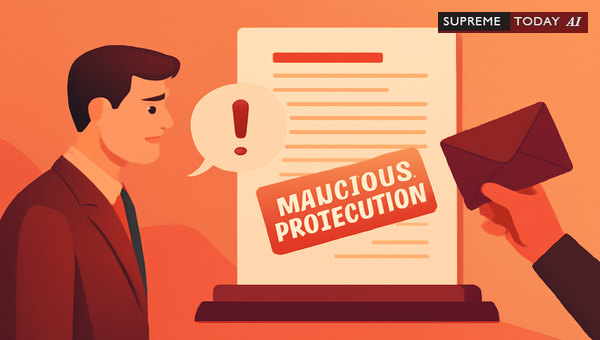
Understanding Claims in Section 80 CPC Notices
is a serious where a person initiates legal proceedings against another without reasonable cause and with malicious intent, leading to wrongful harm. In India, when such claims target government entities or public servants, a mandatory notice under is required before filing a . But what are the precise ingredients for in a ? This blog breaks down the essentials, drawing from judicial precedents, to help you navigate this complex area.
Note: This is general information based on legal precedents and not specific legal advice. Consult a qualified lawyer for your situation.
What Constitutes ?
Generally, a for requires proving:- The proceedings were initiated without .- They were motivated by .- The case terminated in the plaintiff's favor.- The plaintiff suffered damages1992 0 Supreme(Raj) 624.
In an action for damages for , the plaintiff must prove that the proceedings instituted against him were malicious, without , that they terminated in his favour and that he suffered damages. 1992 0 Supreme(Raj) 624
When public officers or the government are defendants, Section 80 CPC adds a layer of , requiring a two-month notice to allow settlement opportunities 2023 0 Supreme(Ker) 454.
Key Ingredients in a for
The question arises: for Ingredients in a ? Courts have outlined specific elements that must be substantially met for the notice to hold up. Here's a detailed breakdown:
1. Strict Compliance with Section 80 CPC
Section 80 mandates a prior notice to the government or public servant before instituting any suit. Key points include:- Two-month waiting period: The suit cannot be filed until two months after the notice 2023 0 Supreme(Ker) 454.- of purpose: The notice must inform the recipient about the nature of the suit to be filed, enabling them to address the grievance 2023 8 Supreme 379.
The notice should substantially fulfill the objective of informing the parties about the nature of the suit to be filed 2023 8 Supreme 379.
Notably, the notice need not explicitly cite Section 80, as long as it meets the ingredients of 2019 6 Supreme 1.
2. Rebuttal of the Presumption of Mens Rea
To invoke defenses like (which presumes acts by public servants are lawful), the defendant must rebut the presumption of criminal intent (mens rea). The plaintiff, in their notice and suit, typically highlights failure to do so:- The act was done without or knowledge2022 0 Supreme(Ker) 716.- It was performed in a lawful manner by lawful means2022 0 Supreme(Ker) 716.- It involved proper care and caution2022 0 Supreme(Ker) 716.
Failure to demonstrate these shifts the burden back, strengthening the claim.
3. Absence of Urgent or Immediate Relief
Courts caution against rejecting suits prematurely under (which allows suits without notice for ). The assessment should not be rigid at the initial stage:
The court should not reject the leave under Section 80(2) of the at the initial stage based on an objective satisfaction that no urgent or immediate relief is needed 2023 0 Supreme(Ker) 454.
The real spirit of Section 80 is to give the government or public servant a chance to settle within two months, not to defeat the plaintiff's rights 2023 0 Supreme(Ker) 454.
4. Compliance with Other Procedural Requirements
Additional hurdles include:- No bar: The suit isn't barred if prior litigation involved the same parties, subject matter, and issues 2015 0 Supreme(SC) 914.- No notice for municipal councils: They aren't 'public officers,' so Section 80 doesn't apply 2015 0 Supreme(SC) 914.- Independent proof of title: Plaintiffs can't rely solely on the defendant's title failure; they must prove their own 2015 0 Supreme(SC) 914.
Limitation Period and Timelines
Beyond the notice, note the one-year limitation for suits from the date of acquittal or , per . Courts may extend via if notices delay filing .
As per Article 74 Part 7 of Schedule to the , it is mentioned that the limitation period for filing a for is one year from the date when plaintiff is acq....
Judicial Insights from Related Cases
Courts interpret Section 80 practically, not pedantically. For instance:- In cases alleging false charges under (false charge with intent to injure), suits are civil remedies, separate from criminal proceedings under Section 340 CrPC 2021 0 Supreme(Mad) 491.
A careful reading of the petition filed by the Respondent at the best makes out a case for . The grounds for maintaining a suit for cannot form the basis for filing a petition under Section 340, Cr.P.C. 2021 0 Supreme(Mad) 491
Mere acquittal doesn't automatically prove ; plaintiffs must show no reasonable cause 1992 0 Supreme(Raj) 624. may bar suits if actions were in good faith.
Historical precedents affirm Section 80's scope, even for malicious arrest claims against public officers 2023 Supreme(SRI)(SC) 20783.
Other cases distinguish from unrelated claims like motor accident compensation or eviction suits, emphasizing specific proof 2014 0 Supreme(Cal) 844 1996 0 Supreme(All) 306.
Practical Tips for Drafting the Notice
To maximize success:- Clearly outline facts of malicious institution, lack of probable cause, , , and damages.- Reference key ingredients without technical rigidity.- Attach supporting evidence like acquittal orders.- Serve properly and wait the full two months.
Conclusion and Key Takeaways
Successfully incorporating into a hinges on compliance, , no undue urgency dismissal, and procedural adherence. Courts favor a purposive interpretation to protect rights while allowing governmental response.
Key Takeaways:1. Prioritize substantial notice content over form 2023 8 Supreme 379.2. Highlight defendant's failure to rebut mens rea 2022 0 Supreme(Ker) 716.3. Argue against premature rejection on urgency 2023 0 Supreme(Ker) 454.4. Watch limitation clocks .
If facing potential malicious proceedings or defending one, professional guidance is crucial. Stay informed, act timely, and protect your rights.
#MaliciousProsecution #Section80CPC #LegalDamages












