


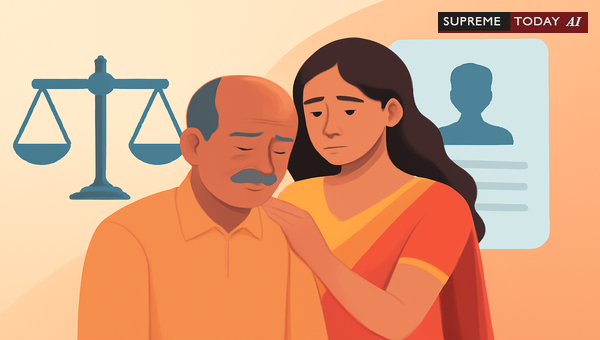
Does a Married Daughter Have a Right to After Her Father's Death?
Imagine the sudden loss of a family's breadwinner—a government employee who passes away unexpectedly, leaving dependents in financial distress. In such heartbreaking scenarios, compassionate appointments offer a lifeline: a job in the same organization to help the family tide over the crisis. But what if the applicant is a married daughter? Does she have a right to this benefit after her father's death?
This question—Married Daughter does Not have Right of after Death of his Father—has sparked intense legal debate in India. While compassionate appointments are not an absolute right, recent judicial interventions have reshaped the landscape, striking down exclusions based on marital status. This blog post delves into the legal nuances, rulings, and key principles governing such claims. Note: This is general information based on judicial precedents and not specific legal advice. Consult a qualified lawyer for your situation.
What is ?
is a benevolent scheme designed as an exception to the standard process. Its primary purpose is to provide immediate relief to the family of a deceased government employee facing sudden financial hardship. Courts have repeatedly emphasized that it is a concession, not a 2022 0 Supreme(SC) 1001.
Key objectives include:- Enabling genuine dependents to sustain themselves.- Addressing financial crises post the employee's death.- Ensuring the scheme remains limited and non-heritable 2022 0 Supreme(SC) 1001.
However, eligibility hinges on , not automatic entitlement. Policies historically outlined eligible family members, but these faced constitutional scrutiny.
Historical Exclusion of Married Daughters
Traditionally, government policies excluded married daughters from compassionate appointments. The rationale stemmed from societal norms viewing marriage as transferring a daughter's to her husband's family. For instance, an Office Memorandum dated explicitly barred married daughters, deeming them ineligible 2025 0 Supreme(All) 2391.
Such policies classified unmarried daughters, sons, spouses, and sometimes widowed daughters as dependents, but drew a firm line at married ones 2022 0 Supreme(SC) 997. Courts initially upheld this in some cases, noting that marriage transfers a daughter to her husband's family, and she ceases to be part of her parental family 2022 0 Supreme(SC) 997.
Yet, this exclusion was not absolute. Even under older views, courts stressed assessing actual over presumptions 2025 0 Supreme(All) 2391.
Constitutional Challenges: A Shift Towards Equality
The tide turned as constitutional principles clashed with rigid policies. (equality), (prohibition of discrimination), and 16(2) (equality in public employment) of the Indian Constitution formed the bedrock of challenges.
Judges ruled that excluding married daughters solely on marital status is , , and violative of fundamental rights. In the Coal India Limited case, the court declared such exclusions unconstitutional, prioritizing over marital status 2025 0 Supreme(All) 2391.
The reinforced this in key judgments:- Marriage does not sever the parent-daughter relationship or 2024 0 Supreme(Chh) 647.- Policies discriminating on gender or marital lines are 2024 0 Supreme(Chh) 647 2022 0 Supreme(SC) 1001.
Exclusion of married daughters from compassionate appointments is unconstitutional because , not marital status, should be the criterion 2025 0 Supreme(All) 2391.
Recent Rulings: Landmark Clarity
Recent pronouncements have solidified approaches. In a pivotal ruling 2024 0 Supreme(Chh) 647, the held that exclusion based on marriage is and violates , , and 16(2). The bench directed authorities to reconsider claims without marital bias, emphasizing gender equality and actual need.
Similarly, another decision 2022 0 Supreme(SC) 1001 clarified: is an exception... aimed at enabling families of deceased employees to tide over sudden financial crises. policies undermine this object.
These rulings mandate case-by-case evaluation of , irrespective of marriage. Authorities must prove lack of factually, not presume it from wedding rings.
Nuances from Other Judicial Views
Not all cases align perfectly. For example, in one matter 2024 Supreme(Online)(MP) 39113, denial to a married daughter was upheld because she was not dependent on her father—framing it as but need-based. If married daughter is not granted as she was not dependent on her father, then it cannot be said that same violates the of a woman as she is discriminated on basis of gender.
Contrastingly, some high court decisions have been stricter. A observation noted: The doors for of a married daughter have been completely closed. Even if she is dependent on her father, she would...
. However, precedents now override such views, prioritizing constitutionality.
These examples highlight that while marriage alone cannot bar claims, proof of remains crucial2015 2 Supreme 188. Courts scrutinize family income, living arrangements, and contributions from the deceased.
Exceptions, Limitations, and Practical Recommendations
Compassionate appointments are not heritable or available years after death—prompt action is key. Even eligible candidates may face rejection if:- No genuine financial distress exists.- Better-placed dependents (e.g., spouse, son) are available.- Posts are unavailable 2022 0 Supreme(SC) 1001.
Recommendations for applicants and employers:- Revise policies: Eliminate marital status exclusions for constitutionality 2024 0 Supreme(Chh) 647.- Assess holistically: Consider affidavits, income proofs, and family circumstances.- Seek : Courts are receptive to challenging denials.
Families should gather evidence of early and apply promptly.
Key Takeaways
- No absolute right: is a concession for genuine need 2022 0 Supreme(SC) 1001.
- No marital bar: Exclusion solely on marriage violates , , 16(2) 2024 0 Supreme(Chh) 647.
- rules: Actual reliance on the deceased is paramount 2015 2 Supreme 188.
- Evolving law: favors equality; outdated policies risk invalidation.
Conclusion
In summary, while a married daughter does not enjoy an absolute right to after her father's death, blanket exclusions based on marriage are unconstitutional. Judicial evolution underscores as the litmus test, promoting fairness and equality. Families navigating this should focus on robust evidence of need and stay updated on policy reforms.
For personalized guidance, reach out to a legal expert. Stay informed—justice evolves with every bench pronouncement.
References:1. 2022 0 Supreme(SC) 1001 – Core principles on exception and discrimination.2. 2022 0 Supreme(SC) 997 – Historical policy exclusions.3. 2024 0 Supreme(Chh) 647 – on constitutional violations.4. 2025 0 Supreme(All) 2391 – Coal India and focus.5. 2015 2 Supreme 188 – Unconstitutionality of exclusions.6. 2024 Supreme(Online)(MP) 39113,
– Contrasting high court nuances. #CompassionateAppointment, #MarriedDaughterRights, #SupremeCourtIndia












