


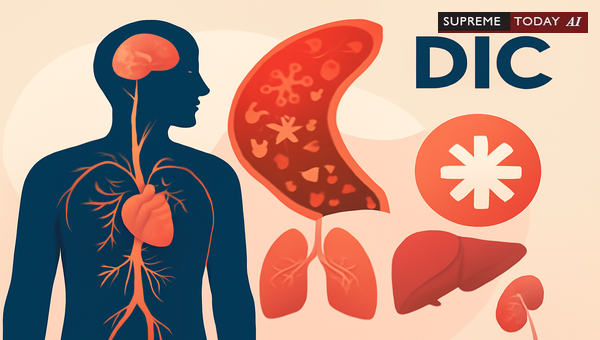
DIC to MODS: Understanding Death Causes Legally
In critical care scenarios, medical professionals often encounter complex conditions where the line between inevitable outcomes and potential negligence blurs. One such intricate issue is death due to Disseminated Intravascular (DIC) leading to Multi-Organ Dysfunction Syndrome (MODS). What exactly does this mean in medical and legal terms? This blog post delves into the definition, pathophysiology, clinical manifestations, and crucially, its implications in legal disputes, particularly .
Drawing from court documents and expert opinions, we'll examine how courts interpret these conditions, emphasizing that this is general information and not specific legal advice. Always consult qualified professionals for individual cases.
What is Disseminated Intravascular (DIC)?
Disseminated Intravascular (DIC) is a serious disorder characterized by the widespread activation of the , leading to the formation of blood clots throughout the small blood vessels. This process consumes clotting factors and platelets, paradoxically resulting in both and . As noted in legal findings, DIC can occur as a or secondary to severe infections, trauma, or critical illnesses.
A. Rajangam @ Velusamy VS Fredrick John - Consumer ()
Document
highlights that death was attributed to cardio-respiratory failure due to and shock resulting from DIC, underscoring its rapid progression. Similarly,
confirms the found the cause of death to be DIC, dismissing negligence allegations.
From additional sources, DIC often manifests with , , , as seen in cases involving IV treatments like Magnesium Sulphate and DIC regimes.
Patients may exhibit bleeding, jaundice, , , , and , with lab findings showing deranged clotting parameters and .
How DIC Progresses to Multi-Organ Dysfunction Syndrome (MODS)
DIC disrupts blood flow, causing inadequate perfusion to vital organs, which triggers Multi-Organ Dysfunction Syndrome (MODS)—the progressive failure of two or more organ systems. This often stems from , shock, or underlying conditions like end-stage liver disease or dengue.
Key mechanisms include:- Microvascular leading to .- Consumption of clotting factors causing bleeding and .- Systemic inflammation from exacerbating vascular permeability, myocardial dysfunction, and dehydration. 2021 Supreme(Online)(NCDRC) 264
Court records illustrate this: The Death Summary in 2021 Supreme(Online)(NCDRC) 279 states the immediate cause of death was with with , not directly linked to primary diseases. Another case notes , Multi Organ Dysfunction syndrome, syndrome. 2023 Supreme(Online)(MAD) 544
In 2024 Supreme(Online)(NCDRC) 159, death was due to and multiple organ dysfunction, with detailed causes including , , and .
explicitly links it to (PPH) and Disseminated intravascular coagulation (DIC), affirming the death was due to these factors.
Legal Findings and Precedents
In medical negligence litigation, establishing the cause of death is pivotal. Courts scrutinize whether DIC/MODS resulted from or inherent disease progression.
- Document
Padma Ramanathan VS - Consumer ()
lists DIC as a contributing factor on the death certificate, noting the complexity of diagnosing the exact cause when multiple factors are involved. - 2017 0 Supreme(Mad) 1165 discusses systemic and multi-organ dysfunction arising from conditions like DIC, highlighting interconnected medical issues.
- The landmark sets the on the complainant, evaluating care against established practices.
Other precedents reinforce this:1. In 2018 0 Supreme(Cal) 378, the death certificate cited ‘ syndrome, and multi-organ dysfunction syndrome’, with no respiratory issues noted prior.2.
describes , severe liver abnormalities, , , and in a jaundice patient with chronic alcoholism.3.
attributes death to multi-organ dysfunction syndrome because of pre-existing diseases including suspected dengue fever, finding no lapses despite critical condition.
These cases typically dismiss negligence when DIC/MODS aligns with known complications.
Implications for Legal Representation
For defendants (often doctors/hospitals), key strategies include:- Demonstrating DIC as a significant factor, not negligence.
- Expert testimony on DIC complexities and outcomes.
A. Rajangam @ Velusamy VS Fredrick John - Consumer ()
- Meticulous documentation review, including death certificates.Padma Ramanathan VS - Consumer ()
Counterarguments often hinge on absent post-mortems, creating ambiguity. 2004 0 Supreme(Cal) 201 notes this weakens prosecution. Defense emphasizes DIC's unpredictability despite best efforts.
A. Rajangam @ Velusamy VS Fredrick John - Consumer ()
In insurance disputes, like 2021 Supreme(Online)(NCDRC) 279, death summaries clarify non-linkage to primary illnesses, aiding claim denials.
Prognosis, Challenges, and Prevention
DIC carries high mortality, especially with or trauma, progressing rapidly to MODS. Early intervention—treating underlying causes, supportive care—is vital, but outcomes remain guarded.
State
mentions DIC in contexts like post-vomiting.Legally, recommendations include:- Gathering all records and expert opinions.- Countering negligence by stressing DIC's nature.- Advocating post-mortems for clarity. 2004 0 Supreme(Cal) 201
Conclusion and Key Takeaways
Death due to DIC leading to MODS represents a formidable medical-legal challenge, blending acute pathophysiology with . Courts generally uphold that such outcomes may occur despite optimal care, as evidenced across documents like
A. Rajangam @ Velusamy VS Fredrick John - Consumer ()
.Key Takeaways:- DIC triggers clotting chaos, evolving into MODS via organ .- Legal defenses succeed by proving alignment with medical norms.- Comprehensive records and experts are indispensable.
This post provides general insights based on public legal documents and is not legal advice. Consult attorneys and medical experts for case-specific guidance.
References:
A. Rajangam @ Velusamy VS Fredrick John - Consumer ()
Padma Ramanathan VS - Consumer ()
2017 0 Supreme(Mad) 1165 2004 0 Supreme(Cal) 201 2021 Supreme(Online)(NCDRC) 279 2023 Supreme(Online)(MAD) 544 2024 Supreme(Online)(NCDRC) 1592021 Supreme(Online)(NCDRC) 264
State
2018 0 Supreme(Cal) 378#DICMODS, #MedicalNegligence, #LegalHealth















