


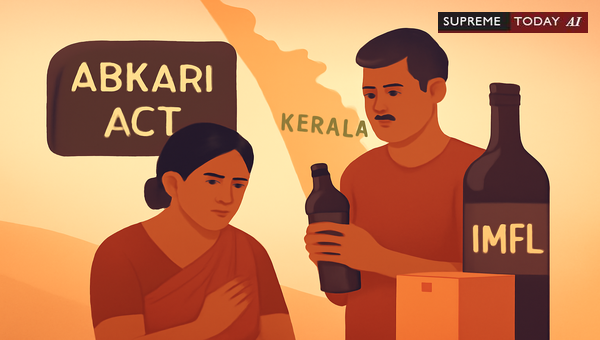
Can a Mother Be Accused in an Abkari Case for Her Son's ?
In Kerala, where the Abkari Act strictly regulates liquor and , families often face unexpected legal troubles during routine police checks. Imagine a mother simply standing next to her adult son who is carrying a bottle of Indian Made Foreign Liquor (). Can she be dragged into an Abkari case solely based on her proximity? This question—Whether Mother Standing Next to his Son who Possessed can be Accused in Abkari Case—raises critical issues of evidence, presumption, and family liability.
This blog post breaks down the 's key provisions, applies them to such scenarios, and draws insights from related judgments. Note: This is general information based on legal precedents and not specific legal advice. Consult a qualified lawyer for your situation.
Overview of the
The , 1077 (M.E.), governs the production, sale, , and of liquor in the state. It aims to curb illegal liquor trade while allowing personal consumption within limits. Violations can lead to fines, imprisonment, and property confiscation.
A common trigger for cases is of exceeding permissible quantities. But mere presence nearby doesn't equate to guilt. Courts emphasize the prosecution's burden to prove beyond .
Key Legal Provisions on
Permissible Quantity Limits
Under Section 13 of the Abkari Act, individuals may possess up to 3 litres of without a permit. Exceeding this invites charges unless explained satisfactorily. For instance, a person is allowed to possess a maximum of 3 litres of . beyond this limit constitutes an offence unless satisfactorily accounted for 2009 0 Supreme(Ker) 740 2012 0 Supreme(Ker) 850.
In the scenario, if the son possesses only 1.620 litres—as sometimes cited in cases—it's well within limits, negating any offence.
and
Section 64 allows courts to presume an offence if excess liquor is found, but the accused can rebut it. If a person is found in of exceeding the permissible limit, the court can presume, under , that the accused committed an offence unless they can satisfactorily explain their 2012 0 Supreme(Ker) 850 2022 0 Supreme(Ker) 1049.
However, this presumption applies to the possessor, not bystanders. Labels like For Sale in Pondicherry State Only don't prove without evidence. The mere presence of labels indicating that the liquor is for sale in another state... does not automatically imply illegal importation. The prosecution must provide concrete evidence of illegal importation 2020 0 Supreme(Ker) 543 2015 0 Supreme(Ker) 936.
Application to Mother's Liability
Mere Presence Isn't Enough
If the mother is standing next to her son with legal quantities of (e.g., 1.620 litres), she cannot be accused without proof of involvement. If the mother is merely standing next to her son who possesses within the permissible limit... she cannot be held liable unless there is evidence showing her involvement in the illegal or of the liquor. The law requires clear evidence of in the offence, which is not established by mere presence 2020 0 Supreme(Ker) 543.
The son's must also be legal—purchased from a licensed vendor with bills as proof. If the son possesses within the legal limit and can prove that it was legally obtained... then neither he nor his mother can be accused under the Abkari Act 2009 0 Supreme(Ker) 740 2015 0 Supreme(Ker) 936.
Prosecution's Burden
Prosecutors must demonstrate or excess quantity. Without it, cases crumble. This protects innocents from guilt by association.
Insights from Related Family Liability Cases
Indian courts consistently shield family members from in . Analogous principles apply here.
In a consumer dispute, the couldn't disconnect a wife's or mother's phone for a husband's or son's unpaid bills. The department cannot disconnect the telephone standing in the name of the wife or the mother... for the default committed by the husband or son... disconnection of the wife's telephone for the husband's default would be arbitrary, unreasonable, and amount to gross deficiency in service
. This underscores separate accountability.
Similarly, in compassionate appointment matters, authorities must guide families without penalizing delays unfairly. The authority failed to inform the widow of the son's ineligibility... and the prolonged delay in processing the son's application were unjust 2022 0 Supreme(Cal) 255. While not Abkari-specific, it highlights duties toward family units.
Property disputes further affirm individual proof requirements. Courts dismissed claims where plaintiffs couldn't prove shares, protecting minors' rights: the plaintiff failed to prove his ownership share in the disputed land and attempted to deprive his minor grandson of his rightful share 2013 0 Supreme(All) 1674.
Even in serious IPC cases, family statements are scrutinized for evidence, not assumption. In a murder appeal, witness proximity didn't imply guilt without proof: Who did the accused think was possessed by Devil to tell his mother in law... 2006 0 Supreme(Bom) 1478.
These precedents reinforce: family ties alone don't transfer liability.
Practical Recommendations
- Document Purchases: Always keep bills from licensed shops for .
- Challenge Presumptions: If charged, rebut under Section 64 with quantity proofs.
- Seek Bail Promptly: Abkari cases often allow if no prior record.
- Family Precautions: Educate adult children on limits; avoid interstate bottles without permits.
| Aspect | Legal Limit | Consequence of Violation ||--------|-------------|--------------------------|| | 3 litres | Fine/Imprisonment under Sec 13 & 64 2012 0 Supreme(Ker) 850 || Proof Required | Bill/Receipt | Presumption Rebuttable 2022 0 Supreme(Ker) 1049 || Family Liability | None without Evidence | Mere Presence Insufficient 2020 0 Supreme(Ker) 543 |
Conclusion and Key Takeaways
Generally, a mother standing next to her son with permissible cannot be accused in an Abkari case. The prosecution must prove excess quantity, , or her active role—mere proximity fails. A mother cannot be accused in an Abkari case solely based on her son's of , provided that the quantity is within the permissible limit and there is no evidence of illegal activity. The prosecution bears the 2009 0 Supreme(Ker) 740.
Key Takeaways:- Stick to 3L limit.- Retain purchase proofs.- Family members aren't automatically liable.- Challenge weak evidence early.
This analysis shows solid defenses exist. For personalized guidance, contact a Kerala-based advocate specializing in excise laws. Stay informed, stay legal.
#AbkariAct #LiquorLawIndia #FamilyLiability














