


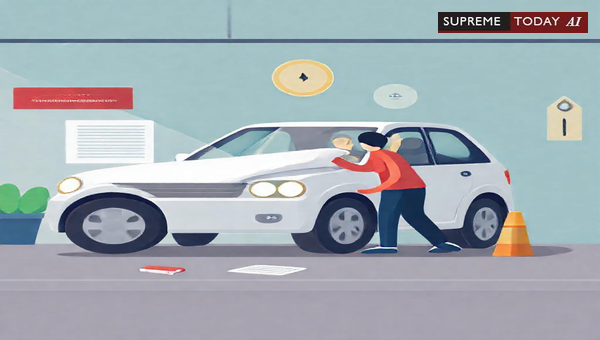
When an Owner Dies Moving His Motorcycle in a Private Garage, Is the Insurer Liable to Pay Compensation?
A tragic and unusual fact pattern recently raised a difficult question: a motorcycle owner was pulling the vehicle out of his home garage when he suddenly felt vertigo, collapsed, and the motorcycle fell on him, causing fatal head injuries. His wife filed a claim against the insurer before the . The insurer refused to pay, arguing that the death did not occur due to the use of the vehicle because the motorcycle was not in use at the time. The complainant insisted that maneuvering the vehicle out of the garage itself amounts to use. Who is right?
The First Hurdle: Was the Vehicle In Use?
mandates insurance against liability arising out of the in a public place. The insurer's instinctive defence — that a motorcycle parked in a garage is not in use — is not the end of the inquiry. When the owner is actively moving or maneuvering the vehicle, there is a genuine argument that the vehicle was in use at that moment.
However, a second and more fundamental problem arises: the accident was caused not by any mechanism or operation of the motorcycle, but by the owner's own medical condition (vertigo). Courts have generally taken the view that where a death results from a — the rider or owner falling due to his own act or condition — the insurer is not liable to pay compensation under the , because the statutory cover does not extend to the risk of death or bodily injury to the owner himself 2025 Supreme(Online)(Tel) 74134 and 2025 Supreme(Online)(Tel) 47585.
The Owner Rule: Section 147 Does Not Cover the Owner's Own Death
The 's position is clear and consistent. In , , the Court held that Section 147 does not require an insurance company to assume risk for death or bodily injury to the owner of the vehicle 2004 7 Supreme 164. The Court further observed that the premium paid under the own damage heading covers damage to the vehicle, not injury to the person of the owner, and that an owner can only claim where a personal accident insurance has been separately taken out 2004 7 Supreme 164.
This principle extends to the owner's . In , , the Court held that cannot apply where the owner of the motor vehicle himself is involved in the accident 2007 1 Supreme 609. In , , the Court articulated the doctrine — a person permitted to ride another's vehicle steps into the shoes of the owner and cannot claim as a third party 2020 1 Supreme 34. By extension, the wife and of the deceased owner step into the shoes of the owner and cannot claim against the insurer of that very vehicle under . This was reaffirmed in , , where the Court reasoned that a person cannot be both claimant and recipient with respect to the same claim 2023 0 Supreme(Bom) 1995.
vs : Why the Type of Cover Matters
The nature of the policy is often decisive in these cases:
- Act (statutory) policy: The owner fulfils only his statutory obligation under Section 147. The insurer's liability is confined to , and there is no liability whatsoever for the death of the owner or his family members 2023 0 Supreme(Bom) 664 and 2009 1 Supreme 447.
- Comprehensive or package policy with : If the insurer has contractually undertaken to compensate for the owner's death or bodily injury, it must honour that contractual liability, even though no statutory liability exists 2012 0 Supreme(Ker) 97.
This distinction proved decisive in similar cases decided by , where the insurer was exonerated on the but the claimants were still held entitled to the of ₹1,00,000 because a premium had been paid for personal accident protection 2025 Supreme(Online)(Tel) 17459.
The Use of Vehicle and Public Place Dimension
Even assuming the claimant could maintain the petition, the declares that third-party harm is deemed to arise out of the use of a vehicle in a public place where the act or omission leading to the accident occurred in a public place 2007 3 Supreme 136. Here, both the maneuvering and the fall occurred inside a private garage, which weakens any argument that the statutory third-party cover was triggered. The in has also analysed the deliberate legislative distinction between ( under ) and (), noting that claims require the accident to arise out of the use of a motor vehicle within the third-party insurance scheme 2012 0 Supreme(Ker) 97.
It is also worth noting that under proceedings, the insurer cannot raise a defence of negligence against the deceased — but that protection is irrelevant where the claim itself is barred because the deceased was the 2022 0 Supreme(Telangana) 61.
Practical Outcomes and Options for the Family
Applying these principles to the garage accident scenario:
- The insurer's objection that the death did not arise out of the carries substantial legal weight, especially because the fall was caused by the owner's own medical condition.
- Even if use were established, the wife, as legal heir of the owner, cannot claim as a third party under Section 147 or against the insurer of the motorcycle.
- The claim survives only if the policy was a comprehensive or package policy including for the owner; the family should carefully examine the policy document.
- Recovery under statutory no-fault provisions against the insurer is generally not available in such a fact pattern; any remedy lies, if at all, within the four corners of the insurance contract.
Key Takeaways
- An accident inside a private garage caused by the owner's own fall from vertigo is unlikely to attract the insurer's statutory liability under Section 147.
- The owner of a vehicle — and his — cannot claim as a third party under against the insurer of the same vehicle.
- under a may be the only viable route to compensation from the insurer.
- Every claim of this kind turns on the precise policy terms; families should insist on a copy of the policy and verify whether owner-driver was included.
This article reflects general legal principles drawn from decided cases and is not a substitute for advice on the specific facts of any individual claim.
#MotorVehiclesAct #InsuranceLiability #Section163A #ThirdPartyInsurance #ConsumerCommission









