


When a Driver Was Never Employed by the Vehicle Owner Who Bears the Accident Liability
A frequent dispute in motor accident compensation cases is whether the registered owner of a vehicle can be made to pay when the person behind the wheel at the time of the crash was not the owner's employee. The question arises in many forms: a garage mechanic taking a car for a test drive, a hirer borrowing a vehicle with its regular driver, or an unauthorised person simply taking the wheel. Claimants naturally look to the owner as the deep pocket, while owners argue they had no control over the driver at all. This article examines how Indian courts resolve that conflict and when an owner may still be held liable despite the absence of an employment relationship.
The General Rule: No Employment, No
The foundational principle is straightforward. An owner of a motor vehicle is generally not vicariously liable for the tortious acts of a person who is not their employee and who was driving the vehicle without the owner's authorisation. under the doctrine of rests on the : the person who has the right to hire and fire the employee is generally responsible for torts committed by that employee during the and within the scope of authority 2022 0 Supreme(Raj) 877.
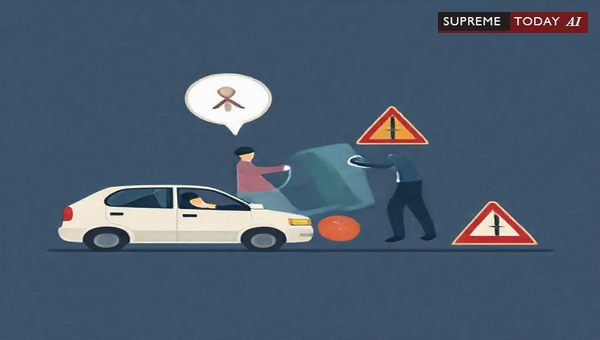
Crucially, this presumption is rebuttable. Where the driver is an or a bailee—such as a workshop entrusted with a vehicle for repairs—the relationship is not one of master and servant. In the garage scenario, courts have observed that the vehicle was entrusted to the workshop for repairs and it is only reasonable to infer permission to take it for test driving as part of the work; the burden then falls on the party alleging excess of authority to prove it 2023 0 Supreme(All) 593. The mechanic driver is not directly the agent of the car owner, even though the garage owner may act as the car owner's agent for various purposes 2023 0 Supreme(All) 593.
The Key Exception: Consent and
The general rule is not absolute. In , the Supreme Court extended the owner's liability beyond strict employment, holding that the owner is not only liable for the negligence of a driver who is his servant acting in the course of his employment but also when the driver is, with the , driving the car on the owner's business or for the owner's purposes 2023 0 Supreme(All) 593 and 2025 0 Supreme(AP) 101 and 1995 0 Supreme(Del) 882.
This extended principle serves a public policy purpose: holding owners accountable for accidents caused by the drivers they entrust vehicles to ensures victims are not left remediless 2025 0 Supreme(AP) 101. Courts have also applied the trend of making the master liable for acts that do not strictly fall within the term in as ordinarily understood, so long as the act was authorised by the owner but done in an unauthorised manner 1995 0 Supreme(Del) 882 and 2019 0 Supreme(Bom) 400.
A related nuance arises in lending arrangements. In , the court held that where a driver remains on the original owner's payroll but works under a hirer's command, the hirer may bear if over the driver was transferred; the original owner can avoid liability by establishing that such transfer occurred 2022 0 Supreme(Raj) 877. , not the payroll, is often the decisive factor.
The Claimant's Burden of Proof
Since is a , the burden of establishing the or the typically lies on the claimant. Practical evidence matters:
- Employment records, wage payments, or FIR references describing the driver's role 2025 0 Supreme(All) 2550
- Proof that the owner handed over the vehicle to a specific authorised driver 2024 0 Supreme(Raj) 315
- Evidence of the owner's duty to verify that the driver held a valid licence at the time of employment, failing which the owner may be liable under the policy 2025 Supreme(Online)(Tel) 26361
Interestingly, employment between family members is not prohibited by law, and courts have upheld employment relationships based on evidence and the peculiar family context even when owners denied them 2023 0 Supreme(J&K) 63.
Insurance Dimensions and Statutory Limits
The employment question also affects insurers. Under the , the insurer is generally not liable to pay compensation in respect of a passenger in a goods vehicle unless that passenger is the owner of the goods or their authorised agent travelling with the goods 2008 0 Supreme(Mad) 4747.
In Swaroop Singh-type litigation involving an unauthorised driver, courts have taken a claimant-protective approach: even where the insurance company is not liable to indemnify the owner due to , it may still be directed to pay compensation to the claimant first, with the right to recover the amount from the owner 2024 0 Supreme(Raj) 315.
When the Owner Can Escape Liability
Owners may successfully resist liability where:
- The driver was acting entirely outside the scope of any authority granted by the owner and without the
- The driver was an or bailee, and the owner retained no over the vehicle's operation
- The driver obtained the vehicle for their own business, even indirectly—for instance, where the de facto driver was neither the driver nor the agent of the owner but one who had obtained the car from a servant of the master, the owner would prima facie not be liable 1987 Supreme(Online)(Ker) 21
However, even a specific instruction—for example, forbidding the driver from carrying passengers—does not always absolve the owner if the underlying act of driving was authorised but performed in an unauthorised manner 2019 0 Supreme(Bom) 400.
Key Takeaways
- An owner is generally not vicariously liable when the driver is not their employee and drove without consent or authorisation.
- Liability can still attach where the driver acted with the owner's actual or implied consent, on the owner's business, or where the owner retained .
- In hiring arrangements, over the driver—not the payroll—determines who is liable.
- The claimant bears the burden of proving the employment relationship or the .
- Insurers may be compelled to pay claimants first despite policy breaches, with recovery rights against the owner.
Each case ultimately turns on its facts. This discussion is general information based on judicial precedents and should not be treated as advice on any specific claim.
#VicariousLiability #MotorAccidentClaims #MotorVehiclesAct #VehicleOwnerLiability #CompensationLaw









