


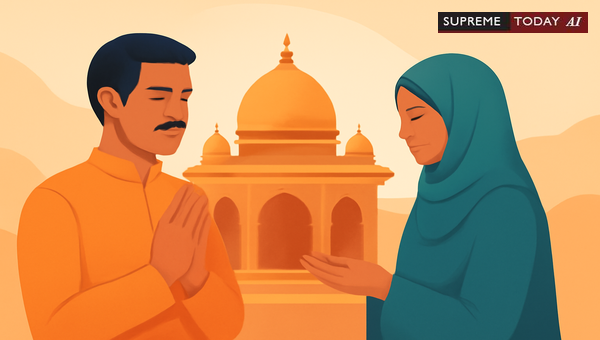
Can a Muslim Be of a Hindu Temple? Legal Analysis
In India's diverse legal landscape, questions at the intersection of religion and family law often arise. One such intriguing query is: Can a Muslim be of a Hindu temple? This role, central to Hindu Undivided Families (HUFs), raises issues of religious identity, property management, and statutory frameworks. While temples may have unique management structures, the position is fundamentally tied to Hindu law principles.
This article delves into the legal framework, historical context, and modern interpretations to provide clarity. Note that this is general information based on established principles and should not be considered specific legal advice—consult a qualified lawyer for personalized guidance.
Understanding the Role of in Hindu Law
Definition and Responsibilities of
The is the manager of a (), typically the eldest male member, who acts on behalf of the entire family. The is the manager of a () and acts on behalf of the entire family. The is typically the eldest male member of the family and has specific rights and responsibilities regarding the management of 2020 1 Supreme 206.
Key powers include:- Managing and alienating for or estate benefit, binding all members, including minors and widows 2022 1 Supreme 755 2020 1 Supreme 206.- Extensive authority, but actions must benefit the family or meet 2019 1 Supreme 670.
A incurs unlimited liability and is representative of the family in all the affairs. The position of in a joint Hindu family is unique. He is that person who takes care of the whole family and its property and administers it and all the members of the family remain in discipline under his control and are bound by his decisions 2019 0 Supreme(Mad) 1884.
Historically, only male Hindus qualified, but the , changed this. Where under the old law, since a female could not act as of the joint family, as a result of the new provision, she could also become of the joint Hindu family 2022 Supreme(Online)(SEBI) 132. Courts have affirmed: We, therefore, conclude that neither the Legislature nor the traditional Hindu Law in any way limits the right of a woman to be a 2023 0 Supreme(Del) 6722.
in the Context of Hindu Temples
While Kartas primarily manage properties, temples often operate under similar joint family or trust structures in Hindu traditions. The role demands alignment with Hindu customs, making religious affiliation pivotal.
Applicability to Non-Hindus: Can a Muslim Assume This Role?
Hindu law's foundations limit the to Hindus. The concept is deeply rooted in Hindu law, which traditionally recognizes only Hindus as members of a . No provisions in the Hindu Succession Act allow non-Hindus as .
Impact of Religious Conversion
Conversion from Hinduism to Islam severs Hindu legal ties. When a Hindu converts to Islam, he ceases to be recognized as a Hindu under law, and his societal and legal status changes accordingly. A converted person loses rights to joint family management, governed instead by Muslim 2022 0 Supreme(Mad) 3876.
Did you ever inform any Muslim Cleric disclosing that you are still practicing Hindu Religion despite being married to a Muslim? Ans. No. This snippet highlights identity conflicts in mixed contexts 2025 Supreme(Online)(DEL) 98. Post-conversion, one is no longer a in .
Muslim Law's Distinct Framework
Muslim lacks a equivalent. Under Muslim Law, the concept of a does not exist; family management is not vested in a single head akin to Hindu Law's . Property rights accrue via inheritance post-death, not lifetime joint management 2022 0 Supreme(Guj) 1064.
The , governs Muslims, excluding Hindu Succession Act application 2022 0 Supreme(Raj) 1236. (b) the in the case of a ()—this explicitly ties the role to HUFs, not other faiths 2018 0 Supreme(Mad) 489.
Key Legal Precedents and Considerations
No direct precedents permit a Muslim as of a Hindu temple. Cultural-religious ties reinforce exclusivity: the role embodies Hindu family customs.
Related cases emphasize Hindu status:- Similarly, the validation of the claim... would be sustainable only if the suit property was an absolute property... and not if it was purchased by Shri R.G. Nayar as a of a 2013 0 Supreme(Del) 1778.- Women post-: Now that this disqualification has been removed by the Amendment, there is no reason why Hindu women should be denied the position of a 2022 Supreme(Online)(SEBI) 132. Note Hindu women—reinforcing religious requirement.
For temples, or under state laws (e.g., ) typically require Hindu trustees, extending to managerial roles.
Practical Implications and Alternatives
If a temple or needs management:- Appoint a Hindu as for compliance.- Explore trusts, societies, or court-appointed receivers for non-traditional setups.- In interfaith families, partition shares before conversion to avoid disputes.
Where such person is a , the of that 2018 0 Supreme(Mad) 1984—official documents consistently link to Hindu structures.
Conclusion and Key Takeaways
Generally, a Muslim cannot be of a Hindu temple or . The position is reserved for Hindus under Hindu law, with conversion to Islam terminating eligibility. This reflects deep-rooted religious and legal distinctions between Hindu joint family systems and Muslim personal laws.
Key Takeaways:- role is unique to Hindu Undivided Families 2019 0 Supreme(Mad) 1884.- Non-Hindus, including Muslims, lack recognition due to faith-based governance.- Amendments expanded to Hindu women but not beyond faith boundaries 2022 Supreme(Online)(SEBI) 132 2023 0 Supreme(Del) 6722.- Conversion shifts to Muslim law, sans concept 2022 0 Supreme(Guj) 1064 2022 0 Supreme(Mad) 3876.
For specific scenarios, seek expert legal counsel. Understanding these nuances helps navigate India's pluralistic legal framework effectively.
Word count: 1028. References include 2020 1 Supreme 206, 2022 1 Supreme 755, 2019 1 Supreme 670, 2019 0 Supreme(Mad) 1884, 2022 Supreme(Online)(SEBI) 132, 2023 0 Supreme(Del) 6722, 2025 Supreme(Online)(DEL) 98, 2018 0 Supreme(Mad) 489, 2013 0 Supreme(Del) 1778, 2018 0 Supreme(Mad) 1984, 2022 0 Supreme(Guj) 1064, 2022 0 Supreme(Raj) 1236, 2022 0 Supreme(Mad) 3876.
#HinduLaw #Karta #LegalInsights












