


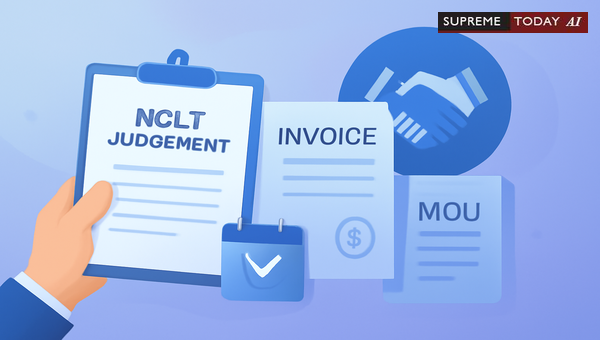
NCLT Judgments: Determining When No Payment Date is Mentioned in Invoice
In the complex world of under the , establishing the is crucial for filing applications before the (NCLT). But what happens when an invoice is silent on the payment due date? This is a common scenario in commercial disputes, where NCLT judgements on come into play.
Imagine issuing an invoice for goods or services supplied, only to find no explicit payment term mentioned. Does this ambiguity derail your insolvency petition? Generally, no. Courts and tribunals typically look beyond the invoice to , conduct of parties, or related agreements to pinpoint the date. This blog post delves into key legal principles, NCLT precedents, and practical recommendations, drawing from established rulings. Note: This is general information and not specific legal advice. Consult a qualified lawyer for your case.
The Core Legal Issue: Absence of Specific Payment Date
The question at hand is straightforward yet pivotal: NCLT Judgement on when no Date of Payment is Mentioned in Invoice. Without a clear due date, creditors risk challenges on or the very existence of , as NCLT emphasizes proving before admitting applications. 2018 0 Supreme(UK) 22
Under , '' occurs when the fails to pay a . But when is it 'due'? NCLT rulings clarify that silence in the invoice does not preclude determination; instead, tribunals infer from:- or party conduct.- Acknowledgments of debt.- Contractual arrangements like Memorandums of Understanding (MoUs).
Legal Principles from NCLT and Appellate Tribunals
NCLT and the (NCLAT) adopt a pragmatic approach. When an invoice lacks a payment date, the focus shifts to implicit indicators:
and MoU Terms: If parties have an MoU specifying payment schedules, the date aligns with the due date therein, even sans invoice mention. For instance, invoices raised prior to entering into the Memorandum of Understanding, for arriving at the . 2024 Supreme(Online)(NCLT) 4090
: Letters, credit memos, or correspondence can establish the date. Tribunals hold that the date can be reasonably inferred from the earliest acknowledgment or the agreed schedule for payments. 2022 0 Supreme(SC) 794
Conduct and Correspondence: Subsequent interactions often reveal when payment was expected. In , ties to the first unpaid instance, like the last was committed on , wherein payment against invoice dated ... was defaulted.
NCLT stresses: Limitation starts from the 'date ,' requiring substantiation of date, often via details. Based on the above judgements it is evident that limitation starts from the date ‚‛ the applicant couldn’t substantiate on ... 2023 Supreme(Online)(NCLT) 1765 2023 Supreme(Online)(NCLT) 1766
Judicial Precedents: How NCLT Determines Date
NCLT cases illustrate nuanced applications:
Reliance on MoUs and Mutual Obligations: In one ruling, payment obligations stemmed from Clause 10 of an MoU, recording mutual obligations. Even without invoices, the MoU set the timeline.
Invoice Due Dates When Specified: Where mentioned, like the due date of the Last invoice... was , which is to be considered as the date, it governs. 2024 Supreme(Online)(NCLT) 4015
Challenges in Absence of Clarity: Tribunals reject arbitrary dates. The Operational Creditor has... arbitrarily mentioned the as regards certain invoices to be ... Subsequent can recalibrate. 2024 Supreme(Online)(NCLT) 4090
and First : For ongoing dealings, has been occurring since when the payment against the first invoice... dated .
The first invoice's date, like , marks the start. 2024 Supreme(Online)(NCLT) 2604
Multiple precedents affirm: Without explicit dates in invoices or ledgers, isn't presumed from issuance alone. Courts consider the date when the debt becomes due and payable, often relying on contractual terms, , or subsequent correspondence. 2023 Supreme(Online)(NCLT) 1353 2023 Supreme(Online)(NCLT) 1230 2023 Supreme(Online)(NCLT) 3203
Even in tax contexts, analogous principles apply: when is the 'date of receipt of payment' where no tax invoice is issued... the earlier of (i) the date on which the payment is entered in the books... 2021 0 Supreme(Bom) 975
and Evidence Requirements
Limitation under IBC aligns with the . No acknowledgment? Proceedings may fail: neither any other has been stated... nor any suggestion about any acknowledgement. 2020 5 Supreme 159
Where agreements specify, like the agreement spells out the date when the payment is due, applies. 2018 0 Supreme(Del) 2354 Or invoices noting due date for payment of invoice was . 2018 0 Supreme(Guj) 678
Key Evidence to Gather:- MoUs or settlement agreements.
- Acknowledgment letters or emails. 2022 0 Supreme(SC) 794- Payment ledgers showing due dates.- Correspondence implying timelines, e.g., proforma to final invoices adjusting for fluctuations. 2007 0 Supreme(Del) 1515
Practical Recommendations for Creditors
To avoid pitfalls:- Document Explicitly: Always include payment terms in invoices and agreements.- Preserve Records: Collate MoUs, emails, and ledgers proving .- Substantiate in Petitions: Clearly state date in with supporting rationale.- Anticipate Disputes: In , track first meticulously.
NCLT favors well-evidenced claims, ensuring a comprehensive and legally sound determination of the date. 2018 0 Supreme(UK) 22
Conclusion and Key Takeaways
NCLT jurisprudence confirms: No explicit payment date in an invoice does not bar establishing . Rely on , MoUs, acknowledgments, or conduct to infer the date when debt became due and unpaid. This approach upholds IBC's objective of timely resolutions while safeguarding against unsubstantiated claims.
Key Takeaways:- date inferred from MoUs, acknowledgments, or correspondence when invoice silent.
- Limitation accrues from 'right to apply' date; substantiate rigorously. 2023 Supreme(Online)(NCLT) 1765- Tribunals scrutinize arbitrary dates, favoring contractual or evidential clarity.- Proactively document to strengthen insolvency applications.
Stay informed on evolving precedents. For tailored guidance, engage insolvency experts.
#NCLT, #InsolvencyLaw, #DefaultDate












