Searching Case Laws & Precedent on Legal Query..!
Scanned Judgements…!



Searching Case Laws & Precedent on Legal Query..!
Scanned Judgements…!
Enforceability of Debt under the Negotiable Instruments Act (N.I. Act) - For a cheque to constitute an offence under Section 138, it must represent a legally enforceable debt or liability at the time of encashment. The debt must be legally valid, supported by proper documentation like accounts or income tax returns, and issued specifically to discharge such debt 2024 0 Supreme(SC) 1374, 2023 0 Supreme(Bom) 1154,
Ketanbhai Natwarbhai Patel Thro Poa Vinodbhai Manibhai Patel VS State of Gujarat - Crimes
.Timing of Debt Enforceability - Even if money was lent jointly or in the past, the cheque must reflect a legally enforceable debt at the time of dishonour. A cheque issued for a debt that was not enforceable at the time of encashment (e.g., due to expiry, absence of documentation, or non-existence of debt at that time) does not attract liability under Section 138 2022 8 Supreme 240.
Burden of Proof and Presumption - The statutory presumption under Section 139 of the N.I. Act presumes that the cheque was issued for a legally enforceable debt. However, the accused can rebut this presumption by proving the absence of such enforceability, such as lack of proper documentation or that the debt was not legally recoverable at the time of dishonour 2023 0 Supreme(Bom) 1154.
Joint Lending and Liability - Even if money was jointly lent, the enforceability depends on whether the cheque was issued specifically to discharge a legally enforceable debt. The mere fact of joint lending or signature does not automatically establish enforceability; proof of the debt's validity and documentation is essential 2021 Supreme(Online)(MAD) 49854, 2022 Supreme(Online)(MAD) 18118.
Money Lending Without License - If the lender is unlicensed and fails to maintain proper accounts, establishing enforceable debt becomes more challenging. The burden shifts to the lender to prove the debt was legally enforceable, which may be rebutted if the lender cannot substantiate the loan with proper evidence 2021 Supreme(Online)(MAD) 49854.
Company and Personal Capacity - When cheques are issued by a company or authorized signatory for debts owed personally, enforceability hinges on whether the debt was a legally enforceable liability at the time of cheque issuance. Cheques issued for personal loans but signed by authorized representatives are valid if the debt was enforceable then 2024 0 Supreme(Guj) 1043.
Analysis and Conclusion:
A cheque, even if issued jointly or for a loan, is only legally enforceable if it reflects a legally valid and enforceable debt at the time of dishonour. The enforceability depends on proper documentation, timing, and proof of debt. The mere issuance of a cheque does not automatically establish enforceability; the claimant must prove that the debt was legally enforceable at the relevant time. When the debt was not enforceable at the time of encashment, or if the debt was not properly documented, the offence under Section 138 of the N.I. Act may not be attracted, even if money was jointly lent or the cheque was issued for a prior loan.
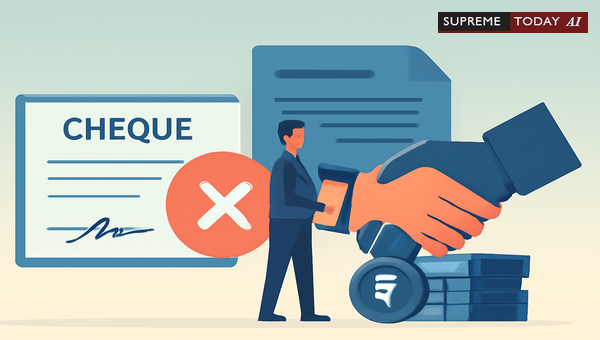
In the world of business and personal loans, cheques are a common payment method, but what happens when a cheque bounces under the ? A frequent question arises: Ni Act Enforceable Debt Even when Money was Jointly Lent? This issue is critical for lenders and borrowers alike, especially in joint lending scenarios where multiple parties are involved.
Under , issuing a cheque that bounces due to insufficient funds or similar reasons can lead to criminal liability—but only if the cheque was issued for a or liability. When money is lent jointly to multiple borrowers, enforceability hinges on factors like authorization to issue the cheque, the validity of the debt, and supporting documentation. This post breaks down the legal nuances, key court rulings, and practical advice to help you navigate these complexities. Note: This is general information, not specific legal advice. Consult a qualified lawyer for your situation.
The enforceability of a debt under the NI Act when funds are jointly lent depends on whether the cheque was issued for a . Courts examine the transaction's nature, parties' relationships, and available documentation. Crucially, the cheque must be issued by a person authorized and liable to pay that debt 2017 0 Supreme(AP) 536.
If funds are advanced jointly, liability doesn't automatically extend unless the cheque issuer represents all borrowers or has explicit authority 2021 3 Supreme 612. creates a that the cheque was issued to discharge a , but this can be challenged if the debt lacks validity or enforceability
.
For instance, in cases of joint loans, a cheque from only one borrower may not suffice unless authority from all is proven 2021 3 Supreme 612.
The NI Act presumes a bounced cheque represents a
. However, the accused can rebut this by showing:- The cheque wasn't for a valid debt.- The debt is time-barred or lacks consideration 2017 0 Supreme(AP) 536.
Even antecedent debts from years prior can remain enforceable with documentation or acknowledgments 1997 2 Supreme 658. Yet, without promissory notes, accounts, or ITR evidence, claims weaken 2024 0 Supreme(SC) 1374 2023 0 Supreme(Bom) 1154.
As noted, The term debt would mean the ‘’ under the explanation to 2023 4 Supreme 711. If the debt extinguishes (e.g., via insolvency under ), Section 138 liability vanishes.
Joint loans complicate matters. Liability typically requires the cheque to be issued by all joint borrowers or an . A non-signatory or unauthorized person can't be prosecuted under Section 138, even if jointly liable 2021 3 Supreme 612.
Courts clarify: a person who is signatory to cheque and cheque is drawn by that person on an account maintained by him and cheque has been issued for discharge, in whole or in part, of any debt or other liability... can be said to have committed an offence2021 3 Supreme 612.
In joint family or partnership scenarios, like where a father-in-law and daughters ran firms, mere joint involvement doesn't prove debt if signatures or liability are disputed 2022 Supreme(Online)(Mad) 101987. Similarly, loans between spouses (e.g., Rs.5,93,500/- from ) need proof of enforceability 2025 Supreme(Online)(Mad) 62793.
Lenders must substantiate claims with evidence. Absence of records—like promissory notes or affidavits—allows rebuttal. In one case, despite an agreement and promissory note, the presumption was rebutted as no loan was advanced to him even though there was an agreement and a corresponding promissory note and an affidavit
.
Unlicensed money lending further burdens the lender, as courts demand proper accounts 2021 Supreme(Online)(MAD) 49854. Cheques given as 'security' with deposit conditions may not trigger Section 138 unless tied to an enforceable debt 2022 0 Supreme(Guj) 161.
The debt must be enforceable at the time of dishonour. A cheque for a past joint loan fails if undocumented or expired 2022 8 Supreme 240. Endorsements like Account Closed rebut presumptions if debt isn't proven 2021 0 Supreme(Guj) 977.
Payments reducing debt (e.g., Rs.25,000/- paid) can eliminate liability if no balance remains 2018 0 Supreme(P&H) 3932.
.
Historical cases echo this: Even shop debts from weren't enforceable without fresh proof
.
To strengthen your position:- Secure Joint Signatures: Ensure cheques are from all borrowers or authorized representatives.- Document Thoroughly: Use promissory notes, acknowledgments, account statements, and ITRs.- Time Cheques Properly: Issue for current enforceable debts, not barred ones.- Rebut Strategically: Borrowers, gather evidence like payment proofs or loan non-existence.
In partnerships or family loans, clarify capacities in writing 2022 Supreme(Online)(MAD) 18118.
Under the NI Act, a cheque for jointly lent money may be enforceable if it represents a legally valid debt, issued by an authorized party, and backed by documentation. The Section 139 presumption favors holders, but robust rebuttals often succeed without proof 2023 0 Supreme(Bom) 1154.
Key Takeaways:- Prioritize authorization in joint scenarios 2021 3 Supreme 612.- Debt must be enforceable at dishonour 2022 8 Supreme 240.- Documentation trumps presumptions 2017 0 Supreme(AP) 536.
Stay proactive to avoid disputes. For tailored guidance, seek professional legal counsel.
#NIAct, #ChequeBounce, #JointDebt


Even then, the liability has to be discharged by the person(s) concerned and that would be a legally enforceable debt repayable, under the purview of Section 138 of the Act. ... Learned counsel for the petitioners submitted that the cheque(s) must be proved to have been issued for a legally enforceable debt, but in the present cases, the complainant has not produced any statement of acc....

At the core, the issue is whether the offence under Section 138 of the Act would deem to be committed if the cheque that is dishonoured does not represent the enforceable debt at the time of encashment. ... Though a post- dated cheque might be drawn to represent a legally enforceable debt at the time of its drawing, for the offence to be attracted, the cheque must represent a legally enforceable....

On that premise it was held that to attract Section 138 of the Act of 1881 the debt had to be a legally enforceable debt as per the ‘explanation’ to Section 138 of the Act of 1881. ... The presumption mandated by Section 139 of the Act of 1881 included the presumption of existence of a legally enforceable debt or liability and it was for the accused to....

Negotiable Instruments Act (in short 'the NI Act') alleging that the respondent's wife lend money as loan in favour of the petitioner's wife to the tune of Rs.5,93,500/- from 13.04.2016 to 10.09.2017.

Except the cheque, promissory note and the communications between the Bank and the appellant, the appellant did not produce any other documents to show that on 01.07.2005, he lent money to the respondent and the respondent issued the disputed cheque only to discharge the legally enforceable debt, whereas ... The respondent did not issue any cheque in favour of the appellant to discharge the legally enforceable#HL....
money to the respondent and the respondent issued the disputed cheque only to discharge the legally enforceable debt, appellant to discharge the legally enforceable debt. ... The respondent's father-in- law and his three daughters were jointly running a partnership firms and in signature is admitted by the respondent, he has denied the liability.

It has to be noted that any money lent by the complainant in his capacity as a money lender without appropriate license will fall him into category of legally enforceable debt. ... Even from the very cross-examination of P.W.1 himself, it is exhibited that he is not maintaining accounts for the money lent by him. ... If the said fact is established by....

Explanation.— For the purposes of this section, “debt or other liability” means a legally enforceable debt or other liability.] 141. ... —Where any cheque drawn by a person on an account maintained by him with a banker for payment of any amount of money to another person from out of that account for the discharge, in whole or in part, of any debt or other liability, is returned by the bank unpaid, ei....

Explanation.- For the purposes of this section, “debt or other liability” means a legally enforceable debt or other liability.] 141. Offences by companies. ... -Where any cheque drawn by a person on an account maintained by him with a banker for payment of any amount of money to another person from out of that account for the discharge, in whole or in part, of any debt or other liability, is returned by ....
Even at that date (the 14th December, 1894) action on the shop debt (save an item of 25 cents) was statute barred. ... Prescription-Goods sold and money lent-Payment on account-Appropriation of payment-Bides relating to such appropriation. ... Where plaintiff sued defendant for balance value of goods sold and delivered between 17th December, 1892, and 9th January, 1894, and for money #HL_STAR....

This may be read with Section 2(6) & 2(8) resply of the IBC. The term debt would mean the ‘legally enforceable debt’ under the explanation to Section 138 of the NI Act. Once the debt itself gets extinguished either under Section 31 of the IBC or in the process from Sections 38 to 41 and 54 resply of the IBC, the basis of Section 138 of the NI Act no longer remains. B. The liability is primarily of the company and prosecution of natural persons under Section 141 of the NI Act ....
It specifically mentions that the cheque in question has been given as 'security' and also lays down the conditions as to when the said cheque shall be deposited. In the case of Lalit Kumar Sharma v. State of Uttar Pradesh, 2008 (5) SCC 638, the facts were that a Company, named M/s. Mediline India (P) Ltd. had taken loan of Rs.5 Lacs from the complainant. It is a settled proposition of law that proceedings under Section 138 of the NI Act would lie only in respect of any 'enforceable ....
Thus, the aforesaid decision also, would be of no help to the complainant. Indisputably, the complainant has deposited the cheque in question on 16.05.2003, which was dishonoured with an endorsement “Account Closed”. Thus, the respondent No. 1 appears to have rebutted the presumption under the provisions of Section 139 of the NI Act besides the fact that, the debt is not proved to be the legally enforceable debt. 7.3 In NEPC Micon Ltd. and Others (supra), the Court has held t....

So, keeping in view the above said discussion, it becomes clear that the accused has discharged his legal liability on 25.06.2006 by making payment of Rs. 25000/- to the employee of the complainant firm and there was no legally recoverable debt standing against the accused for which he cold have issued the cheque in question. So, keeping in view the above said discussion, it becomes clear that the complainant miserably failed to prove on record any legally enforceable debt against the accused ....
The aforesaid loan was not shown in the ITR return of the petitioner. Keeping the above proposition of law in mind, on an analysis of fact, the scale of balance tills in favour of the respondent. The respondent appears to have rebutted the presumption under Section 139 of the NI Act, namely, the existence of a legally enforceable debt by establishing that no loan was advanced to him even though there was an agreement and a corresponding promissory note and an affidavit. An ad....


An indispensable Tool for Legal Professionals, Endorsed by Various High Court and Judicial Officers
Please visit our Training & Support
Center or Contact Us for assistance

Scan Me!
India’s Legal research and Law Firm App, Download now!


For Daily Legal Updates, Join us on :



 Back to top


