


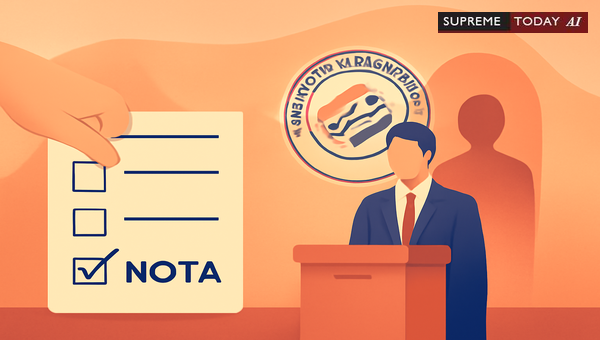
Can NOTA Prevent Wins in India?
In India's vibrant democracy, the 'None of the Above' (NOTA) option empowers voters to reject all contesting candidates, introduced by the in to enhance voter choice. But what happens in an , where only one candidate files nomination? Can the mere availability of NOTA stop that candidate from being declared elected? This question often arises amid debates on and voter expression.
We'll examine the legal position, drawing from guidelines and . Note: This is general information based on available legal documents and not specific legal advice. Consult a qualified lawyer for your situation.
What is NOTA and How Does It Work?
NOTA, or 'None of the Above,' appears as the last option on , allowing voters dissatisfied with candidates to register their protest without abstaining entirely. As per instructions from the , marking preferences against NOTA has specific rules: Marking against NOTA is to be done by writing figures 1, 2, 3, etc., and if preference ‘1’ is marked against NOTA, the is invalid. 2018 0 Supreme(SC) 834
If preferences are marked for both candidates and NOTA, the remains valid, and votes are counted accordingly. 2018 0 Supreme(SC) 834 However, these rules primarily apply to contested elections with multiple candidates.
Uncontested Elections: The Default Rule
In uncontested or , only one candidate remains after . The general principle under Indian election law is straightforward: when only one candidate contests, that candidate is declared elected by default, unless there is a legal or . 2018 0 Supreme(SC) 916 2002 4 Supreme 294
No formal vote count is required. The declares the candidate elected under relevant provisions like . The presence of NOTA does not alter this, as there is no 'contest' to reject—voters aren't choosing between options but simply participating in a procedural vote.
Key points from legal documents:- NOTA serves as a democratic safeguard in contested polls but doesn't invalidate automatic declarations in uncontested scenarios. 2018 0 Supreme(SC) 834- Judicial opinions confirm: if an election is uncontested, the candidate’s election is not dependent on the voting process or the availability of NOTA. 2018 0 Supreme(SC) 834 2018 0 Supreme(SC) 916 2002 4 Supreme 294
Does NOTA Override Uncontested Declarations?
No, typically not. The law emphasizes NOTA's role in contested elections, where it expresses voter preference for 'none.' In uncontested cases:- The election is automatic, as there is no contest. 2018 0 Supreme(SC) 834- Voters may still press NOTA, but it doesn't trigger re-elections or disqualify the sole candidate.
The in the NOTA judgment (People’s Union for Civil Liberties) upheld it as a voter right, but didn't extend its effect to uncontested polls. Relatedly, A voter who is not satisfied with any of the candidates... can opt not to vote for any candidate. 2015 8 Supreme 641 This reinforces NOTA as an individual choice, not a mechanism to nullify unopposed wins.
on
Courts have consistently upheld declarations in uncontested scenarios. For instance, in a case under the , after unseating an elected candidate, the court declared the sole remaining candidate elected: The can declare the sole candidate elected, post unseating the elected candidate, by 'amending the declared result of the election' under . 2016 0 Supreme(Bom) 6
This mirrors uncontested logic—no need for further contest if only one valid candidate exists. Similarly, None of the respondents have cited any judgment... which can be said to have laid down a law that if there are two candidates involved in an election and if the elected candidate is unseated, the Court cannot declare the surviving candidate as elected. 2016 0 Supreme(Bom) 6
In legislative contexts, resignation or doesn't retroactively affect unopposed declarations unless specified. 2016 0 Supreme(Ker) 242
Insights from Related Election Cases
While direct NOTA-uncontested rulings are sparse, analogous cases clarify principles:
Voter Information and Rights: Full disclosure of candidate antecedents is mandatory, enabling informed NOTA choices. Non-disclosure can amount to or , but this applies to contested filings. If a voter is denied... the entire gamut of criminal antecedents... the exercise of electoral right would not be an advised one. 2015 8 Supreme 641
Ex-Parte and Uncontesting Parties: In civil suits, uncontesting defendants aren't equated to contesting ones for procedural notices, avoiding absurdity. This procedural distinction parallels elections: uncontested candidates proceed by default. 2019 0 Supreme(Ker) 865
Nuances: A candidate need not be declared disqualified if resignation is accepted, distinguishing from requiring trials. The said decision has no application... where the petitioner need not be declared as disqualified in case his resignation is accepted. 2016 0 Supreme(Ker) 242
These reinforce that uncontested elections follow simplified rules, unaffected by NOTA unless explicitly legislated.
Exceptions and Limitations
While the default holds, exceptions may apply:- Legal Disqualifications: If the candidate is ineligible (e.g., conviction under ), election fails regardless of contest status.- Procedural Irregularities: Improper nomination scrutiny could invite challenges.- Specific Rules: Local body or state laws might differ, e.g., requiring minimum votes (rare for uncontested).
No current documents indicate NOTA triggers these in uncontested polls. 2018 0 Supreme(SC) 834 2018 0 Supreme(SC) 916
Recommendations for Clarity
- Election authorities should explicitly state NOTA's non-impact on uncontested declarations.
- Amend laws to address ambiguities, ensuring voter options don't undermine procedural efficiency.
- Candidates in potential uncontested races should ensure full compliance with disclosure norms to preempt challenges. 2015 8 Supreme 641
Key Takeaways
- Yes, uncontested candidates can generally be elected despite NOTA: Law supports automatic declaration. 2018 0 Supreme(SC) 916 2002 4 Supreme 294
- NOTA empowers voters in contests but doesn't halt unopposed wins.
- Judicial trends favor efficiency in uncontested scenarios. 2016 0 Supreme(Bom) 6
- Always verify with latest advisories or legal counsel.
In summary, while NOTA strengthens democracy, it doesn't preclude uncontested elections. This balance upholds both voter voice and electoral practicality. For more on Indian election law, stay tuned.
References:1. 2018 0 Supreme(SC) 834: NOTA instructions.2. 2018 0 Supreme(SC) 916: Uncontested principles.3. 2002 4 Supreme 294: Election declarations.4. 2016 0 Supreme(Bom) 6: Sole candidate rulings.5. 2015 8 Supreme 641: Voter rights and NOTA.6. 2016 0 Supreme(Ker) 242, 2019 0 Supreme(Ker) 865: Related procedural insights.
#NOTA, #ElectionLaw, #UncontestedElection















