Searching Case Laws & Precedent on Legal Query..!
Scanned Judgements…!



Searching Case Laws & Precedent on Legal Query..!
Scanned Judgements…!
The consistent theme across sources is that children are included in voter lists only if they meet specific legal criteria (age, residence, relation) and are verified through documentary evidence. There is no direct indication that children of a D voter are automatically counted as D voters.
Analysis and Conclusion:
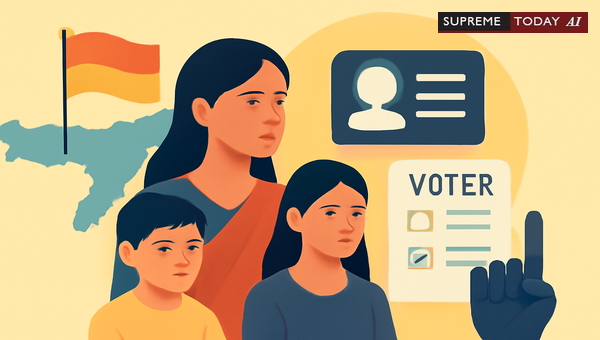
In Assam, the designation of a —or —carries significant implications for citizenship and electoral rights, often stemming from suspicions of illegal migration. A pressing question arises: Children of D voter will be considered as D voter? This issue affects families entangled in the complex web of voter lists, , and the (NRC). While no definitive law automatically tags children with their parents' D-status, judicial precedents offer nuanced insights. This post analyzes key judgments to clarify the landscape, emphasizing that individual cases require professional legal review.
D-voters are individuals marked as doubtful in electoral rolls, typically under the 's scrutiny for citizenship verification, linked to the and . The process began intensifying in the , with references to for resolution. A landmark judgment highlights an individual's challenge to this tag: The petitioner was marked as a D voter in and has continued to be so marked since then 2019 0 Supreme(Gau) 1026. Here, the focus was on the petitioner's right to contest the indefinite D-marking, but crucially, The judgment does not explicitly address the legal status or rights of children of D voters 2019 0 Supreme(Gau) 1026.
This absence underscores a key point: parental D-status does not inherently extend to offspring. Voter eligibility is assessed individually, based on personal residency, documents, and citizenship proof, not familial lineage alone.
Examining the central document 2019 0 Supreme(Gau) 1026, the court addressed an individual's grievance: The petitioner challenges the process that led to his D voter status, asserting that indefinite tagging as D is unjust 2019 0 Supreme(Gau) 1026. The ruling emphasized procedural fairness for the petitioner but remained silent on progeny. Based solely on the provided document, there is no direct discussion, ruling, or legal principle articulated regarding the children of D voters 2019 0 Supreme(Gau) 1026.
Key findings from this case:- status is tied to individual verification processes.- No mention of automatic inheritance by children.- The document's scope: The focus remains on individual voter rights and the process of designation as D 2019 0 Supreme(Gau) 1026.
This suggests children may register independently if they provide sufficient proof of citizenship, such as birth certificates linking to pre- Assam residency or voter lists.
Other precedents reinforce individualized assessment, often in citizenship and residency contexts. For instance, residency claims involving children were dismissed as irrelevant: So far as the allegation that petitioner's children are studying at Hatta or his children got birth at Hatta is concerned, this has no relevance in the present case 2006 0 Supreme(MP) 677. Children's education or birth locations do not determine parental—or their own—voter eligibility.
In citizenship probes, family documents are scrutinized per individual: Similarly the other documents produced by the petitioner regarding the birth of their children deserve no consideration in view of the findings that the name of the mother of the children/petitioner no.2 is shown as Pratibha Das, whereas petitioner no.2 is Pratima Das
. Discrepancies in parental records can impact cases but do not blanket-label children as D-voters.
Foreigners Tribunal cases highlight evidence requirements: Petitioner has not been able to prove the documents as required by law and failed to discharge his burden to prove his citizenship
. Tribunals evaluate voter lists and police verifications holistically 2024 0 Supreme(Gau) 1210, remanding matters if key evidence like family voter lists is overlooked: The court found that the Tribunal failed to consider crucial evidence, including police verification reports and voter lists 2024 0 Supreme(Gau) 1210.
Residency definitions further clarify: ‘Reside’ means dwell permanently or for considerable period 2006 0 Supreme(MP) 677. Property ownership alone does not suffice; actual living arrangements matter, applicable to children claiming voter status independently 2024 0 Supreme(P&H) 1336.
In co-operative society elections, voter lists exclude unqualified minors or non-members, but this is procedural, not citizenship-based: The minor who was not qualified to be a member of the Society has also been listed as a voter 2024 0 Supreme(Bom) 244. Objections must align with specific rules like 2024 0 Supreme(Bom) 244.
persistence across lists is noted: Since the year and the subsequent voter lists, he was categorized as the 'D' Voter 2021 0 Supreme(Gau) 419. Yet, family members appeared without the tag, implying no automatic extension.
Challenging D-status involves notices from Tribunals: Notice issued to petitioner, being crucial and Critical for decision of Court 2021 0 Supreme(Gau) 419. Proceedees can question reference validity before merits. Bail and hearings are directed in ongoing cases: It is expected that the Tribunal will fix the next immediate date for hearing within a reasonable time 2020 0 Supreme(Gau) 192.
Evidence like voter IDs must predate elections: Petitioners have filed copies of voter I.D’s and it is noticed therefrom that voter I.D’s have been downloaded in the month of only 2025 Supreme(Online)(Tel) 60587. Post-notification claims are often rejected.
Panchayat voter lists consider '' status: A person is not deemed solely based on property ownership; residency must be established through actual living arrangements 2024 0 Supreme(P&H) 1336.
While no judgment explicitly states children of D-voters are D-voters, the pattern is clear: status is personal. Children born in India to D-voters may claim citizenship under the , if parents are citizens or legal residents. However, in Assam's unique context, linkage to cutoff is critical.
Practical steps typically recommended:- Gather pre- documents (voter lists, land records).- File objections or claims with .- Approach or for relief.- Consult Election Commission guidelines.
.
In summary, children of D-voters are generally not considered D-voters by default, but verification is case-specific. This post draws from judgments like 2019 0 Supreme(Gau) 1026, 2024 0 Supreme(Gau) 1210, and others for informational purposes. It is not legal advice—seek counsel from qualified attorneys or the Election Commission for personalized guidance, as laws may evolve.
#DVoterStatus, #AssamElectionLaw, #CitizenshipIndia


The expression “absenting temporarily” has been considered in many cases by the Courts and has been interpreted. ... In the instant case, the petitioner contends that he owns an ancestral house in Duggirala village and his father has settled that house in the name of the children of the petitioner and his mother and he is the guardian of the children and his mother and as such, he owns a house in Duggirala village ... If any such application is filed, satisfying requirements of law, as discussed supra, the same has to be conside....

It is further case of the appellant that, the respondent No.4 has suppressed the material facts before the respondent No.2 about the fact that he having three children i.e. one male child namely Mr. Aakash Jaiswal born on 13.02.1987, and two female children viz., Ms. ... In normal circumstances, it is highly improbable for any third person to get possession of original Voter Identity Card pertaining to any third party. ... Whether the respondent No.4 has three children, and therefore liable to be disqualified under Sect....

The minor who was not qualified to be a member of the Society has also been listed as a voter. The evidence placed on record was not considered. ... He was not the member disqualified to be a voter. Therefore, the objection for the members who were not listed in the provisional voters list could not be considered. Rule 11 of the Election Rules, 2014, debars from raising objec tions for the other members. ... However, he shall be a voter. Where a society is a voter, the authorized repre....

a voter for the ward in which he resides. ... ], the Chief Justice held that the person who can object that a voter is disqualified must be a voter in the same ward. ... the Ordinance was a step in the matter of the revision of the lists, that such revision was pending at the date when the amending Ordinance came into force and that in view of the provisions of section 5 (3) of the Interpretation Ordinance only the provisions of the principal Ordinance could be considered ... Held, that a person claiming to be r....
Petitioners have filed copies of voter I.D’s and it is noticed therefrom that voter I.D’s have been downloaded in the month of December, 2025 only. 6. In view thereof, the claim of the petitioners cannot be considered. ... Learned counsel for the petitioners submitted that petitioners have been issued voter I.D’s, however, their names were not included in the voters list and they are not permitted to vote. ... He even submitted that the petitioners have made representation subsequent to the Election Notification and ther....

Petitioners have filed copies of voter I.D’s and it is noticed therefrom that voter I.D’s have been downloaded in the month of December, 2025 only. 6. In view thereof, the claim of the petitioners cannot be considered. ... Learned counsel for the petitioners submitted that petitioners have been issued voter I.D’s, however, their names were not included in the voters list and they are not permitted to vote. ... He even submitted that the petitioners have made representation subsequent to the Election Notification and ther....

So far as the allegation that petitioner's children are studying at Hatta or his children got birth at Hatta is concerned, this has no relevance in the present case. ... Because merely, the children are studying at Hatta which is better place for education or the birth of children took place at Hatta will not be a ground to presume that the petitioner is an ordinarily resident of Hatta. ... So far as the contention that children of the petitioner are studying at Hatta is concerned, there is no documenta....

Similarly the other documents produced by the petitioner regarding the birth of their children deserve no consideration in view of the findings that the name of the mother of the children/petitioner no.2 is shown as Pratibha Das, whereas petitioner no.2 is Pratima Das. ... The father of the petitioner no.2 was a voter in the voter list of 1971 of 85-Raha Constituency at village Khaliamari in Nagaon district. ... We have considered the submissions of the learned counsel for the petitioner that the above ....

In his cross-examination, though the DW-2 has stated that the petitioner has 7 children, but he could state the names of only 3 children. 7. One Khagen Kairy was examined as DW-3, who was the then Gaon Panchayat Secretary. ... In light of the discussions made in paragraphs 13 to 19 above, the Court is of the considered opinion that as the learned Member, Foreigners Tribunal No. 8th, Goalpara in F.T. Case No. 754/2017, had not considered the two set of docments, viz. ... Thereafter, the certified copies of three #HL_START....

Subsequently, the matter was considered and an order became passed whereby the respondents were shown to be the residents and voters of gram panchayat Duta, having H.B. ... The objections were filed before the Electoral Registration Officer, and when the same were not considered, therebys the petitioner filed CWP2336-2018. In the said writ petition, the official respondents were directed to consider and decide the representation. ... The petitioner is resident of Village Kua Diary, Tehsil Patran, District Patiala and his name was duly reflected in the #HL_....

O.P No. 2 has produced voter I.D card, duplicate I.D card, affidavit of Muneshwar Singh and voter I.D card of Harendra Kumar Yadav to establish his identity as Ramjee Singh. They have stated that the said Ramjee Singh Yadav was never an employee under BCCL whereas the accused was working for the last 32 to 34 years.
Mr. A.I. Ali, learned Standing Counsel for the Election Commission of India was directed vide order dated 08.01.2018 to inform this Court as to what consequential steps have been taken following marking of the petitioner as Doubtful (D) Voter. Since the year 1997 and the subsequent voter lists, he was categorized as the "D" Voter. His name is also shown along with the other family members in the voter lists of 1985, 1989, 1997, 2001, 2005, 2010, 2016 and 2017. Being aggrieved by the said action and as per the allegation that no show cause notice/notices were served upon him....

So, since 1997, he has been shown in the Voter List as D voter. But, when he shifted to No. 2, Kairigaon Village, his name was displayed in the Voter List of Golaghat District as D voter.
Since then he has been continued to be marked as "D" voter thereby depriving him from exercising his right of franchise. 3. According to the petitioner he was a voter of Samuguri Constituency in the district of Nagaon but in the voter list of 1997 he was marked as "D" voter. Petitioner has questioned the process by which he was marked as "D" voter.
Interestingly, in this certificate, the President referred to the certificate holder i.e., petitioner as a D voter, meaning thereby doubtful (D) voter. This certificate cannot be accepted as a valid piece of evidence for more than one reason. Firstly, we had seen registration of the initial reference against the petitioner in the year 2004. Ext-3 is a certificate dated 13.03.2016, issued by the President, Jhagrarpar Gaon Panchayat, certifying that Halim Khan was the son of Hajarat Khan of village-Jhagrarpar Pt-I under Dhubri Police Station.


An indispensable Tool for Legal Professionals, Endorsed by Various High Court and Judicial Officers
Please visit our Training & Support
Center or Contact Us for assistance

Scan Me!
India’s Legal research and Law Firm App, Download now!


For Daily Legal Updates, Join us on :



 Back to top


