


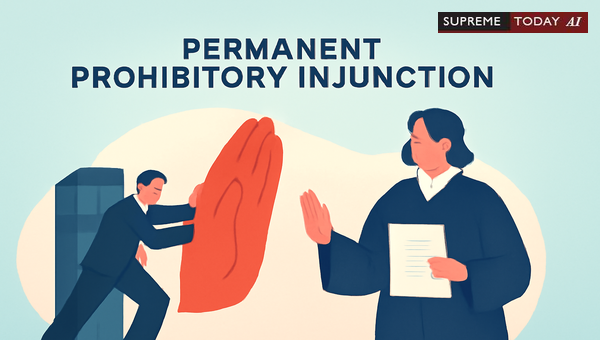
Permanent Injunction Against Industry Obstruction: Key Insights
In property and business disputes, few remedies are as critical as a . Imagine running an industry or business reliant on access to certain land or pathways, only for neighbors or rivals to start obstructing your operations. This is the scenario faced by many plaintiffs who file suits like: Plaintiff Filed a Suit for from Obstructing his Industry. Such cases often hinge on , credible threats of interference, and robust evidence.
This article breaks down the legal framework, drawing from established principles in . We'll explore requirements, relevant case law, and practical steps. Note: This is general information based on precedents and not specific legal advice. Consult a qualified lawyer for your situation.
Understanding Permanent Prohibitory Injunctions
A is a court order that perpetually restrains a defendant from performing acts that violate the plaintiff's rights, such as obstructing access to property or business operations. Unlike temporary measures, it is granted at the suit's final hearing upon merits under .
To succeed, plaintiffs typically must prove:- Ownership or peaceful possession of the property or right in question.- A continuing or imminent threat of interference by defendants.
Courts emphasize possession over title in injunction suits, especially when dispossession is threatened. As one ruling notes, It is not necessary to decide the question of title in a suit for when possession is established 2010 Supreme(Online)(KER) 25239.
Key Legal Principles and Requirements
1. Establishing Possession and Interference
Possession is foundational. Plaintiffs must show they are in actual, peaceful possession and that defendants' actions—like blocking pathways or constructing barriers—constitute unlawful interference.
In a case involving disputed land, the court stressed the need for local investigation to verify possession and obstruction 2002 0 Supreme(HP) 231. Similarly, where defendants obstructed a path essential for industry access, courts considered to restore the status quo 2023 0 Supreme(HP) 444.
From other precedents:- Plaintiffs claiming over pathways succeeded when proving , though decrees must properly schedule properties under
.- Construction like steps for access doesn't violate injunctions if it doesn't impede passage 2025 Supreme(Online)(KER) 14245.
2. Legal Standing ()
Plaintiffs need direct interest, often via revenue records, partition deeds, or prior acknowledgments. One case upheld standing based on peaceful possession threatened by defendants 1995 0 Supreme(SC) 209. Ownership claims in partition orders bolster injunction pleas 2015 0 Supreme(HP) 1631.
3. Interference with Business Operations
Obstructing industry isn't just a property issue—it's economic harm. Courts protect business rights from unlawful interference, as seen where defendants hindered operations, justifying injunctions 2018 0 Supreme(HP) 2282. In a tenancy dispute, forcible eviction without due process was restrained to safeguard business continuity 2013 Supreme(Online)(KER) 36861.
Role of Temporary Injunctions
While pursuing permanent relief, plaintiffs often seek interim protection under to avert immediate harm. For instance, one plaintiff obtained a temporary injunction against construction pending suit resolution 2022 0 Supreme(Ker) 42.
Interim applications accompany main suits, as in a case where I.A No.5387 of restrained trespass on a schedule way 2019 Supreme(Online)(KER) 6795. Courts grant these if case, , and favor the plaintiff.
However, without proof of possession, temporary relief fails—possession typically follows title absent contrary evidence 2021 0 Supreme(P&H) 655.
Insights from Case Law on Execution and Limitations
Even after decree, enforcement matters. Prohibitory injunctions under require precise petitions with evidence of violations. Dismissed executions can be refiled with better proof, like in a right-of-way dispute.
Limitations don't bar execution of mixed mandatory/prohibitory decrees; applies indefinitely for perpetual restraints. Decree for mandatory injunction is granted only consequent to the finding that plaintiff is entitled to permanent injunction. If obstruction continues, that will be violation of decree for permanent injunction also 1999 0 Supreme(Mad) 2735.
are common—defendants may seek their own injunctions, as in suits denying trespass while claiming title 2016 Supreme(Online)(KER) 33691. Plaintiffs must amend plaints if facts change, like actual obstruction post-filing
.
Common Pitfalls and Failed Claims
Suits falter without specifics:- No dates/times for alleged threats: Appellants’ witnesses have not stated as to on which date, respondents threatened to obstruct pathway—There is no specific averment, date and time
.- Pre-existing structures: Walls built before suit negate urgency 2021 0 Supreme(UK) 162.- Missing : Pure injunction suits may fail if title clouds possession; pair with claims 2021 0 Supreme(Bom) 400.
In fraud cases, civil findings bind land tribunals, aiding injunctions tied to title restoration 2008 0 Supreme(Ker) 786. Forged documents prompt preemptive injunctions against alienation 2022 Supreme(Online)(Ker) 73376.
Practical Recommendations
To strengthen a suit like the one for against industry obstruction:- Gather Evidence: Photos, videos, witness statements, revenue records, and site plans proving possession and obstruction.- Seek Temporary Relief: File interim applications promptly to maintain status quo.- Anticipate Defenses: Prepare for , title disputes, or limitation arguments.- Procedural Compliance: Ensure plaints schedule properties correctly and update for new obstructions.- Local Investigation: Request court-commissioned probes for disputed facts.
Courts may remand for amendments or fresh trials if procedural lapses occur
.
Conclusion and Key Takeaways
Plaintiffs seeking permanent prohibitory injunctions against industry obstruction have viable paths under Indian law, rooted in possession protection and business rights. Success demands solid evidence of interference and strategic interim steps. Cases like those emphasizing possession over title 2010 Supreme(Online)(KER) 25239 and perpetual execution rights 1999 0 Supreme(Mad) 2735 underscore enforceability.
Key Takeaways:- Prove possession and imminent harm first.- Use temporary injunctions to bridge to permanent relief.- Cite robust documentation to counter defenses.- No strict limitation for prohibitory decrees.
For tailored guidance, engage legal experts. Stay informed on evolving precedents to protect your property and business interests.
#PermanentInjunction #PropertyLaw #BusinessProtection















