


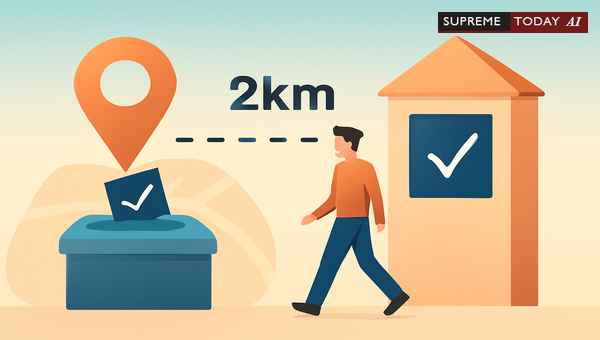
Is 2km Polling Booth Limit Mandatory in India?
In the lead-up to elections, voters often raise concerns about the accessibility of polling stations. A common question arises: Can a polling booth be situated more than 2 kms away from voters? This issue touches on voter rights, electoral fairness, and administrative practicality. While the 2km distance is frequently cited as a standard, it's not an ironclad rule. This post explores the legal framework, guidelines from the (), judicial interpretations, and exceptions, drawing from key cases and directives.
Understanding this helps voters, candidates, and election officials navigate expectations during polls. Note: This is general information based on precedents and guidelines; consult legal experts for specific advice.
The 2km Guideline: A Norm, Not an Absolute Rule
The 's guidelines specify that polling stations should, , be located so that no voter has to travel more than 2 km2001 0 Supreme(AP) 621. This principle, outlined in a circular dated , aims to ensure voter convenience and high turnout. However, the same document clarifies flexibility: in scarcely populated hilly or forest areas, or where setting up a station at a smaller number of voters is necessary, this norm may be relaxed2001 0 Supreme(AP) 621.
The Manual on Polling Stations reinforces this by emphasizing careful site selection for convenience, treating the 2km as a guideline rather than a mandatory limit 2001 0 Supreme(AP) 621. In essence, while voter accessibility is prioritized, practical realities allow deviations.
Judicial Perspective: Directory Guidelines, Not Mandatory
The has explicitly held that these guidelines are . Decisions on polling station locations fall within the discretion of authorities, considering local circumstances 2024 0 Supreme(AP) 214. Courts defer to election officials unless actions are arbitrary or malafide.
For instance, in cases involving security threats, relocating booths beyond 2km has been upheld. Judgments from Bihar and Andhra Pradesh affirm that authorities may shift polling stations in exceptional circumstances like security concerns2016 0 Supreme(Pat) 185. The Court declined interference, recognizing the need for safety in extraordinary situations 2016 0 Supreme(Pat) 185.
Exceptions Where 2km Can Be Exceeded
Several scenarios justify relaxing the norm:
- Difficult Terrain: Hilly, forest, or scarcely populated areas permit longer distances 2001 0 Supreme(AP) 621.
- Low Voter Numbers: Booths with fewer voters can be merged. In case voters assigned to present polling booth are less in numbers, it can be merged with another booth2003 0 Supreme(Raj) 1494. This was relevant in reconstituting booths in Ladnu municipal area, where voter counts stayed under 1500, aligning with directions dated 2003 0 Supreme(Raj) 1494.
- Security and Public Safety: Shifts for threat mitigation are permissible 2016 0 Supreme(Pat) 185.
- Administrative Efficiency: Multiple booths at one station aid smooth polling; a Presiding Officer oversees the station, not each booth 1990 0 Supreme(P&H) 544.
These exceptions ensure elections remain feasible without compromising core democratic principles.
Related Case Law on Polling Irregularities and Booth Management
Polling booth locations intersect with broader election integrity issues. Courts have addressed discrepancies that could arise from poor site choices or mismanagement:
In an Assam case, irregularities like ballot mismatches at booths (e.g., Booth No.65 with 665 voters but 606 counted papers) led to recount orders due to material impact on results 1998 0 Supreme(Gau) 168. Irregularities and illegalities committed during counting which warrant a recount1998 0 Supreme(Gau) 168. Proper location aids in preventing such issues by boosting supervision.
High voter turnout anomalies, like over 90% at a booth with 181 voters showing 167 polled (152 for one candidate), prompted recount demands 1994 0 Supreme(SC) 1088. Narrow margins (e.g., 80 votes) underscore the need for accessible, well-placed booths to avoid disputes.
allegations require high proof standards () and specific evidence before inspections 1991 0 Supreme(AP) 438. The standard of proof required for proving the allegations of , is 1991 0 Supreme(AP) 438. Strategic booth placement in secure areas mitigates such risks.
In Uttar Pradesh, claims were scrutinized, but witness statements alone weren't sufficient without corroboration
.
These cases highlight how location influences fairness, reinforcing the guideline's role in preventing undue influence.
Key Takeaways for Voters and Authorities
- For Voters: If a booth exceeds 2km without justification, raise concerns with returning officers or , but courts rarely intervene in reasoned decisions.
- For Authorities: Adhere to 2km as default, document deviations (e.g., terrain reports, security assessments), and consult stakeholders.
- Judicial Review: Limited to arbitrariness; courts will generally not interfere unless arbitrary or malafide decisions are made2001 0 Supreme(AP) 621.
Recommendations include:- Involving political parties in site consultations.- Prioritizing transparency in booth rationalization.- Ensuring multiple booths per station for efficiency 1990 0 Supreme(P&H) 544.
Conclusion: Balancing Convenience and Practicality
The query Polling Booth Cannot be Situated more than 2 Kms reflects a common misconception. Legally, no absolute prohibition exists; it's a guiding principle that can be relaxed under justified circumstances2001 0 Supreme(AP) 621 2024 0 Supreme(AP) 214 2016 0 Supreme(Pat) 185. This flexibility accommodates India's diverse geography and security challenges while upholding voter rights.
Elections thrive on trust and accessibility. By understanding these nuances, stakeholders contribute to robust democracy. Stay informed, vote responsibly, and report genuine issues to helplines.
This post summarizes public legal resources and is not legal advice. For personalized guidance, contact an election law specialist.
#PollingBooths #ElectionLaw #VoterRights












