


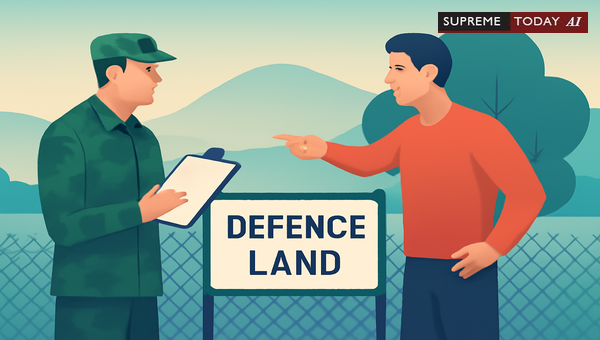
How Estate Officers Prove Defence Land Encroachment
Defence lands in India are critical assets managed under strict regulations to ensure national security. Encroachments on these lands pose significant challenges, often leading to disputes where Estate Officers play a pivotal role. A common question arises: Encroachment of Defence Land how to be Proved by Estate Officer? This blog post explores the legal framework, , and evidentiary standards typically required, drawing from judicial precedents and key principles.
Understanding how Estate Officers establish encroachment is essential for landowners, occupants, and authorities involved in such cases. While this provides general insights, it is not legal advice—consult a qualified lawyer for specific situations.
Overview of Proving Title to Defence Land
In disputes over defence land, the generally lies with the party claiming ownership or seeking to evict encroachers. Estate Officers, acting on behalf of defence authorities, must demonstrate clear title to the land to succeed in eviction proceedings under laws like the .
Courts emphasize that plaintiffs (often the Estate Officer representing defence interests) must provide robust evidence of ownership. This includes registered documents and official records. For instance, The plaintiff must prove their title to the property. This includes providing evidence of ownership, such as sale deeds or court judgments affirming their title against other parties 1955 0 Supreme(Bom) 62 2023 0 Supreme(Bom) 808.
Failure to produce such evidence can weaken the case, as seen in various judgments where prosecution or plaintiffs could not substantiate claims. In one case, the prosecution side is claiming over the land in dispute, but they did not prove any document in support of their case, whereas the defence proved sufficient documents claiming over the land in dispute 2017 0 Supreme(Jhk) 653.
Key Principles for Proving Encroachment
1. on the Estate Officer
The Estate Officer typically bears the initial burden to prove that the land belongs to the defence establishment and is encroached upon. This involves:- Documentary Evidence: are crucial. A registered sale deed dated was pivotal in establishing the petitioner's title 2023 0 Supreme(Bom) 808.- Official Registers: Entries in the serve as strong proof of defence ownership 2014 0 Supreme(Bom) 1023.
Courts have dismissed claims where such records are absent. For example, in a land dispute, plaintiffs failed to prove that the ... had retained the under nor have they proved how did they acquired valid title over the suit land 2015 0 Supreme(Tri) 277.
2. Evidence of Title
Title to defence land can be established through:- .- Prior court judgments affirming ownership 1955 0 Supreme(Bom) 62.- Official land records like the 2014 0 Supreme(Bom) 1023.
In criminal contexts involving land disputes, defence parties succeeded by producing documents: defence had provided all kind of document as well as the pleading stated that they were the owners of the property and having possession of the same 2017 0 Supreme(Jhk) 653. Estate Officers should similarly compile comprehensive records to mirror this evidentiary standard.
3. Countering Claims
Encroachers often claim , arguing long-term, continuous, public, and hostile occupation. However, defendants must prove this for the (typically 12 years under the ). Courts reject unsubstantiated claims: Defendants claiming title through must prove continuous, public, and hostile possession for the . If they fail to provide sufficient evidence, their claims will be rejected 2006 0 Supreme(Bom) 93 2002 1 Supreme 36.
In one instance, despite generational possession claims, courts ruled against defendants without proof: Defendants may argue that they have been in possession for generations... without proof of ownership or valid , such claims are typically insufficient 2006 0 Supreme(Bom) 93 2002 1 Supreme 36.
4. License vs. Ownership Distinction
Occupants claiming licensee status must show the license is irrevocable under , by proving permanent structures built with consent. Absent this, eviction follows: If defendants are occupying land as licensees, they must prove that their license has become irrevocable... This requires demonstrating that they executed on the land with the 2006 0 Supreme(Bom) 93.
5. Judicial Findings and Precedents
Courts consistently uphold title-proof requirements: Courts have consistently held that if the plaintiff proves their title, the defendants' claims, including those based on or license, may be dismissed 1990 0 Supreme(SC) 775 2011 0 Supreme(Bom) 596.
In acquisition-related cases, prior government notifications override later claims. For Meghalaya lands, Even if the appellants were put in possession of the land in question by the Nokma, they have no right of ownership in view of the acquisition of the land under the provisions of the 2014 0 Supreme(Megh) 230. The court upheld that the land acquisition matter decided in cannot be reopened based on the issued in 2014 0 Supreme(Megh) 230. This principle applies analogously to defence lands, where historical records prevail.
Other cases reinforce that The defence regarding ownership will be judged in the trial. The defence will get the benefit if they are able to prove their over the land in question 2008 0 Supreme(Pat) 1060. Similarly, evidence like Exts. E, F & G proved possession and title, aiding private defence pleas 2007 0 Supreme(Pat) 643.
Exceptions and Common Counterarguments
Defendants frequently raise:- Long-term possession without documents.- Private defence in clashes over disputed land.
However, Courts have emphasized the necessity of clear pleadings and evidence regarding the source of title. Failure to adequately establish the basis of ownership can lead to dismissal of the suit 2014 0 Supreme(Bom) 738. Non-examination of key witnesses, like investigating officers, can prejudice cases, as in The prosecution had not even examined the I.O., of the case, and the Court below has held that this has caused seri... 2017 0 Supreme(Jhk) 653.
In eviction under the , 's findings on acquired land boundaries were upheld despite later pattas 2014 0 Supreme(Megh) 230. Estate Officers should ensure boundary demarcations and historical acquisitions are documented.
Practical Recommendations for Estate Officers
To effectively prove encroachment:- Gather registered deeds, entries, and prior judgments.- Conduct site surveys and injury reports if clashes occur, as The defence has proved the injury report showing that the one person of the defence side had also been injured 2017 0 Supreme(Jhk) 653.- Anticipate or license defenses with counter-evidence.- Regularly update records amid evolving case law.
Conclusion and Key Takeaways
Proving encroachment on defence land by Estate Officers hinges on robust title evidence, outmatching defendants' possession claims. Key takeaways:- Prioritize Documents: Sale deeds, registers, and judgments are foundational 2023 0 Supreme(Bom) 808 2014 0 Supreme(Bom) 1023.- Address Defenses Proactively: Disprove and licenses with facts 2006 0 Supreme(Bom) 93.- Leverage Precedents: Historical acquisitions and official findings hold strong 2014 0 Supreme(Megh) 230.
References: 1955 0 Supreme(Bom) 62 2006 0 Supreme(Bom) 93 2014 0 Supreme(Bom) 1023 2023 0 Supreme(Bom) 808 1990 0 Supreme(SC) 775 2011 0 Supreme(Bom) 596 2014 0 Supreme(Bom) 738 2002 1 Supreme 36 2017 0 Supreme(Jhk) 653 2015 0 Supreme(Tri) 277 2014 0 Supreme(Megh) 230 2008 0 Supreme(Pat) 1060 2007 0 Supreme(Pat) 643.
This overview highlights general practices; outcomes vary by facts. Seek professional legal counsel for tailored advice.
#DefenceLandEncroachment, #EstateOfficer, #LandTitleProof















