


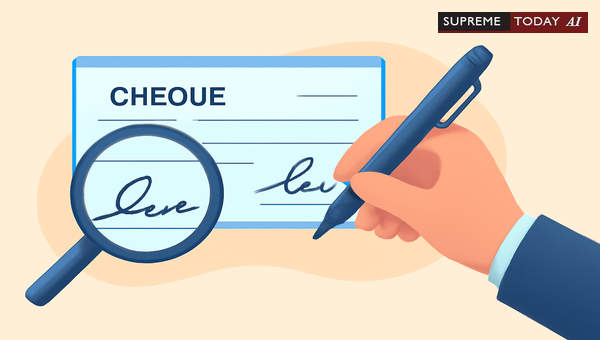
Execution of Cheque: Legal Meaning & Proof Guide
In the world of financial transactions, cheques remain a cornerstone despite digital advancements. However, when a cheque bounces, it often leads to legal battles under (NI Act). A pivotal question arises: What is ? This isn't just about handing over a piece of paper—it's about legally proving that the accused drew, signed, or issued it. Without solid proof, even a in court won't hold up.
This blog dives deep into the concept, drawing from judicial precedents and statutory principles. We'll explore proof requirements, presumptions, and practical tips. Note: This is general information based on case law and should not be taken as specific legal advice—consult a lawyer for your situation.
Defining
refers to the act of drawing, preparing, or signing it by the (the accused). Legally, it means the accused themselves created or authenticated the instrument. As clarified in key judgments, drawing a cheque means creating, preparing, or signing the cheque by the 2022 0 Supreme(Raj) 2384.
Under , execution is proved by verifying the handwriting and signature—typically through the signatory's examination or expert testimony 2022 0 Supreme(Raj) 2384. Mere production of the cheque in court doesn't suffice; the prosecution must demonstrate the accused's direct involvement.
Key takeaway: If the complainant says, The accused gave me the cheque, but didn't witness the signing, that's often insufficient without more evidence 2022 0 Supreme(Raj) 2384.
The on Prosecution
In cheque dishonour cases, the prosecution bears the initial burden to prove execution. The must be proved by admissible evidence demonstrating that the accused himself drew or signed the cheque; mere production of the cheque in court, without proof of its drawing or execution by the accused, is insufficient 2022 0 Supreme(Raj) 2384.
Once execution is established, raises a that the cheque was issued for a . However, this presumption applies only if the prosecution proves that the cheque was drawn or executed by the accused 2022 0 Supreme(Raj) 2384.
Courts stress: The burden of proving that the accused drew the cheque lies with the prosecution, and in the absence of , must lead to the irresistible conclusion that the cheque was drawn by the accused 2022 0 Supreme(Raj) 2384.
Types of Evidence Required
- Witness testimony: Someone who saw the accused sign or prepare the cheque.
- Admission by the accused.
- opinion matching signatures.
- Cheque book records or serial numbers linking to the accused.
- Context of possession: How the complainant obtained it must be explained.
Proof of drawing or involves establishing that the accused himself created, prepared, or signed the cheque; this can be demonstrated through direct or , such as witnesses who saw the act or handwriting experts 2022 0 Supreme(Raj) 2384.
From other cases, when signatures are disputed, expert examination of the cheque can be necessary to establish authenticity. Failure to do so weakens the defense (inspired by 2023 0 Supreme(Ker) 379). In one instance, accused denied the very execution of the cheque itself... though attempt was made... it has come out from the evidence... that... one tallies with that in Ext.P1 2021 0 Supreme(Ker) 225.
Caution on Possession: The mere possession or production of the cheque in court does not automatically prove that the cheque was handed over or issued by the accused; the circumstances under which the cheque came into possession of the complainant must be proved 2022 0 Supreme(Raj) 2384.
Presumptions Under
If execution is proved and signatures aren't denied, courts presume a debt or liability exists. Once the execution of cheque is admitted Section 139 of the Act mandates a presumption that the cheque was... 2024 0 Supreme(Ker) 1487. This shifts the burden to the accused to rebut it, e.g., by showing the cheque was stolen, blank, or a security misused.
However, if execution itself is disputed, no presumption arises. When a cheque is presented and the signature is not denied, courts presume that the cheque was issued for a debt or liability... placing the burden on the accused (from analysis in other sources like 2023 0 Supreme(All) 2283).
In defenses, courts examine context: if at all Ext.P1 cheque was issued as a , since the revision petitioner failed to repay... the cheque matures for presentation 2023 0 Supreme(Ker) 895. Serial numbers can prove issuance timing, as in cases where the cheque in question bearing no.552091 had been issued by the accused at the time of execution of Ex. CX-1 2015 0 Supreme(Del) 1002.
Case Law Highlights
: The execution of a document has to be proved by evidence of those who can vouchsafe for the truth of the facts in issue, and that mere production and marking of a document as exhibit by the court cannot be held to be a due proof of its contents 2022 0 Supreme(Raj) 2384.
Disputed execution leading to acquittal: The execution of the cheque itself was disbelieved and notices were suspicious and the accused was acquitted 2013 0 Supreme(MP) 640.
Admitted signatures but denied execution details: Courts still invoke presumptions if alterations aren't material 2023 0 Supreme(Ker) 900.
These precedents underscore that without proof of the accused's hand in drawing, acquittal is justified—even if the cheque bounces due to insufficient funds.
Exceptions and Rebuttals
- Strong : Can suffice if it convincingly shows that the cheque was issued or signed by the accused 2022 0 Supreme(Raj) 2384.
- Accused's Defense: Provide probable explanations like misuse: the defence of the accused that the cheque in question was a and it was blank and signed
Anu Products Ltd. VS Raj Agro Tech - Dishonour Of Cheque
. - Procedural Flaws: Incorrect notices or unproven service can undermine cases 2023 0 Supreme(Bom) 2291.
The accused can rebut the presumption by providing a probable explanation... but must do so with credible evidence 2022 0 Supreme(Raj) 2384. Dishonor due to account closure isn't always criminal 2023 0 Supreme(Ker) 845.
Practical Recommendations
For Complainants/Prosecution:- Secure witnesses to the signing.- Obtain reports early.- Document how you received the cheque.
For Defendants/Accused:- Challenge execution if no direct proof.- Contest presumptions with evidence of non-debt or misuse.- Demand expert verification if signatures are disputed.
Prosecution should gather of the act of drawing or signing, such as witnesses who saw the accused sign the cheque or testimony 2022 0 Supreme(Raj) 2384.
Conclusion and Key Takeaways
is the linchpin in NI Act cases—prove it, and presumptions favor the complainant; fail, and the case crumbles. Courts won't assume from mere possession or production; evidence rules.
Key Takeaways:- Prosecution must prove accused drew/signed via direct or strong 2022 0 Supreme(Raj) 2384.- Section 139 presumption kicks in post-execution proof 2007 2 Supreme 611.- Disputes over signatures/alterations require experts 2023 0 Supreme(Ker) 379.- Always rebut with credible defenses in cheque bounce matters.
Stay informed, but seek professional advice for your cheque-related disputes. Understanding these nuances can prevent costly litigation.
References:- 2022 0 Supreme(Raj) 2384: Core principles on proof of execution.- 2007 2 Supreme 611: Burden and presumptions under Section 138.- 2024 0 Supreme(Ker) 1487, 2021 0 Supreme(Ker) 225, 2015 0 Supreme(Del) 1002, others as cited.
#ChequeExecution #NIAct #LegalProof















