


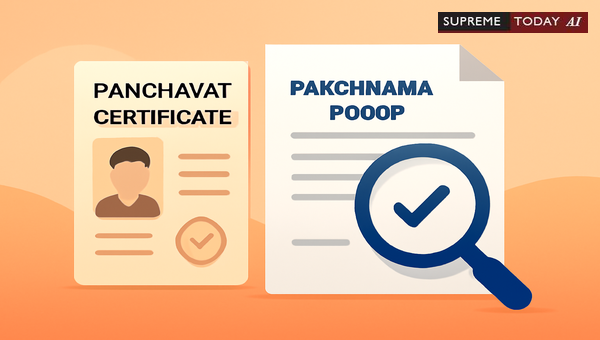
Proving & in Court: A Legal Must
In legal proceedings across India, documents like panchnamas and often play crucial roles as evidence. But are they automatically admissible just by being marked as exhibits? The answer is no. The and the Panchayat Certificate Must be Proved in Evidence in Accordance with Law. This principle, rooted in the , ensures that such documents undergo rigorous scrutiny for authenticity, credibility, and . This blog post explores this requirement in detail, drawing from key judicial findings and practical insights to help you understand its implications.
Whether you're a lawyer preparing a case, a litigant relying on local records, or simply curious about courtroom evidence rules, grasping this concept is vital. Note that this is general information and not specific legal advice—consult a qualified attorney for your situation.
The Core Legal Principle
The law mandates that panchnamas (witness statements recorded by panch witnesses) and certificates issued by Panchayats (local self-government bodies) must be proved in accordance with the . Mere production or marking as exhibits does not establish their truth. Courts require proof through , including examination of sources, authenticity checks, and credibility assessments. 2012 0 Supreme(SC) 619
Key points include:- Documents must be proved by primary (originals) or (certified copies), with the burden on the relying party. 2012 0 Supreme(SC) 619- are supporting documents, not conclusive proof of facts like citizenship unless verified. 2024 0 Supreme(Gau) 303- Panchnamas narrate observed events, not confessions, and their value depends on legal compliance—not hit by if properly proved. 2015 0 Supreme(Del) 580
Detailed Proof Requirements for Panchnamas
A records events witnessed by independent panchas (witnesses). It is not an admission of guilt or confession but a factual narration. Its hinges on proper proof under the Evidence Act. Signatures or endorsements like produced by only confirm production, not content accuracy—full proof is essential. 2015 0 Supreme(Del) 580
Courts emphasize examining:- Witnesses who prepared it.- Their credibility and source of information.- Whether it was properly recorded and signed.
In trap cases, for instance, pre-trap and post-trap panchnamas must follow due process. As noted, deposition of PW-2, Complainant himself, clearly establishes the pre-trap carried by the by following the due process of law and post-trap . 2025 Supreme(Online)(Bom) 2968 This underscores that procedural adherence bolsters admissibility, but proof via witness testimony remains key.
Another case highlights that facts can be proved by direct evidence, oral or documentary: This fact in issue can be proved either by direct evidence which can be in the nature of oral evidence or documentary evidence. 2024 Supreme(Online)(Guj) 27021 Panchnamas fit here but require .
Proving : Verification is Key
, issued by officials like the Secretary or Gaon Bura, support claims such as residence or citizenship. However, they lack conclusive value without:- Disclosure of information source.- Proper verification and authentication.- Compliance with Evidence Act standards. 2024 0 Supreme(Gau) 303
The Supreme Court has ruled: certificates without registers or verification have no , based on or informal knowledge. They need two-stage verification: document authenticity and content truth, often via examining the issuer. 2024 0 Supreme(Gau) 1317 2024 0 Supreme(Gau) 303
Unverified certificates cannot conclusively establish facts. For reliability, issuers should maintain records, aiding court scrutiny.
Legal Standards Under the Indian Evidence Act
Sections of the Evidence Act dictate:- : Original documents.- : Certified copies or affidavits, under strict conditions.- Admission ≠ Proof: Marking a document does not prove it. 2012 0 Supreme(SC) 619
Courts consistently hold these documents non-self-proving. Without witness examination, source verification, or , they fail. In contexts (e.g., ), burdens differ—prosecution vs. accused—but proof standards apply uniformly. as laid down under must also be considered, but in respect thereof, it is trite law that, standard of on accused vis-a-vis standard of on prosecution would difer.
Exceptions, Limitations, and Practical Insights
While strict, exceptions exist:- Admissible as support: Verified with credible sources. 2024 0 Supreme(Gau) 303- Panchnamas in compliance: Proved by event witnesses, usable for observed facts. 2015 0 Supreme(Del) 580
Limitations:- No sole reliance on unproved documents.- -based certificates have limited value.
From related rulings:- Age certificates (schools, Panchayats) also need proof. 2023 1 Supreme 306- Trap procedures reinforce due process. 2025 Supreme(Online)(Bom) 2968
Recommendations for Legal Practitioners and Authorities
To strengthen cases:- Prove rigorously: Call witnesses, verify sources, authenticate via issuers.- Maintain records: Panchayat officials should use registers for traceability.- Court scrutiny: Judges must probe issuance manner and proof conditions.
Parties relying on these documents should anticipate challenges—proactive proof averts dismissal.
Conclusion and Key Takeaways
In summary, panchnamas and must be proved in evidence in accordance with law, primarily the . Their admissibility demands verification, witness examination, and credibility checks—mere filing suffices not. This upholds justice, preventing reliance on untested records.
Key Takeaways:- Not self-proving; burden on proponent. 2012 0 Supreme(SC) 619- Focus on source, authenticity, process. 2024 0 Supreme(Gau) 303- Useful as support when verified, not standalone.- Integrate with oral/direct evidence for strength. 2024 Supreme(Online)(Guj) 27021
Stay informed on evolving jurisprudence. For case-specific guidance, seek professional legal counsel. This principle safeguards evidentiary integrity in Indian courts.
References:1. 2012 0 Supreme(SC) 619, 2024 0 Supreme(Gau) 303, 2015 0 Supreme(Del) 580, 2024 0 Supreme(Gau) 1317, 2023 1 Supreme 306, 2024 Supreme(Online)(Guj) 27021, 2025 Supreme(Online)(Bom) 2968,
#PanchnamaProof, #EvidenceActIndia, #LegalDocuments












