


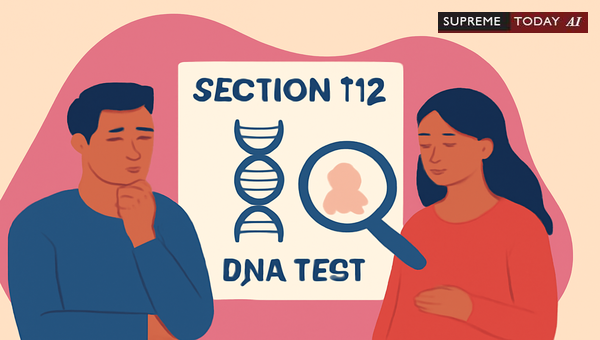
Paternity Presumption Without Legal Marriage in India: Key Legal Insights
In today's diverse family structures, questions about paternity often arise outside traditional marriage. Imagine a child born to unmarried parents—does a legal apply? What evidence is needed to establish or dispute biological fatherhood? These issues are critical in civil cases involving inheritance, maintenance, or custody in India.
The question at hand is: when there is no Legal Marriage between the Parents. While , provides a strong presumption for children born during a valid marriage, its application is absent without marriage. This blog delves into how courts handle such scenarios, emphasizing proof through evidence like DNA testing, while balancing privacy and the child's best interests. Note: This is general information, not specific legal advice—consult a qualified lawyer for your situation.
The Presumption Under Section 112: Marriage Requirement
Section 112 states that a child born during the subsistence of a valid marriage is to be the legitimate child of the husband, unless (impossibility of conception) is proven with strong, reliable evidence. 2023 3 Supreme 418
However, when there is no legal marriage, this presumption does not apply. Paternity must be established through other means, shifting the focus to direct evidence or scientific methods. Courts rely on the civil standard of , where the fact is proven if probabilities favor its existence after weighing evidence. 2023 0 Supreme(Cal) 414
Key distinction:- Married parents: Conclusive presumption unless rebutted by proof.- Unmarried parents: No automatic presumption; claimant must prove biological link. 2018 0 Supreme(AP) 699
Proving Paternity in Civil Cases Without Marriage
In non-marital scenarios, proving paternity typically involves:- Documentary evidence: Birth certificates, affidavits, or witness testimonies showing cohabitation or acknowledgment.- Scientific evidence: DNA testing as the gold standard.
Courts emphasize that DNA testing is regarded as the most reliable method for disputed paternity, but it is not ordered routinely.
It serves as of paternity when results exclude or confirm biological ties. 2014 0 Supreme(AP) 546
The person claiming or disputing paternity bears the burden. For claimants (e.g., child or mother seeking maintenance), they must bring material to show a nexus, such as shared living or acknowledgment. Mere denial by the alleged father is insufficient without evidence. 2018 0 Supreme(AP) 699 2018 0 Supreme(AP) 974
In civil cases, the standard is , not 'beyond reasonable doubt'. If plaintiffs claim paternity but fail to prove it, courts may rule against them—as in a case where claimants could not establish the child as daughter of specific parents. 2023 0 Supreme(Cal) 414
Role and Conditions for DNA Testing
DNA tests are valuable , especially when genetic markers are incompatible, excluding paternity. 2023 3 Supreme 418 2025 3 Supreme 600
Courts order tests only under strict conditions:- Strong case: Evidence of non-paternity or unclear relationship must exist first. The petitioner must raise the presumption with material on record. 2023 3 Supreme 418 2018 0 Supreme(AP) 699- Necessity: When other evidence is insufficient or inconclusive. 2023 0 Supreme(Ker) 641- Child's best interests: Privacy, dignity, and emotional impact are paramount, especially for minors. Courts avoid tests causing social stigma. 2023 3 Supreme 418 2025 3 Supreme 600- Not mechanical: No routine or collateral orders if paternity is not directly in issue. 2023 0 Supreme(Telangana) 453
Refusal to undergo testing can lead to but does not automatically prove/disprove paternity. 2023 3 Supreme 418 In one instance, resistance did not prevent inferences favoring testing. 2014 0 Supreme(AP) 546
Example quote: Test more or less is conclusive prove of paternity. 2014 0 Supreme(AP) 546
Whether in this case DNA analysis may be used as an evidence to prove paternity of child... is question to be considered.2013 0 Supreme(P&H) 1001
and Balancing Interests
Courts exercise caution:- Direct vs. Collateral Issue: Tests are more likely if paternity is central; unnecessary if admitted or resolvable otherwise. 2023 0 Supreme(Ker) 337- Posthumous or Irrelevant Claims: Generally not permitted. 2023 0 Supreme(Telangana) 453- Child's Welfare: Potential trauma weighs heavily. 2024 0 Supreme(All) 2308
Leading Evidence: Parties must first lead evidence; DNA follows if needed. Courts avoid arbitrary orders. 2023 0 Supreme(Bom) 387
In cross-examination scenarios, denial of access may prompt DNA to prove the paternity of the child. 2011 0 Supreme(Mad) 1555
Exceptions and Limitations
- No presumption without marriage—proof required via probabilities or DNA.
- DNA not for frivolous claims; nexus needed. 2018 0 Supreme(AP) 974
- Privacy Precedence: Child's rights over speculative disputes. 2025 3 Supreme 600
Practical Recommendations
- Gather Initial Evidence: Photos, messages, witnesses before seeking court intervention.
- Seek DNA Judiciously: File with material to avoid dismissal.
- Prioritize Amicable Resolution: Mediation preserves family ties.
- Courts should ensure tests align with child's dignity. 2023 3 Supreme 418
Key Takeaways
- No marriage = No Section 112 presumption; prove via preponderance of evidence or DNA.
- DNA is powerful but ordered only with strong case and child's interests in mind.
- Burden on claimant/disputer; refusal infers adversely but not decisively.
- Always balance truth-seeking with privacy.
In summary, while marriage triggers a conclusive presumption, unmarried parents navigate proof through evidence and cautious use of science. Proving paternity hinges on probabilities favoring the fact, with DNA as a decisive tool when warranted. 2023 0 Supreme(Cal) 414 Courts prioritize justice without undue harm. 2025 3 Supreme 600
Disclaimer: This article provides general insights based on legal precedents and is not a substitute for professional legal advice. Laws evolve, and outcomes depend on case specifics—consult an Indian family law expert.
References
- 2023 3 Supreme 418, 2025 3 Supreme 600, 2023 0 Supreme(Cal) 414, 2018 0 Supreme(AP) 699, 2018 0 Supreme(AP) 974, 2014 0 Supreme(AP) 546, 2013 0 Supreme(P&H) 1001, 2011 0 Supreme(Mad) 1555,
, 2023 0 Supreme(Ker) 641, 2023 0 Supreme(Gau) 1519, 2024 0 Supreme(Mad) 914, 2025 0 Supreme(Kar) 1397, 2023 0 Supreme(Bom) 387, 2023 0 Supreme(Telangana) 453, 2024 0 Supreme(All) 2308, 2023 0 Supreme(Ker) 337















