Searching Case Laws & Precedent on Legal Query!
Scanned Judgements…!



Searching Case Laws & Precedent on Legal Query!
Scanned Judgements…!
Quashing of FIR in 498A cases often involves settlement or no-objection from the complainant, as seen in Delhi High Court judgments where FIRs under Sections 498A, 406, 34 IPC were quashed after disputes were settled or complainant expressed no objection
CHAND MOHD & ORS. vs THE STATE (GOVT.OF NCT OF DELHI & ANR. - Delhi
,ANEESH GUPTA & ORS. vs STATE OF NCT OF DELHI & ANR. - Delhi
.Courts have emphasized that when parties settle their disputes, and there is no public interest concern, FIRs under matrimonial sections like 498A can be quashed to promote amicable resolution
CHAND MOHD & ORS. vs THE STATE (GOVT.OF NCT OF DELHI & ANR. - Delhi
,ANEESH GUPTA & ORS. vs STATE OF NCT OF DELHI & ANR. - Delhi
.In cases where FIRs include additional sections such as 377 IPC (unnatural offences) or 354 IPC (assault or sexual harassment), courts have still quashed the FIRs if the disputes are settled and no coercive proceedings are necessary
VIVEK BHARADWAJ & ORS. vs THE STATE GOVT OF NCT OF DELHI & ANR. - Delhi
,SHYAM KUMAR & ORS. vs STATE & ANR. - Delhi
.The courts often rely on the principle that continuation of criminal proceedings in matrimonial disputes, especially where parties have settled, may cause unnecessary harassment, and thus, FIRs can be quashed in the interest of justice
CHAND MOHD & ORS. vs THE STATE (GOVT.OF NCT OF DELHI & ANR. - Delhi
,ANEESH GUPTA & ORS. vs STATE OF NCT OF DELHI & ANR. - Delhi
.Some judgments highlight that the mere registration of FIR does not bar quashing if the parties have settled and public interest or third-party rights are not involved; the courts exercise their inherent powers under Section 482 Cr.P.C. to prevent abuse of process
CHAND MOHD & ORS. vs THE STATE (GOVT.OF NCT OF DELHI & ANR. - Delhi
,ANEESH GUPTA & ORS. vs STATE OF NCT OF DELHI & ANR. - Delhi
.Overall, landmark judgments demonstrate a judicial tendency to favor quashing FIRs in matrimonial cases after settlement, provided there is no objection from the complainant or public interest concerns, thereby fostering reconciliation and reducing unnecessary criminal litigation
CHAND MOHD & ORS. vs THE STATE (GOVT.OF NCT OF DELHI & ANR. - Delhi
,ANEESH GUPTA & ORS. vs STATE OF NCT OF DELHI & ANR. - Delhi
.Analysis and Conclusion:The main insight from these judgments is that the courts prioritize amicable settlement and the absence of public interest over the continuation of criminal proceedings under Sections 498A and related IPC sections. These landmark rulings reinforce the principle that FIRs, especially in matrimonial disputes, can be quashed when parties have resolved their issues, safeguarding individuals from prolonged legal battles and promoting reconciliation.
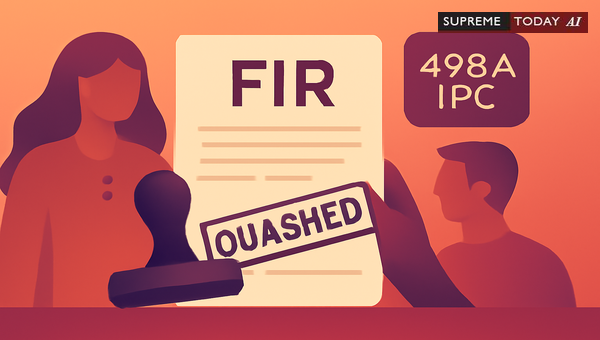
In the realm of Indian criminal law, the quashing of a (FIR) under is a critical remedy for accused persons facing potentially frivolous or baseless charges. This is particularly relevant in matrimonial disputes involving dowry harassment allegations under . While principles of quashing may extend to other statutes like —where judgments in favor of the accused emphasize lack of specific evidence or —the focus here is on dowry cases, drawing from landmark rulings and recent High Court decisions. Courts exercise this power sparingly to prevent misuse of laws meant to protect women, ensuring justice for genuine cases while curbing harassment of innocents. This post examines legal principles, key precedents, and scenarios like settlements that lead to quashing. Note: This is general information, not legal advice; consult a lawyer for specific cases.
Courts approach with caution, guided by established doctrines. Here's a breakdown:
FIRs must contain specific, tangible facts, not vague generalizations. Vague or generalized allegations are insufficient to warrant continuation of criminal proceedings or to prevent quashing 2004 0 Supreme(P&H) 864. Without credible material, proceedings are liable to be quashed to avoid .
Matrimonial issues often overlap civil and criminal realms. The pendency of a civil suit or divorce proceedings does not automatically bar criminal proceedings, but the court must assess whether the allegations merit further investigation 2022 0 Supreme(MP) 969. Courts scrutinize if the FIR stems from personal vendetta rather than criminal intent.
Under Section 482 CrPC, quashing is exercised sparingly and with circumspection. Proceedings aren't quashed prematurely unless allegations are frivolous, baseless, or purely speculative 2015 0 Supreme(P&H) 527.
Courts hesitate to intervene early if investigation is pending and allegations are specific. The courts generally refrain from quashing FIRs at the initial stage when investigation is ongoing, especially if allegations are specific enough to warrant further probe 2022 0 Supreme(MP) 969.
There's a judicial push to prevent indiscriminate roping in of relatives. Courts discourage inclusion of distant family members without concrete evidence 2004 0 Supreme(P&H) 864.
Several and High Court rulings shape this landscape:
Recent High Court judgments highlight quashing post-settlement, promoting reconciliation:
In cases, FIRs under 498A/406/34 IPC were quashed upon affidavits of no-objection from complainants. For instance, the affidavit placed on record on behalf of the complainant giving no-objection to the quashing of the present FIR also only mentions Sections 498A/406/34 IPC
- Delhi
.Similar relief in cases involving additional sections like 354/377 IPC: This petition under Section 482 Cr.P.C. has been filed for quashing of FIR No.003/2016 for offences under ... Resultantly, FIR N...
ANEESH GUPTA & ORS. vs STATE OF NCT OF DELHI & ANR. - Delhi
- Delhi
.also quashed FIRs in 498A/323/506 cases post-settlement or vague claims: While examining an FIR/complaint, quashing of which is sought, the
- Allahabad
- Allahabad
.Courts note: Continuation post-settlement causes undue harassment, absent public interest. Quashing of FIR in 498A cases often involves settlement or no-objection from the complainant (from analysis of Delhi HC judgments).
These rulings underscore that settled matrimonial disputes warrant quashing to foster harmony, especially without third-party rights involved.
| Case | Key Holding | Relevance ||------|-------------|-----------|| Ch. Bhajan Lal (AIR 1992 SC 604) | Criteria for quashing baseless proceedings | Foundation for discretion 2004 0 Supreme(P&H) 864 || Harjit Singh | Specificity required | Vague claims fail || Krishan Lal | Specific proof for relatives 2015 0 Supreme(P&H) 527 | No indiscriminate inclusion || Sudhir Kapur | Tangible evidence needed | Curbs frivolous FIRs || Inder Mohan Goswami | Cautious quashing 2015 0 Supreme(P&H) 527 | Balances justice || Delhi/UP HC on Settlements | Quash post-no-objection
- Delhi
- Allahabad
| Promotes reconciliation |Quashing FIRs in dowry harassment cases hinges on vague allegations, lack of evidence, or settlements, as per precedents like Bhajan Lal. Courts balance protecting victims with preventing law misuse, often quashing omnibus 498A FIRs against relatives. Recent trends favor settlements, with High Courts routinely granting relief under Section 482 CrPC. For accused, early petitions with strong grounds may succeed; for complainants, specificity is key.
Key Takeaways:- Ensure FIR has specific, credible facts.- Settlements often lead to quashing without public interest issues.- Principles apply broadly, including to cases like quashings.
Sources: 2022 0 Supreme(MP) 948 2015 0 Supreme(P&H) 527 2004 0 Supreme(P&H) 864 2022 0 Supreme(MP) 969 - Delhi - Allahabad
This overview (approx. 1050 words) aids understanding but seek professional advice.
#QuashingFIR, #DowryCases, #498A


v) While examining an FIR/complaint, quashing of which is sought, the 498A, 323, 506 I.P.C. and Section 3/4 of POCSO Act. ... Act against the applicant no. 1 and under Sections 498A, 323, 506 I.P.C. and Section 3/4 of D.P. ... No. 15977 of 2021 arising out of Case Crime No. 309 of 2020 (State Vs. ... Learned counsel for the applicants relied upon the judgement of

Further, the affidavit placed on record on behalf of the complainant giving no-objection to the quashing of the present FIR also only mentions Sections 498A/406/34 IPC. ... The present petition has been filed under Article 227 of the Constitution of India read with Section 482 Cr.P.C. on behalf of the petitioners seeking quashing of FIR No.63/2021 registered under Sections 498A#HL_EN....

This petition under Section 482 Cr.P.C. has been filed for quashing of FIR No.003/2016 for offences under Sections 406/498A/354/377/34 IPC, registered at Police Station Crime Women Cell, Nanak Pura and the proceedings emanating therefrom. ... The petitioner no.1 undertakes to file the petition for quashing of FIR within 7 days of grant of decree of divorce. ... Resultantly, FIR N....
This petition under Section 482 Cr.P.C. has been filed for quashing of FIR No.81/2018 for offences under Sections 406/498A/377/34 IPC, registered at Police Station Crime Women Cell, Nanak Pura and the proceedings emanating therefrom. ... decided on 26.02.2021 has taken the following view on a quashing petition filed under the similar circumstances: This is a digitally signed Judgement. ... o....

At the outset, it would be relevant to mention that the sole ground on which the quashing was sought was that this was a second FIR on the same set of allegations made by the complainant after two weeks of lodging the first FIR being FIR No. 19 of 2015 under Section 498A read with Section 34 IPC, Police ... No. 3259 of 2015 dismissing the said petition filed under Section 482 of the Code of Criminal Proce....
This petition under Section 482 Cr.P.C. has been filed for quashing of FIR No.29/2018 for offences under Sections 498A/406/354/377/34 IPC, registered at PS Bindapur and the proceedings emanating therefrom. 3. ... Resultantly, FIR No.29/2018 for offences under Sections 498A/406/354/377/34 IPC, registered at PS Bindapur and the proceedings emanating therefrom are hereby quashed subject to payment....

lodged in Case Crime No. 513 of 2021, Under Sections 498A, 323 I.P.C. ... Issue a writ, order or direction in the nature of writ of certiorari for quashing the impugned First Information Report dated 28.6.2021 ... information report dated 28.6.2021 lodged in Case Crime No. 513 of 2021, Under Sections 498A, 323 I.P.C. and Section facts of the instant case. ... . - ....

Fourth/Final installment to be paid to Respondent no. 2 at the time of recording her statement for quashing of the FIR before the Hon’ble High Court at New Delhi. 10. ... This is a digitally signed Judgement. ... This is a digitally signed Judgement. ... This is a digitally signed Judgement. ... This is a digitally signed Judgement.
The instant petition has been filed by the petitioners with the following prayers :- "(i) issue a writ order or direction in the nature of certiorari quashing the impugned First Information Report in Case Crime ... We have gone through the impugned first information report and we are of the opinion that the guidelines framed by this Court in the above noted judgement are equally applicable to the....
as Case Crime No. 132 of 2021, under sections 498A, 323, 504, 506, 406 IPC, respondent no.3 as Case Crime No. 132 of 2021, under sections 498A, 323, 504, prayers :- "(i) issue a writ order or direction in the nature of certiorari quashing ... . - 46 Case :- CRIMINAL MISC.


An indispensable Tool for Legal Professionals, Endorsed by Various High Court and Judicial Officers
Please visit our Training & Support
Center or Contact Us for assistance

Scan Me!
India’s Legal research and Law Firm App, Download now!


For Daily Legal Updates, Join us on :



 Back to top


