Searching Case Laws & Precedent on Legal Query.....!
Analysing the retrieved Case Laws
Scanned Judgements…!



Searching Case Laws & Precedent on Legal Query.....!
Analysing the retrieved Case Laws
Scanned Judgements…!
Sections 5, 6, 8, and 9 of the Rajasthan Bovine Animal Act, 1995, primarily deal with prohibitions related to the slaughter, possession, transportation, and export of bovine animals. These sections criminalize acts such as illegal slaughter (Section 5), illegal possession or sale of beef (Section 4, implied), and regulate the movement and export of bovines (Section 6). They also specify penalties for violations (Section 8) and procedures for seizure, custody, and disposal of seized animals (Section 7) ["2024 0 Supreme(Raj) 713"], ["2007 0 Supreme(Raj) 979"], ["2023 0 Supreme(Raj) 1952"].
The Act empowers authorities like the District Collector to conduct confiscation proceedings, which are quasi-judicial in nature, not criminal trials. For instance, the proceedings under Section 6-A of the Rajasthan Bovine Animal Act, 1995, are independent and distinct... acts like a quasi-judicial authority ["2025 Supreme(Online)(Raj) 15067"]. The Collector's order for confiscation is based on seizure and is to be executed cautiously, with an emphasis on proper procedure and evidence ["2024 0 Supreme(Raj) 713"].
Several cases highlight enforcement actions, including seizure of vehicles involved in transporting bovines in violation of Sections 5, 6, and 8. For example, vehicles seized under FIRs for offences under these sections are often ordered to be confiscated by the Collector ["2024 0 Supreme(Raj) 713"], ["2024 Supreme(Online)(RAJ) 932"].
The proceedings under these sections are distinct from criminal trials, and the authorities act in a quasi-judicial capacity, with the burden of proof and procedures outlined in the Act. Courts have clarified that confiscation is not a criminal punishment but an administrative action, and proper legal procedures must be followed ["2025 Supreme(Online)(Raj) 15067"], ["2002 0 Supreme(Raj) 479"].
Penalties for violations include imprisonment and fines, with courts sometimes reducing sentences upon appeal or considering the nature of the violation. For instance, the convicted persons were sentenced to imprisonment and fines, but in some cases, sentences were reduced or modified ["2023 0 Supreme(Raj) 1952"], ["2025 Supreme(Online)(Jhk) 4440"].
The law also emphasizes the importance of proper custody and disposal of seized bovines, with authorities empowered to make necessary orders regarding possession or release ["2002 0 Supreme(Raj) 479"], ["2002 0 Supreme(Raj) 478"]. The seizure and confiscation processes are strictly regulated to prevent misuse or arbitrary actions.
Analysis and Conclusion:The Rajasthan Bovine Animal Act, 1995, establishes a comprehensive legal framework to prevent bovine slaughter and regulate the movement and export of bovines. Sections 5, 6, 8, and 9 specifically target illegal slaughter, transportation, and possession, with enforcement carried out through seizure, confiscation, and penalties. The proceedings are quasi-judicial, emphasizing proper legal procedures. Enforcement actions, including vehicle confiscation, are subject to judicial review, and authorities must act cautiously and within their jurisdiction ["2024 0 Supreme(Raj) 713"], ["2025 Supreme(Online)(Raj) 15067"]. The law aims to protect bovines while ensuring that confiscation and penalties are implemented fairly and systematically.
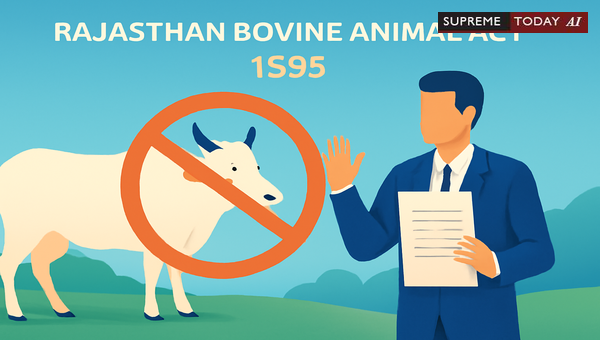
In India, laws protecting bovine animals reflect cultural, religious, and economic values, particularly in states like Rajasthan. A common query arises: section 5,6,8,9 bovine animal Act 1995 trail by – essentially asking about the trial procedure for offences under Sections 5, 6, 8, and 9 of the (the Act).
This blog post breaks down the legal framework, procedures, jurisdiction, and insights from judicial precedents. Whether you're a legal professional, livestock handler, or concerned citizen, understanding these provisions can help navigate compliance and enforcement. Note: This is general information based on legal analyses and cases; consult a qualified lawyer for specific advice.
Sections 5, 6, 8, and 9 form the core prohibitions and penalties under the Act:
Penalties are severe, including up to 10 years and fines up to Rs. 10,000, plus 2024 0 Supreme(Raj) 713 2016 0 Supreme(Raj) 1754. These make violations serious, allowing police to arrest without warrant and investigate promptly.
The Act does not outline a special trial procedure. Thus, by , , inquiries, and trials follow Cr.P.C. provisions 2024 0 Supreme(Raj) 713 2006 0 Supreme(Raj) 2211.
For instance, in cases involving transport for slaughter, charges under , 5/8, 6/8, 9 are framed by trial courts, followed by 2024 Supreme(Online)(RJ) 2611 2024 0 Supreme(Raj) 1260.
A critical distinction: While criminal trials follow Cr.P.C. in courts, of seized animals and vehicles vest exclusively with the (typically the or ).
Courts cannot interfere in these , separating from .
Courts have consistently upheld these principles, often in appeals, , and . Here are key examples:
In multiple appeals, convictions under , 5/8, 6/8, 9 alongside were maintained, but sentences reduced considering time served and mental agony. For example:
The court found that considering the time already served by the appellants and the circumstances, it was just and proper to reduce the sentence to the period already undergone while maintaining the fine amount 2024 Supreme(Online)(RJ) 2611.
Similarly:
Reduction of based on time already served and overall circumstances 2024 Supreme(Online)(RJ) 24124.
In another case under , 5/8, etc., the sentence was reduced from 5 years RI to 3 years RI and fine from Rs.10,000 to Rs.2,000 2019 0 Supreme(Raj) 1106.
Bail is often denied due to the heinous nature:
In cases involving heinous crimes, bail may be denied if there are no new grounds or material change in circumstances 2013 0 Supreme(Raj) 2262.
One case noted: Such offences are increasing day by day – Cows are the sources of milk and milk products – Cows are considered very sacred in Indian culture 2012 0 Supreme(Raj) 876.
The Act shifts burden to the accused:
The is upon the accused to prove that he had not committed the offence under the provisions of the Act of 1995 2017 0 Supreme(Raj) 1949.
In a transport case with dead/injured animals, conviction under , 9, 10 was upheld as accused failed to disprove intent 2017 0 Supreme(Raj) 1949.
Jharkhand's Act mirrors Rajasthan's, with restrictions on releasing seized animals: Under sub-section 5 of Section 11... a restriction has been imposed on release of bovine animals 2022 0 Supreme(Jhk) 1012 2019 0 Supreme(Jhk) 1395. Discrepancies in receipts or lack of destination proof lead to convictions 2022 0 Supreme(Jhk) 1012.
These precedents 2024 0 Supreme(Raj) 713 2006 0 Supreme(Raj) 2211 affirm Cr.P.C. trials for offences and exclusive authority jurisdiction for seizures.
Recommendations:- Follow Cr.P.C. for 2024 0 Supreme(Raj) 713.- Respect finality of confiscation orders.- In defences, produce transport evidence early to shift burden.- For bail/appeals, highlight time served or .
This framework balances enforcement with procedural fairness. Stay compliant to avoid stringent penalties. For personalized guidance, seek expert legal counsel.
Disclaimer: This post summarizes legal findings from referenced documents 2024 0 Supreme(Raj) 713 2006 0 Supreme(Raj) 2211 and cases. Laws evolve; it is not substitute for professional advice.
#RajasthanBovineAct, #CowProtectionLaw, #LegalTrialProcedure


under Section 5 (8) of the RBA Act, 1995. ... , Beawar for offences under Section 5 , 6 and 8 of the Rajasthan Bovine Animal Act, 1995, and seized the vehicle in question, a truck bearing registration No. ... 6 -A of the Rajasthan Bovine Animal Act, 1995. ... Rajasthan #HL_....

(v). that against the order passed by the District Collector being the Competent Authority under Section 2(g) of the Rajasthan Bovine Animal Act, 1995, in exercise of its power and jurisdiction entrusted to him specifically under Section 6-A of the Rajasthan Bovine Animal Act ... . the Collector of concerned District, while passing any order under Section 6-A of the RBA #HL_STA....

Sections 3, 4, 5 and 12 of the Bovine Animal Act read as under: 3. ... Aleem Quraishi and Firoz Quraishi are found and held guilty u/s 12 of Jharkhand Bovine Animal Prohibition of Slaughter Act, 2005 (hereinafter referred as the Act) to be none precise Section 12(1) and (2) of the Act for contravention of Section 5 of the Act and attempt to contravene ....
Succinctly stated the facts of the case are that the SHO, Police Station, Parbatsar District Nagaur and lodged an FIR No.83/2012 at the Police Station Parbatsar, District Nagaur for the offences under Sections 3 , 5, 6, 8 & 9 of the Rajasthan Bovine Animal (Prohibition ... Section 5 /8 of the Act of 1995 and sentenced them to suffer two years rigorous imprisonment along with a fine of Rs.2,000/- a....
... (8). The transporter who transports bovine animals in furtherance of the object of commission of the offence under the Act of 1995 is guilty of abetment under Section 6. it reads thus: ... "6. ... Section 5 prohibits export of bovine animal for the purpose of slaughter and regulation of temporary migration or export for other purposes. Section 5 reads thus: ....
Thereafter, the charge for offence under Sections 3/8, 5/8, 6/8, 9 of Rajasthan Bovine Animal (Prohibition of Slaughter and Regulation of Temporary Migration or Export) Act, 1995 and Section 11 of Prevention of Animal Cruelty Act, was framed by the trial court against the appellants, who denied the charges ... While maintaining the appellants conviction and sent....
Thereafter, the charge for offence under Sections 3/8, 5/8, 6/8, 9 of Rajasthan Bovine Animal (Prohibition of Slaughter and Regulation of Temporary Migration or Export) Act, 1995 and Section 11 of Prevention of Animal Cruelty Act, was framed by the trial court against the appellants, who denied the charges ... The police registered the FIR for offence under Sect....
Thereafter, the charge for offence under Sections 3/8, 5/8, 6/8, 9 of Rajasthan Bovine Animal (Prohibition of Slaughter and Regulation of Temporary Migration or Export) Act, 1995 and Section 11 of Prevention of Animal Cruelty Act, was framed by the trial court against the appellants, who denied the charges ... Upon conclusion of the trial, the learned trial cour....
3/8 of Bovine Animal Act. ... Section 11 of the Bovine Animal Act defines “burden of proof”, which provides punishment for intentionally injuring Act, 1995. ... 3/8 of the Rajasthan Bovine Animal
Sub section (5) of Section 7 of the Act of 1995 further provides that whenever any bovine animal is seized under the Act of 1995, the Competent Authority or the Divisional Commissioner shall have jurisdiction to make orders with regard to possession, delivery, disposal or release of such animal. ... ... (6). To appreciate the above contentions, Section 7 of the Act#HL_....
While maintaining the conviction of the appellant for offence under Section 3/8 of Rajasthan Bovine Animal Act and Section 429 IPC, the substantive sentence awarded to him for offence under Section 3/8 of Rajasthan Bovine Animal Act is hereby reduced from 5 years rigorous imprisonment to 3 years rigorous imprisonment and the amount of fine from Rs. 10,000/- to 2,000/-. 9. As a result, the criminal appeal is partly allowed. Further, the substantive sentence of imprisonment for offence under Section 429 IPC is reduced to the period of imprisonment already undergone by the app....
3. The revisional court in its order dated 19.01.2018 has observed that the plea challenging the description of the cattles seized can be decided during the trial. Under sub-section 5 of Section 11 of the Jharkhand Bovine Animal Prohibition of Slaughtering Act, 2005 a restriction has been imposed on release of bovine animals. Two courts have concurrently observed against the petitioner and in this revision petition the petitioner has tried to raise a similar issue which has already been decided by the courts below. Under section 451 Cr.P.C. one of the conditions for custody....
Learned trial court has convicted accused Kalwa vide this judgment for the offences punishable under Sections 3/8, 5/8, 6/8, 9 & 10 of the Rajasthan Bovine Animal (Prohibition of Slaughter and Regulation of Temporary Migration or Export) Act, 1995 ('the Act of 1995'). 1. This appeal has been preferred on behalf of accused-appellant Kalwa to challenge the judgment impugned dated 20.10.2016 passed by learned Additional Sessions Judge, Kotputli, District Jaipur in Sessions Case No.11/2016. He has been awarded sentence for the aforesaid offences as follows :-

The accused-petitioners filed bail application under Section 439 Cr.P.C. before Additional Sessions Judge No. 1 Jaipur Metropolitan, who vide his order dated 3.9.2013 rejected the bail application. On the basis of the above mentioned report the police registered a criminal case bearing F.I.R. No. 418/2013 for alleged offence under Sections 5, 6, 8, 9(1) of the Rajasthan Bovine Animal (Prohibition of Slaughter and Regulation of Temporary Migration or Export) Act, 1995 and Section 11(1) (Ka)(Gha) (Da) of the Prevention of Cruelty on Animal Act, 1960 and investigation commenced.#HL_EN....
5 and 10 of the Bovine Animal (Prohibition of Slaughter and Regulation of Temporary Migration or Export) Act, 1995. Hon'ble SHARMA, J.—This second bail application has been filed under Sec. 439 Cr.P.C. by the petitioner in FIR No.38/2012 registered at Police Station Khatushyamji, District Sikar for the offence under Secs. The petitioner is in judicial custody since 24.3.2012.


An indispensable Tool for Legal Professionals, Endorsed by Various High Court and Judicial Officers
Please visit our Training & Support
Center or Contact Us for assistance

Scan Me!
India’s Legal research and Law Firm App, Download now!


For Daily Legal Updates, Join us on :



 Back to top


